
Munich Practical Notes
Munich Restaurant Etiquette: Water, Tipping, Cash, and What to Order
How seating, water, tipping, card payment, beer garden tables, kitchen hours, and dietary questions usually work in Munich.
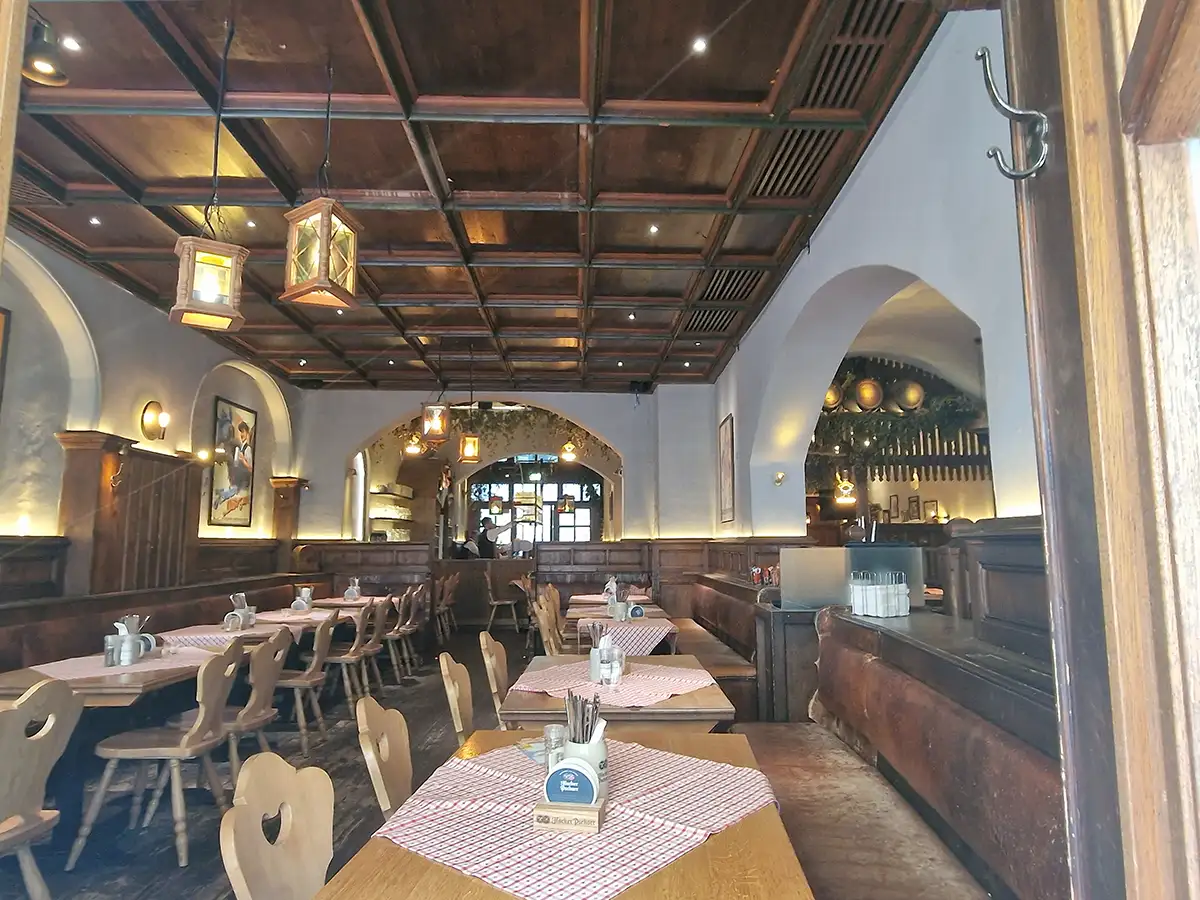
A traditional Bavarian restaurant in Munich before the evening rush. Heavy wooden furniture, checked tablecloths, coat hooks on the wall.
Munich restaurant etiquette is mostly about a few practical differences. Bottled water is normally charged, servers may visit the table less often than some visitors expect, tips are often stated while paying, and beer garden tables can follow different rules from restaurant tables.
This guide covers seating, water, tipping, cash and card payment, beer garden rules, allergies, kitchen hours, and lighter meal choices.
01How table service usually works
In traditional Bavarian restaurants and beer halls, servers may check the table less often than some visitors expect. Once food and drinks are on the table, guests usually signal when they want another order or the bill.
After you sit down, the first question is usually about drinks. Food often comes later. Once the plates arrive, the server may step back. If you want another drink, the bill, or anything else, signal clearly instead of waiting to be noticed.
In central restaurants and beer halls, English is usually enough for ordering. Still, a few German words make the meal smoother, especially when the room is busy.
“Entschuldigung.” Excuse me. The single most useful word at any Munich table.
“Mit Karte, bitte.” By card, please.
02Finding a seat and sharing a table
Self-seating is common in many traditional beer halls, beer gardens, and casual Wirtshaus settings when there is no host directing guests. Other restaurants use a host, reservation desk, or assigned tables. Look at the entrance and follow the venue’s instructions rather than assuming one system applies everywhere.
“Ist hier noch frei?” Is this seat free?
03Water and drinks
Munich restaurants normally sell bottled water instead of automatically placing free water on the table. Do not assume that complimentary tap water will be provided.
It is common for the server to ask “Was möchten Sie trinken?” soon after you sit down. Drinks are often ordered before the food order.
Bottled water is easy to order, but in some restaurants it can cost almost as much as a local beer. Many visitors therefore choose a Helles or Weißbier with the meal.
- Helles: a pale Munich lager. Mild and easy to drink. Ask for “ein Helles” in a traditional restaurant or beer hall.
- Weißbier (Hefeweizen): wheat beer, cloudy, with a light banana and clove character. The other Munich classic.
- Radler: Helles mixed with lemon soda. Refreshing, lower alcohol, good in warm weather.
- Dunkel: dark lager, malty and smooth. Worth trying once.
- Alkoholfrei: non-alcoholic beer, taken seriously here and widely available.
- Apfelschorle: apple juice mixed with sparkling water. Very common in Bavaria.
- Spezi: orange soda mixed with cola. Common on Bavarian menus.
- Stilles Wasser: still bottled water. Always available, always paid.
04Cash and card: cards work in most places, but carry a little cash
Card payment is now common in central Munich restaurants, cafés, beer halls, and many large beer gardens. The old advice that Munich is a cash only city is no longer accurate.
Cash is still useful in smaller places such as neighborhood restaurants, food stalls, kiosks, and late snack counters. Look for “Nur Barzahlung” near the entrance. It means cash only.
If you are unsure before ordering, ask:
“Kartenzahlung möglich?” Is card payment possible?
05Paying the bill at the table
In a normal sit-down restaurant or beer hall, payment is usually handled with the server at the table. Some cafés, casual restaurants, and counter-service places use a register instead, so follow the setup of the venue.
“Zahlen, bitte.” The bill, please.
The server usually brings the bill and handles payment at the table. The card reader comes to you. If you pay cash, change is counted in front of you. When tipping, you normally say the total amount you want to pay.
Example: bill is 27.40 €
“29 Euro, bitte.” This means a tip of 1.60 €.
“30 Euro, bitte.” This means a tip of 2.60 €.
You state the total you want to pay. The server enters that amount or gives change accordingly.
“Stimmt so.” Keep the change.
06Tipping: rounding up is common
Tipping in Munich is voluntary. In everyday restaurants and beer halls, people commonly round the bill up or add a modest amount when the service was good. Around 5 to 10 percent is a familiar reference range, but it is not a required service charge.
Because menu prices already include tax and service, the tip is genuinely optional. That matters if you are traveling on a budget or paying for a large group.
07Beer halls and beer gardens: check the table type
A beer hall such as Hofbräuhaus or Schneider Bräuhaus usually works like a restaurant: you sit, order from a server, eat, drink, and pay at the table.
A beer garden can be different. Some areas have table service. Other areas are self service, and you carry food and drinks back yourself. Before you sit down, look at what the people around you are doing.
Servers come to the table: service area. Order from the server, pay at the table.
No servers, bare wooden tables: self service area. Go to the counter, order and carry everything back yourself.
Some beer gardens use tablecloths to mark the service area, but not all do. The reliable sign is whether staff are taking orders at the table.
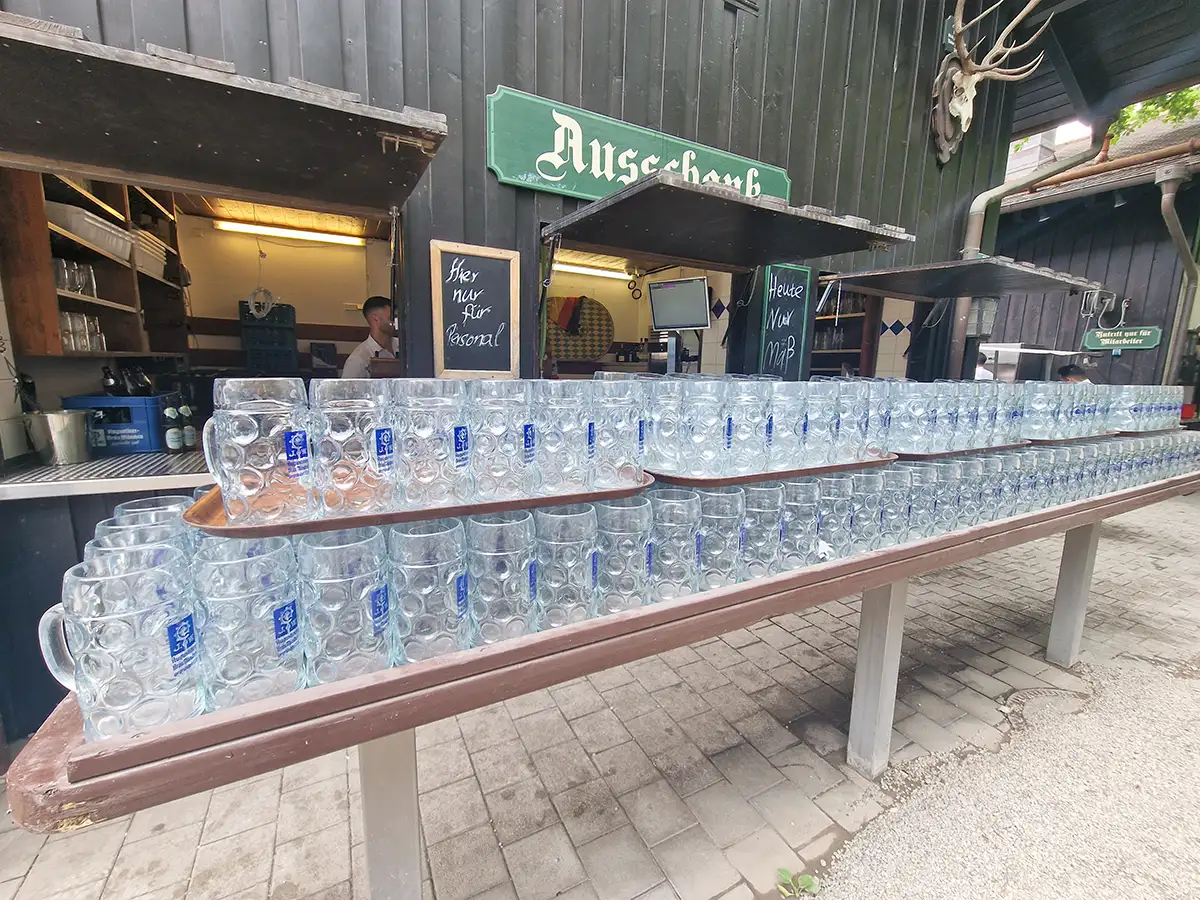
Empty Masskrug mugs lined up at the Ausschank counter. Each one carries a Pfand deposit, so return it when you leave.
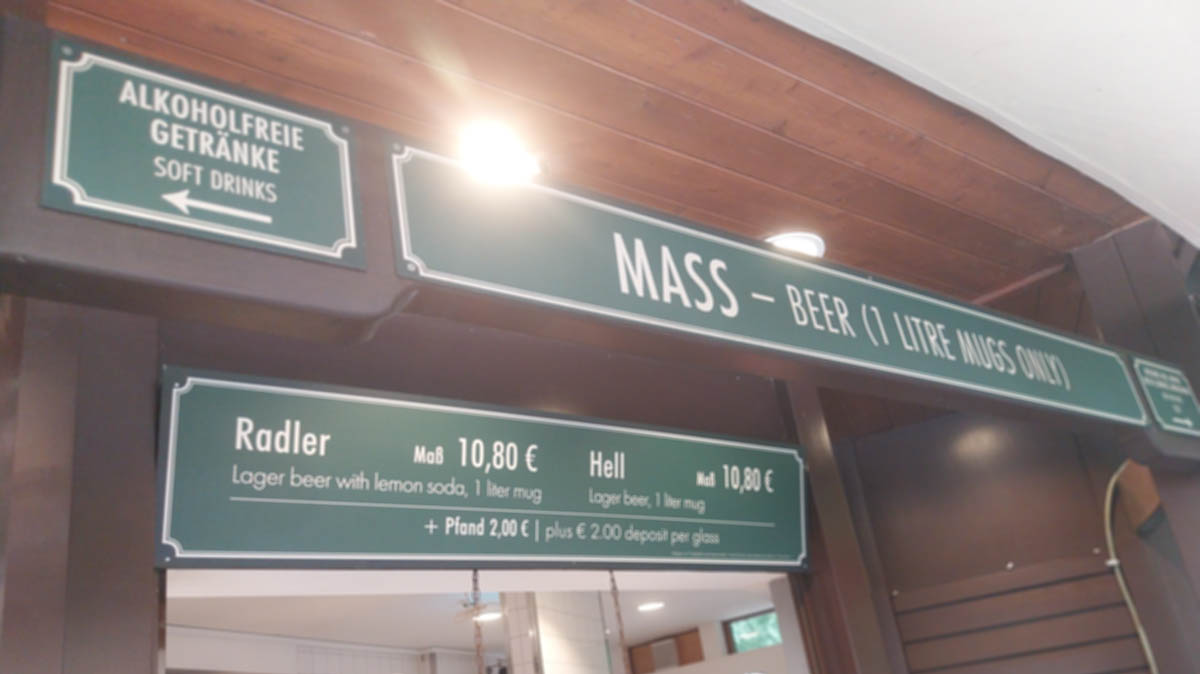
The ordering counter at a Munich beer garden. Radler and Hell both at 10.80 € per Maß, plus 2.00 € Pfand deposit on the glass.
08Bavarian food and lighter meal choices
On a first visit, it is worth making time for one traditional Bavarian meal: pork, dumplings, sausages, roast chicken, pretzel, Obatzda, or a seasonal dish that interests you.
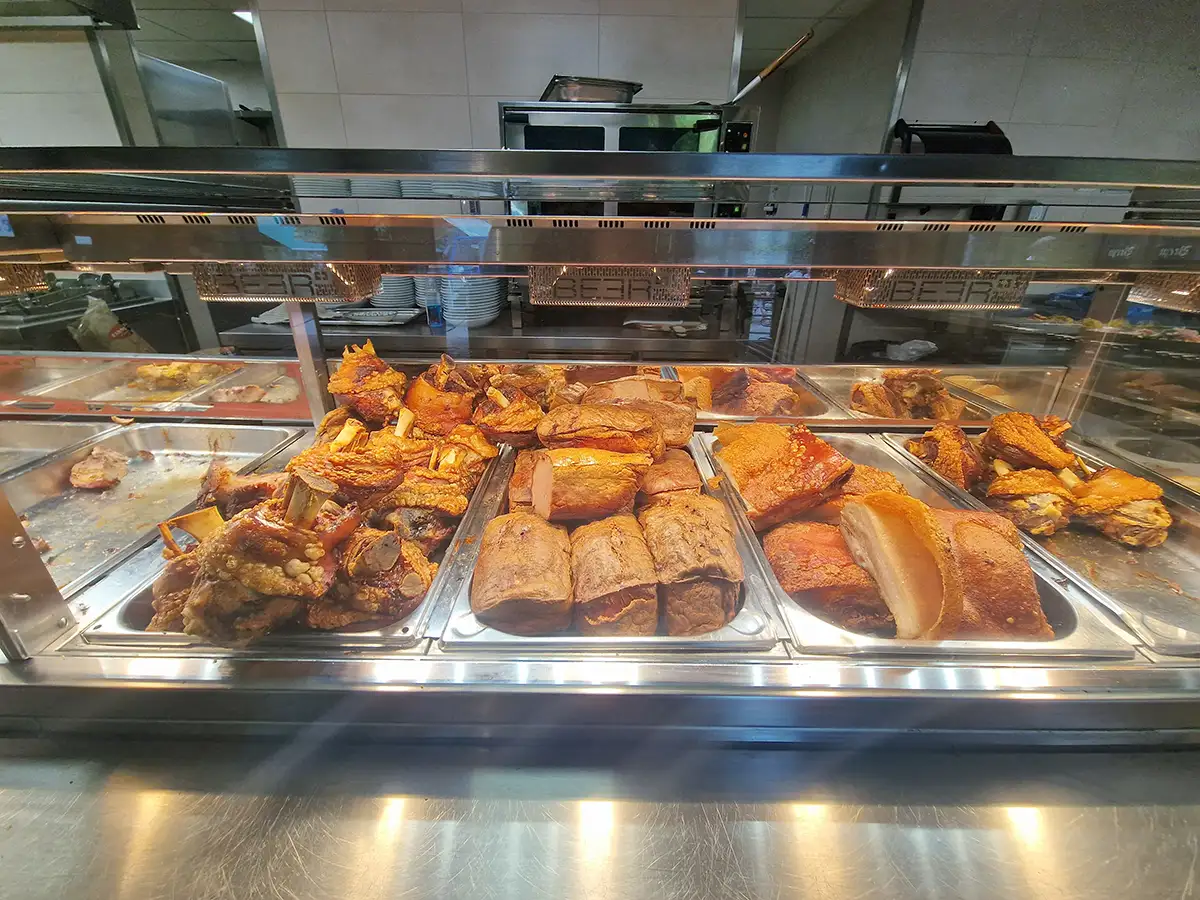
Roasted pork and Bavarian meat cuts at a beer garden food counter. Rich, heavy, and exactly what the beer is for.
After two or three days, heavy sauces, pork, bread, beer, and dumplings can become tiring, especially for children, older travelers, or anyone with a busy evening plan.
Munich’s international restaurants are useful when the group wants something lighter or more familiar. Italian, Vietnamese, Turkish, Japanese, Korean, Middle Eastern, and modern vegetarian places give you plenty of alternatives to another heavy Bavarian meal.
09Allergies and dietary restrictions: say it before ordering
Tell the staff about food allergies and strict dietary rules before ordering. In traditional places, butter, cream, meat broth, bacon, pork fat, wheat flour, or cheese may appear in dishes that look simple on the menu.
This matters most with dairy allergy, gluten, pork free meals, vegetarian or vegan diets, and halal needs. In the EU, restaurants must provide information on major allergens when they are used as ingredients, but the way that information appears can vary from a clear menu legend to a separate folder or a staff answer.
Most central Munich restaurants can answer simple questions in English. If an allergy could cause a serious reaction, say the ingredient clearly and ask the staff to check with the kitchen. The German phrases below can help when English is limited.
“Ich bin allergisch gegen Milchprodukte.” I am allergic to dairy products.
“Enthält das Butter, Sahne oder Milch?” Does this contain butter, cream, or milk?
“Können Sie bitte in der Küche nachfragen?” Could you please ask the kitchen?
10When your group needs a lighter meal
Italian food is often an easy choice for mixed groups, children, and tired travelers. Pizza and pasta are familiar and usually simple to order.
Vietnamese food works well after a long walking day. Pho, rice bowls, fresh herbs, and lighter sauces can feel easier than another heavy meal.
Ramen is useful on a cold or rainy evening, though popular places can still have queues.
Döner or dürüm is useful late at night: filling, fast, and often available after formal kitchens close. Small shops may still prefer cash, so a few euros can help.
For a broader evening plan with beer halls, bars, Korean food, and Sunday reality, use Munich Evenings as the companion note.
11When Korean food is a useful break
Korean food can be a useful choice when the group is tired of heavy meals or wants something familiar.
After several heavy meals, rice, soup, vegetables, grilled meat, kimchi, and spicy side dishes can feel much easier. For Korean visitors, one familiar meal can also make the rest of the trip more comfortable.
If parents are tired, children are losing patience, or the group needs one familiar dinner after a long walking day, I would first look at Pocha near Isartor or Hanssam Korean Grill & Dining in northern Munich.
12Practical food choices by situation
| Situation | What works |
|---|---|
| First proper dinner in Munich | Traditional Bavarian restaurant or beer hall, when you have time and patience. Do not rush it between transit connections. |
| Tired after the old town walk | Something easier: Italian, Vietnamese, Korean, ramen, or a casual place near your route. For route context, see the old town walk note. |
| Food allergy or strict dietary rule | Say it before ordering and ask the staff to check with the kitchen. This matters for dairy, gluten, pork free meals, vegetarian or vegan diets, and halal needs. |
| Arriving late and hungry | Ask whether the kitchen is still serving hot food. After 22:00, many formal kitchens are done. Döner and quick Asian options are often more realistic. |
| Near Hauptbahnhof late at night | Döner, a quick Asian meal, a bakery snack, or another station-area option. Many formal kitchens close earlier. |
| Sunday in Munich | Plan Sunday food earlier than usual. Many restaurants still open, but hours are less forgiving and supermarkets are closed. See Sunday in Munich. |
| Traveling with children | Mix local food with familiar meals. One easy meal can help keep the day comfortable. |
| Traveling with parents | Watch the walking distance after dinner. A restaurant that looks nearby on a map can feel far after a long day. |
| Concert, match, or evening event | Eat early enough to allow for kitchen hours, queues, and transport. Check the event finish time and return route before planning a late dinner. |
For a first meal in Munich, check how seating works, order water clearly, ask before using a reserved table, and signal the server when you are ready to pay.
Tips are voluntary, cards are common but a little cash still helps, and traditional beer gardens have their own self-service rules. If allergies or strict dietary needs matter, say them before ordering and ask the kitchen to confirm.
More on eating and drinking in Munich
Opening hours, kitchen times, payment conditions, reservations, menus, allergen handling, deposits, and individual restaurant procedures can change. Check the restaurant itself when a specific detail matters.