
Munich Practical Notes
Getting Around Munich by Public Transport
Tickets, Zone M, validation, apps, current construction, Allianz Arena access, and airport travel.
- Zone M: covers Munich city and most visitor destinations, including Marienplatz, Hauptbahnhof, Nymphenburg Palace, Olympiapark, and Fröttmaning for Allianz Arena
- Single ticket: 4.20 €: one journey, one direction; not a return
- Single Day Ticket: 10.10 €: unlimited rides until 6 a.m. next day
- Group Day Ticket: 19.70 €: up to 5 adults traveling together
- MVGO app: calculates zones, sells digital tickets, and shows live departures; common visitor tickets can now be bought without creating an account
- Paper tickets: since 24 June 2026, stationary MVG machines issue single, day, and connecting tickets already validated by default unless you choose otherwise
- U3/U6 construction: Sendlinger Tor to Implerstraße remains interrupted during Phase 1 through 18 September 2026
- Airport: Munich Airport is in Zone 5; a city to airport trip normally requires Zones M–5
Munich uses one MVV fare system across U-Bahn, S-Bahn, tram, and bus. Most visitor trips stay inside Zone M, and MVGO can calculate the route and ticket when the journey goes farther.
Common visitor mistakes include buying a single ticket for a round trip, misunderstanding validation, or following an old route during construction. This guide explains how to avoid those problems.
The guide also covers Allianz Arena and airport travel, where the route and ticket area need an extra check.
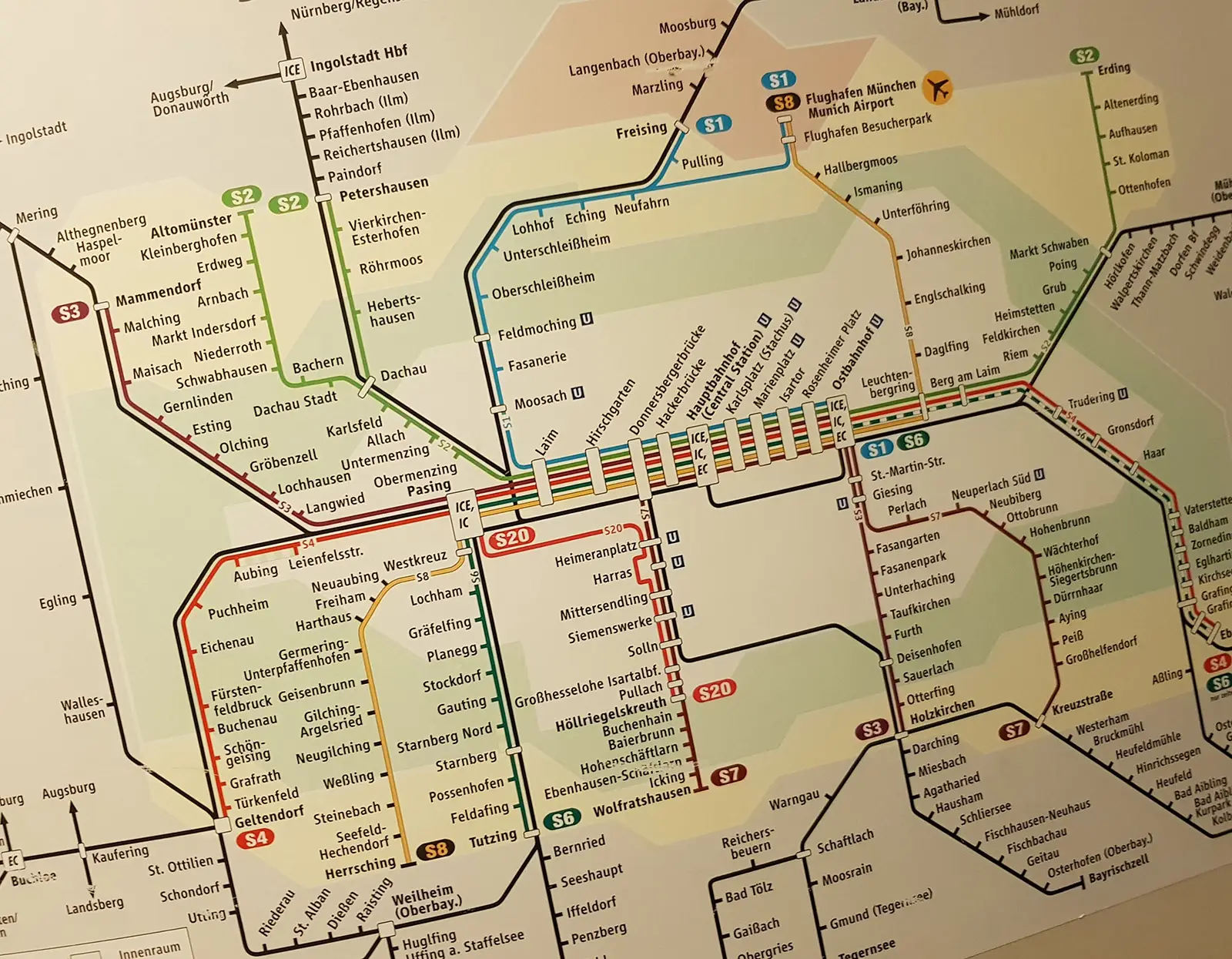
Munich’s S-Bahn, U-Bahn, tram, and bus network uses the MVV fare system.
01Four types of transport, one fare system
U-Bahn is the underground metro and one of the most useful ways to move around the city. Marienplatz, Odeonsplatz, Olympiapark, Schwabing, the university district, and Fröttmaning for Allianz Arena are all on U-Bahn routes.
Tram runs along city streets. It is useful for Nymphenburg Palace, parts of Schwabing, and short connections that would otherwise require a walk.
Bus fills the last stretch: from a station to a hotel, or into neighborhoods that rail does not reach. It becomes more important late at night, especially if your hotel is not directly on a U-Bahn or S-Bahn line.
S-Bahn is the system you may already know from the airport. Inside Munich, it overlaps with some U-Bahn routes. It becomes important again when you go back to the airport or travel to surrounding towns like Starnberg or Dachau.
All four accept the same MVV ticket. The zone has to match your journey, but the type of transport does not matter once you are inside the system.
02Zone M for most city trips
For most days in Munich, you will be moving inside Zone M, the central city fare zone. Marienplatz, Hauptbahnhof, the museum quarter, Englischer Garten, Olympiapark, Nymphenburg Palace, and Fröttmaning for Allianz Arena can all be reached from central Munich with a Zone M ticket.
| Destination | Zone from central Munich | What to remember |
|---|---|---|
| Marienplatz / Old Town | M | Normal central Munich travel. |
| Nymphenburg Palace | M | Still inside the Munich city fare area. |
| Olympiapark | M | Olympiazentrum is inside Zone M. |
| Allianz Arena / Fröttmaning | M | Fröttmaning is marked M/1, but a trip from central Munich stays within Zone M. |
| Munich Airport | M–5 | The airport itself is in Zone 5. |
You do not need to memorize the full zone map. Enter your start and destination in the official MVGO app, and it will calculate the route and ticket area.
When you leave Munich, the zone question becomes more important. Munich Airport is in Zone 5, while other destinations such as Dachau or Starnberg also require fares beyond a normal Zone M city ticket. For airport arrival details, read Getting from Munich Airport to the City.
03Choosing the right ticket
The right ticket depends on three things: how many rides you are making, whether you are coming back, and how many people are traveling together.
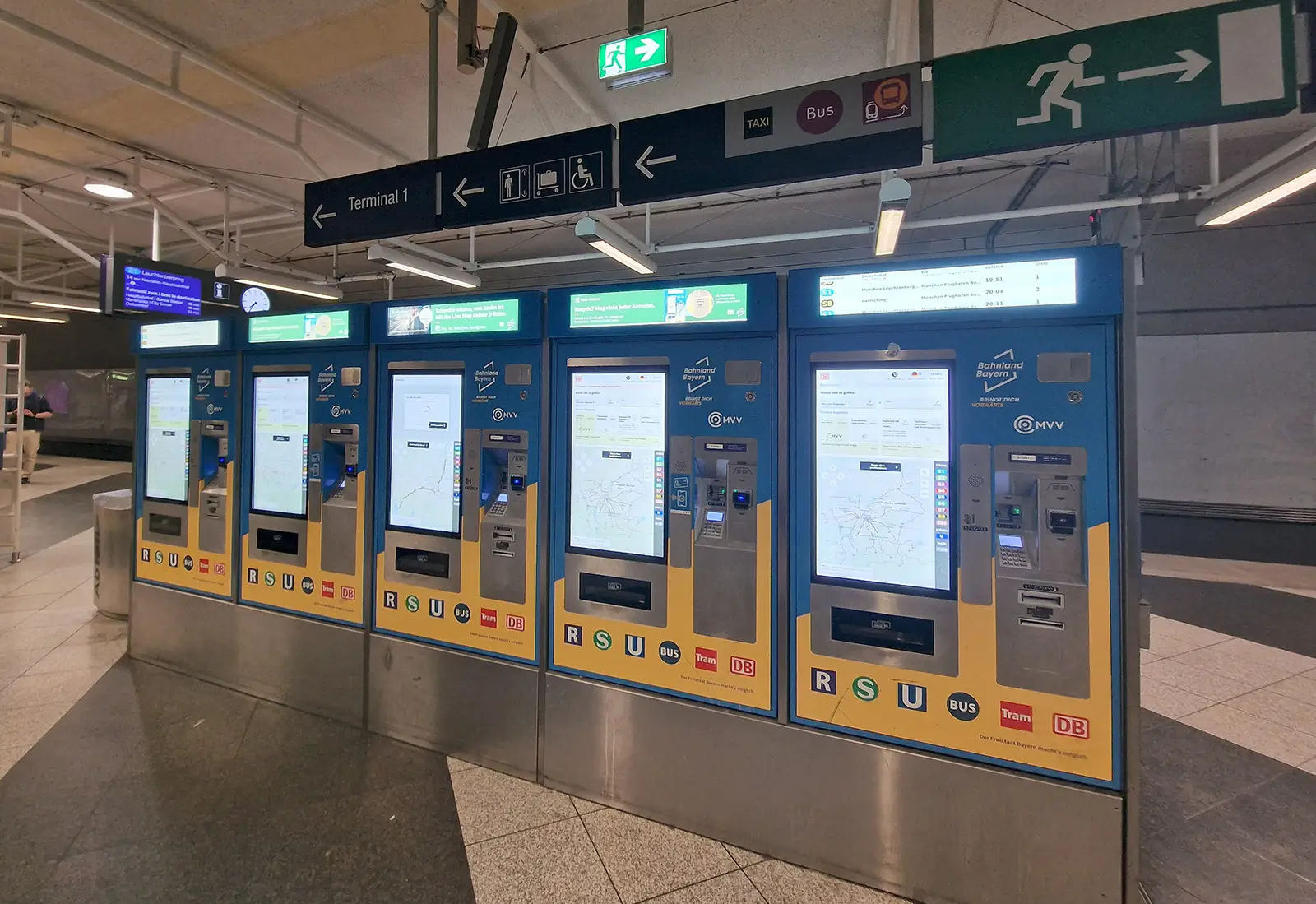
Ticket machines can calculate zones automatically when you enter a destination.
| Ticket | Price in Zone M | When it makes sense |
|---|---|---|
| Single ticket | 4.20 € | One journey, one direction. It is not a return ticket. |
| Single Day Ticket | 10.10 € | Valid until 6 a.m. the next day. Usually better than singles if you make three or more rides. |
| Group Day Ticket | 19.70 € | For 2 to 5 people traveling together. Children aged 6–14 count as half a person. |
| Streifenkarte | 18.70 € / 10 strips | Slightly cheaper per ride but easy to get wrong. Skip it if you are new to Munich. |
| Deutschlandticket | 63.00 €/month | Only if you already have one or understand the subscription rules. Not worth buying for one short city trip. |
For example, two adults buying separate Single Day Tickets would pay 20.20 €. One MVV Group Day Ticket costs 19.70 €. Three adults would pay 30.30 € with separate day tickets, while the Group Day Ticket still costs 19.70 €. Everyone on the group ticket must travel together.
Traveling with children: since January 2026, an adult using a Single Day Ticket can take children aged 6 to 14 free of charge. Your own children and grandchildren: any number. Other children: maximum three. This rule belongs to the Single Day Ticket; the Group Day Ticket uses a different counting rule, with children aged 6 to 14 counting as half a person.
04The MVGO app
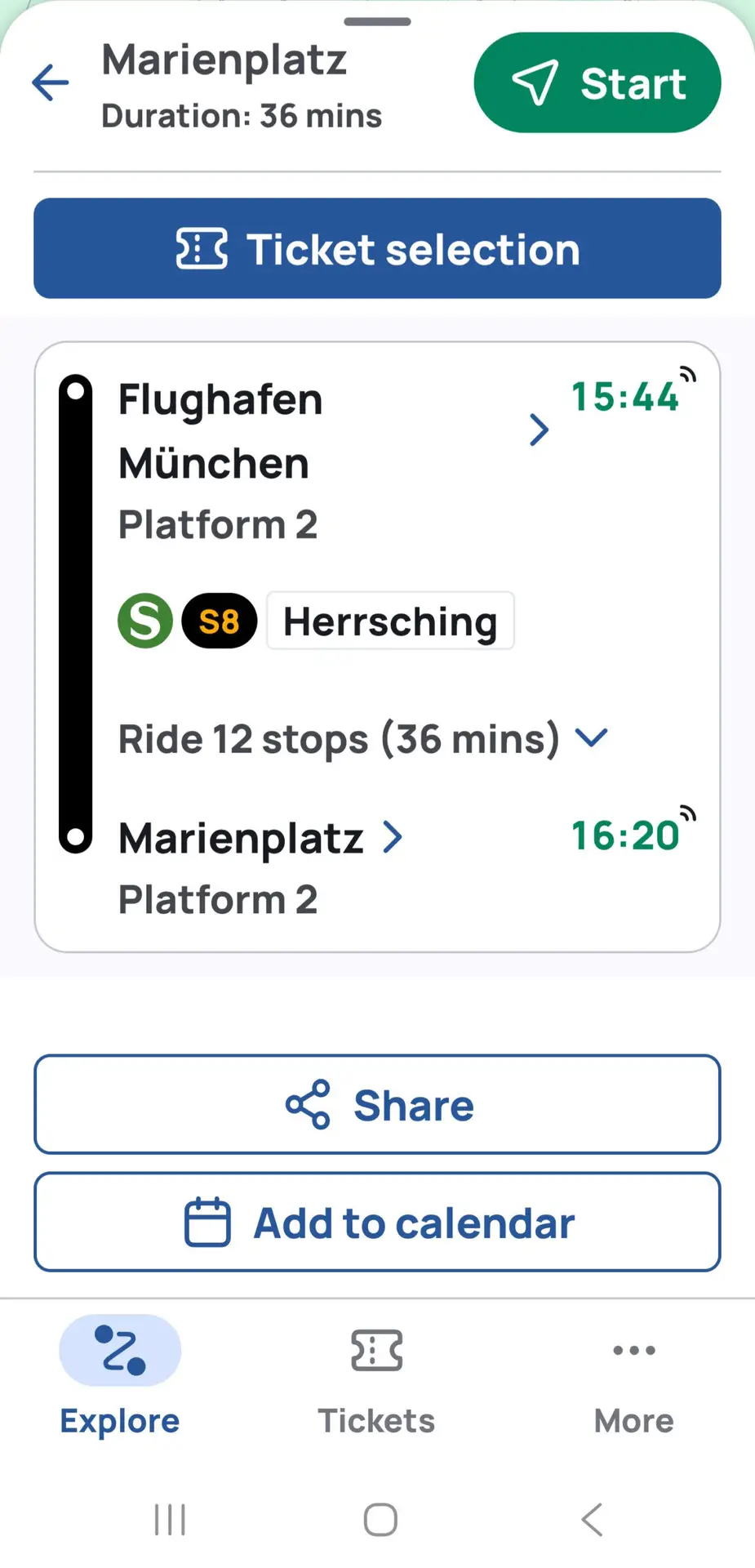
MVGO calculates zones, shows live departures, and sells digital tickets.
Install MVGO before you travel. Type in your destination and it shows the route, platform, departure time, and which ticket to buy.
Since January 2026, single tickets, day tickets, weekly tickets, and connecting tickets can be bought in MVGO without creating an M-Login account. You still enter your name and email because the ticket is personalized. Guest purchases use Apple Pay or Google Pay; an M-Login adds more payment options and account features.
Digital tickets bought through the app do not need stamping. Keep the ticket and a photo ID accessible during the journey, because personalized mobile tickets can be checked together with ID.
With a digital ticket, make sure your phone has enough battery for the whole journey. A paper ticket can be a useful alternative if you are worried about battery life.
05Validation and ticket inspections
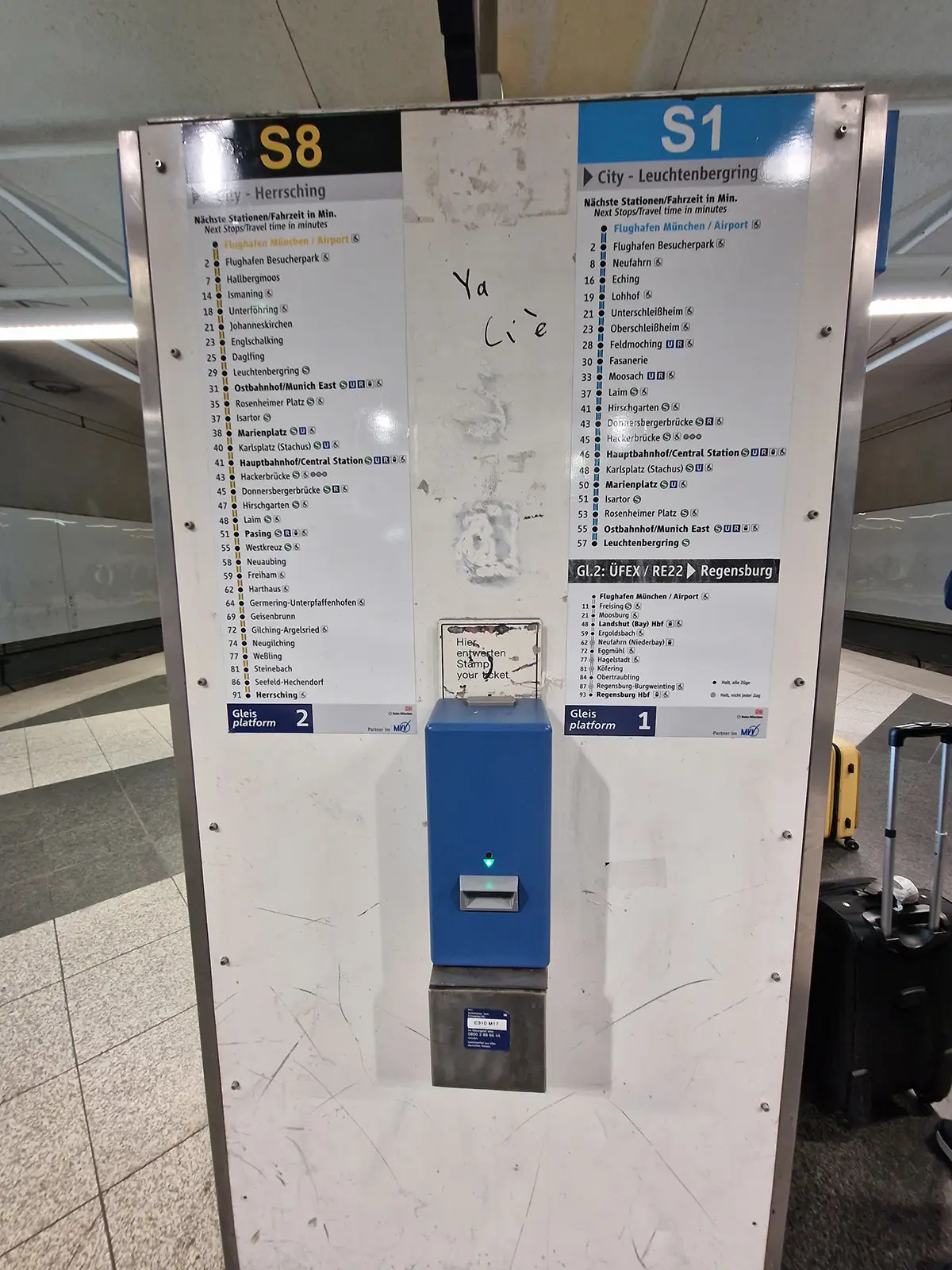
The validation machine on the platform. Paper tickets that require stamping must be validated before boarding.
Munich does not have ticket barriers. Ticket inspections happen regularly, and the increased transport fee for traveling without a valid ticket is at least 60 €.
Since 24 June 2026, stationary MVG ticket machines default to issuing single tickets, day tickets, and connecting tickets already validated for immediate travel. If you want to use the ticket later, choose the unvalidated option during purchase and stamp it before the journey.
Tickets from mobile machines inside MVG buses and trams are also issued already validated. Other ticket types keep their existing rules, so do not assume that every paper product works the same way. The safest habit is to check what is printed on the ticket before boarding.
Second, personalized digital tickets may be checked together with a photo ID. Keep a valid ID accessible.
With paper tickets, do not assume that every ticket needs stamping. Check whether your ticket was issued already validated or still needs validation.
06Check live routes during 2026 construction
Several construction projects are running in 2026. They can change routes, platforms, station exits, replacement buses, lockers, toilets, elevators, and transfer paths.
For important journeys, check the route again on the same day in MVGO, MVV, DB Navigator, or the relevant official service notice.
S-Bahn and airport lines: check the S-Bahn Munich operating situation or DB Navigator, especially on weekends, late evenings, school holidays, or before airport travel.
Tram routes: check MVG tram construction and renewal notices when your hotel or plan depends on a tram line.
Station access: if you travel with luggage, children, stroller, or parents, check elevators and transfer routes before choosing the fastest option.
| Where it matters | What can change | What to do |
|---|---|---|
| Hauptbahnhof | Exits, walking routes, lockers, toilets, and transfer paths can shift during long term reconstruction. | Follow current signs inside the station. Do not rely on memory from an old visit. |
| S-Bahn Stammstrecke | Weekend, late evening, and holiday construction can affect the central S-Bahn corridor and sometimes airport or outer lines. | Check S-Bahn Munich or DB Navigator before airport trips, day trips, early trains, and Sunday morning plans. |
| U-Bahn | Planned closures, replacement buses, and transfer changes can affect routes that look simple on a map. | Use MVGO on the day itself and read the service message when a warning appears. |
| Tram and bus | Street works can move stops, shorten routes, or add replacement buses. | Check MVG service messages if a tram or bus is your last link to the hotel. |
| Elevators and escalators | The fastest route can become difficult with luggage if an elevator is out of service. | Choose the route you can physically manage, not only the fastest route on paper. |
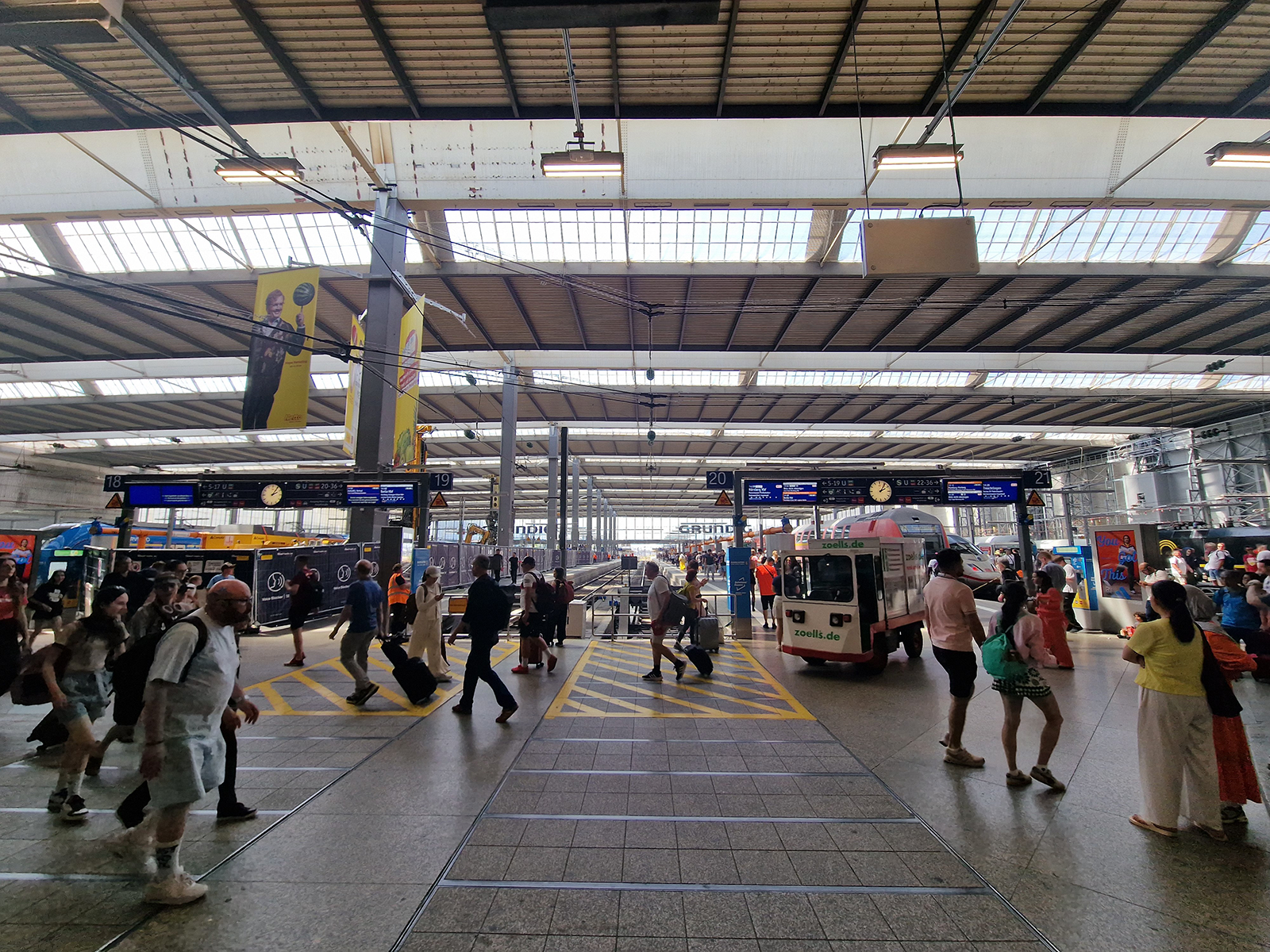
Munich Hauptbahnhof remains fully operational while major reconstruction continues around the station.
Hauptbahnhof is under long-term reconstruction. Rail services continue, but walking routes and station facilities can move as work progresses.
Platform assignments may change, underground passages may be rerouted, exits may close temporarily, and facilities such as lockers and toilets can move. Follow the current signs inside the station instead of relying on an older visit.
Toilets at Hauptbahnhof: paid and free. The station has both options, but they are in different places. A free option is available near the U-Bahn entrance area for U1, U2, U7, and U8; do not assume that every U-Bahn entrance has one.
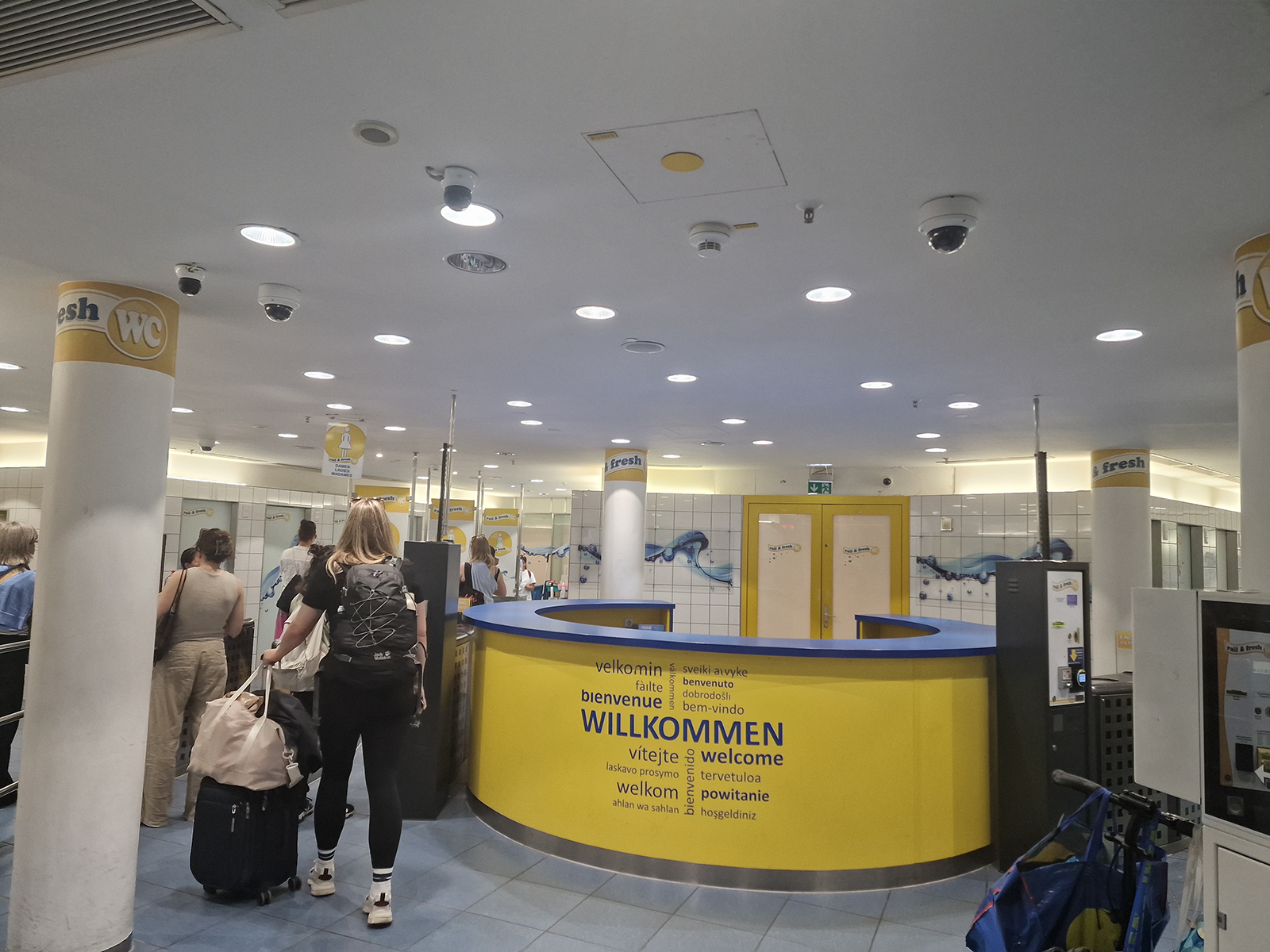
The paid Pay & Fresh facility near the Arnulfstrasse underground entrance. Clean and well maintained. Around 1.00 €.
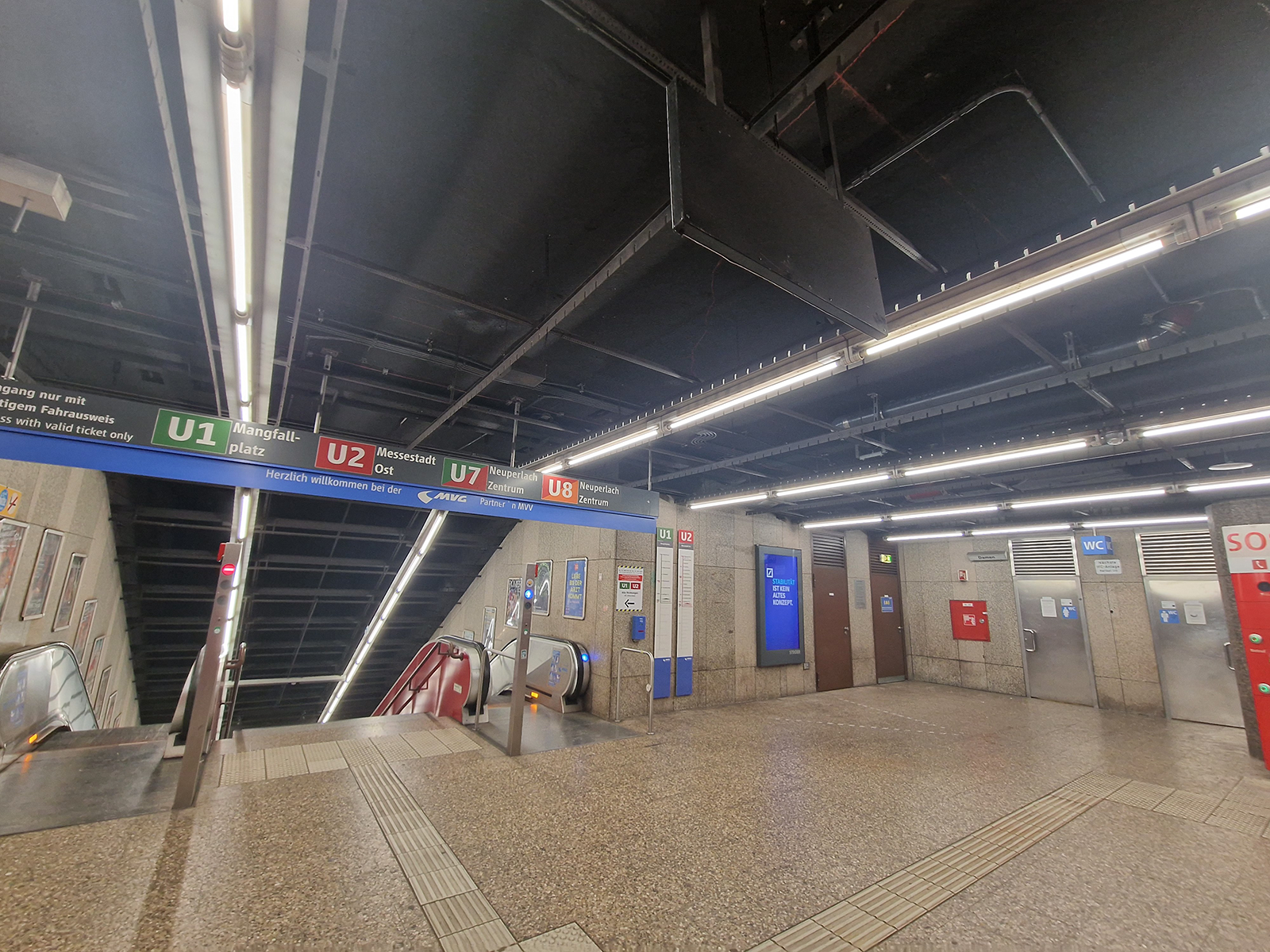
Free toilet near the U1, U2, U7, and U8 entrance area. Available but basic.
Elevators. Older stations have elevators that go out of service without notice. MVGO has an accessibility routing option that shows elevator status. The fastest route is not always the most practical one with luggage.
Summer heat underground. July in Munich is warmer than many visitors expect, and underground platforms hold heat. Older U-Bahn carriages can be uncomfortable during peak hours. Bring water.
07Current construction patch: U3/U6 south of Sendlinger Tor
Phase 1 remains scheduled through 18 September 2026. The U3 and U6 do not run between Sendlinger Tor and Implerstraße because Goetheplatz and Poccistraße are being renovated.
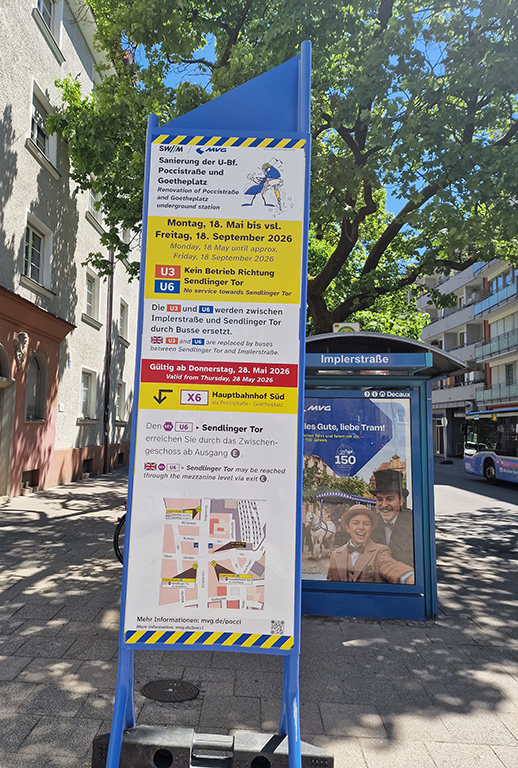
On site notice at Implerstraße: U3 and U6 are replaced by buses between Sendlinger Tor and Implerstraße during the Goetheplatz and Poccistraße renovation.
The U3 and U6 still run on both sides of the closure, but the central-south section is interrupted. MVG is running replacement buses: Bus U6 connects Sendlinger Tor and Implerstraße via Goetheplatz and Poccistraße, and Bus X6 connects Hauptbahnhof with Goetheplatz, Poccistraße, and Implerstraße. Check the official MVG U3/U6 replacement bus notice before using this route.
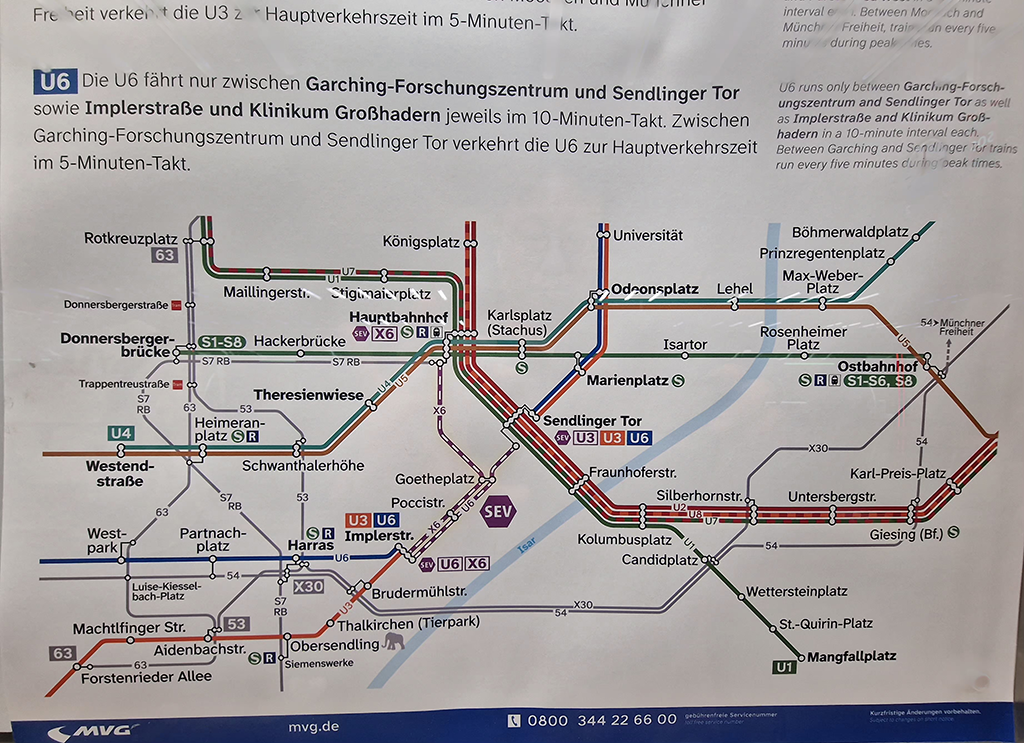
Temporary U3/U6 route map for the 2026 construction phase. U6 runs in two separated sections, and replacement buses cover the gap between Sendlinger Tor and Implerstraße.
| Traveler situation | What changes |
|---|---|
| Hotel south of Sendlinger Tor | Do not assume a direct U3/U6 ride into the old town. Add time for replacement buses or choose another route in MVGO. |
| Going to Allianz Arena from south Munich | Fröttmaning is still on the U6 north, but reaching the northbound U6 from the south may require a bus bridge or a different transfer. |
| Old town only | Marienplatz, Odeonsplatz, and central sightseeing still work, but routes via Goetheplatz or Poccistraße may be slower. |
| With luggage, children, or summer heat | Avoid tight transfers through the construction gap. A route with fewer changes may be better than the fastest route on paper. |
Phase 1 is scheduled to end on September 18. MVG currently lists Phase 2 from October 5 to November 27, 2026, followed by another major closure phase in 2027. If your route uses U3 or U6 between Sendlinger Tor and Implerstraße, check the current phase before traveling.
08Getting to Allianz Arena
Allianz Arena is in the north of Munich, hosting football matches, concerts, and major events throughout the year. For public transport, the standard route is U6 to Fröttmaning, followed by a walk of around 10 to 15 minutes to the arena entrance.
The journey from Marienplatz to Fröttmaning takes around 20 to 25 minutes. On event days, also allow time for platform crowds, the walk from Fröttmaning, security checks, and finding your section.
Important for 2026: if you are staying south of Sendlinger Tor on the U3 or U6 corridor, the renovation between Sendlinger Tor and Implerstraße can affect your route to the northbound U6. Let MVGO calculate the route on the day and add extra time.
After a match or concert, many people leave at the same time. Late service can vary by day, construction phase, and event timetable. Check the actual Fröttmaning departure in MVGO on the event day instead of relying on an old last-train time.
09Going back to the airport: check the S1 destination
The S1 serves both the airport branch and the Freising direction around Neufahrn. On services that operate as coupled sections, the train can divide there.
Before boarding, confirm that your train section is marked Flughafen or Airport. If you prefer a simpler route and S8 works well from your starting point, use S8 instead.
For either line, check the live departure before leaving and give yourself more time than a normal city trip.
10Useful stops for Munich visitors
| Station | Why useful |
|---|---|
| Hauptbahnhof | Central hub. S-Bahn, U-Bahn, tram, bus, regional trains, and long-distance trains. Under long term reconstruction; expect temporary layouts and relocated facilities. Luggage lockers available in two temporary locations; no advance reservation, first come first served. |
| Marienplatz | Old town center. S-Bahn and U-Bahn interchange. Good base for daytime sightseeing. |
| Münchner Freiheit | U3 and U6 interchange. U3 connects toward Olympiapark and Moosach; U6 continues toward Fröttmaning and Allianz Arena. |
| Fröttmaning | Last U6 stop before Allianz Arena. Around 10 to 15 minutes on foot to the arena entrance area. |
| Ostbahnhof | S-Bahn, U-Bahn, tram, and bus connections on the eastern side of the city. Reservable luggage storage available at Mobile Locker near Platform 5. |
For most visitors, three points are enough to get started: most city trips use Zone M, a single ticket is one-way, and paper-ticket validation depends on how the ticket was issued.
Use MVGO for the actual journey, and check live service information when your route includes the airport, Allianz Arena, Hauptbahnhof, or the U3/U6 construction area.
Plan the next decision
Fares, construction phases, replacement buses, and event-day services can change. Check the final route and ticket before travel.