BTS Munich 2026 · Allianz Arena · July 11 & 12 Concert Day Notes →

Munich Practical Notes · Food and Dining

Munich Beer Halls and Beer Gardens: Where to Go, What to Order, and How It Works

A practical first-visit note on Munich beer halls, Munich beer gardens, the six historic breweries, what to order, where to go first, and how the local rules actually work.

Munich Ajussi · June 4, 2026 · about 10 minutes

Munich is one of the easiest cities in the world to find a beer, but not always the easiest city to understand once you sit down in a beer hall or beer garden.

Should you go to Hofbräuhaus or Augustinerkeller? Is a beer hall the same as a beer garden? Can you bring your own food? What is a Maß, and is it really one liter? And if Munich has six famous breweries, why do locals still talk about Giesinger, Tegernseer, or Andechs?

That is where Munich beer culture becomes interesting.

This note is not a drinking checklist or a ranking of the best beer halls in Munich. It is a practical way to understand Munich beer halls and beer gardens: the six historic breweries, the local choices beyond them, what to order first, how self-service beer gardens work, and why Münchner Brauertag on 20 June 2026 is worth noticing if you are in the city.

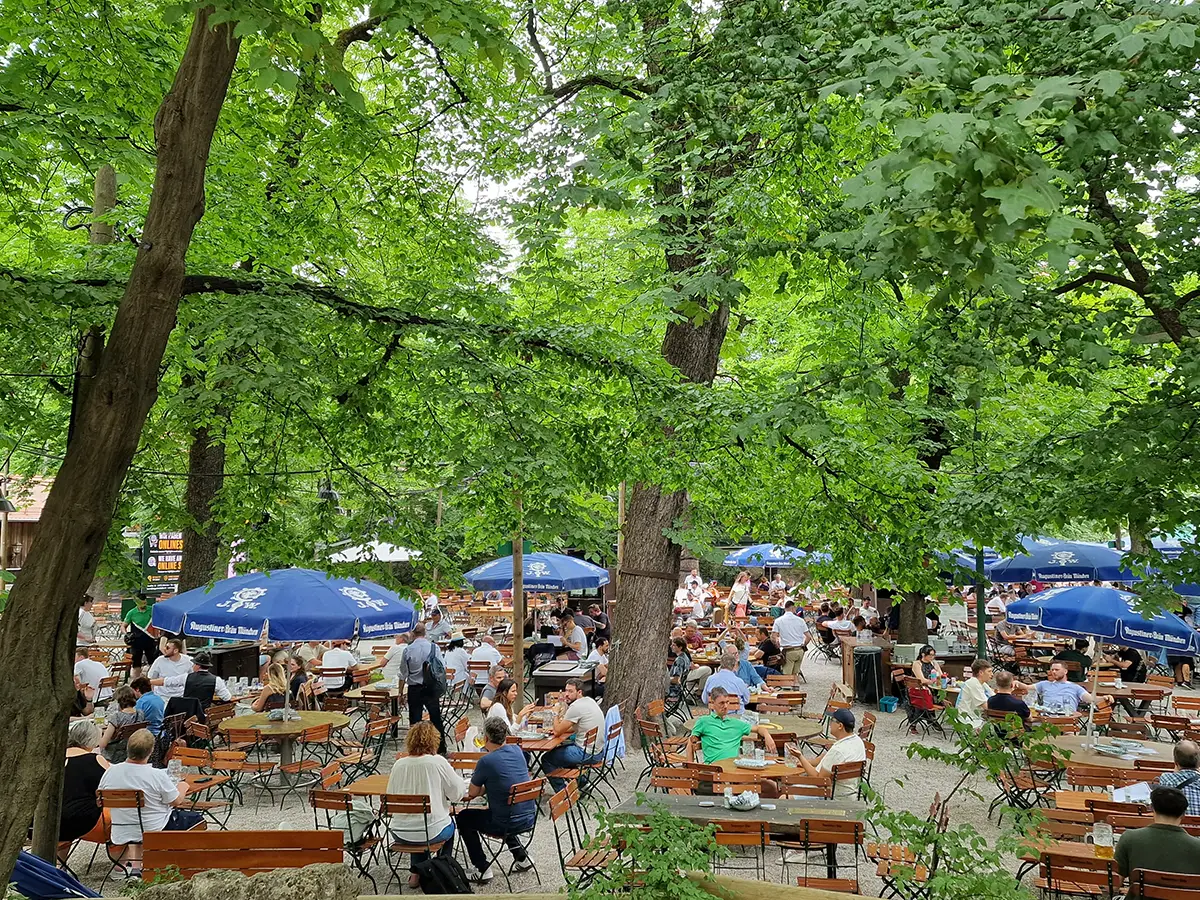
Augustinerkeller beer garden in Munich with long tables under trees

Augustinerkeller beer garden, one of the classic Munich beer garden settings near Hauptbahnhof.

01The six Munich breweries: why these names matter

Munich’s Oktoberfest beer rules are strict. Only beer from the six traditional Munich breweries is served inside the official Oktoberfest tents. That does not mean these are the only beers people drink in Munich, but it explains why these six names carry so much weight.

BreweryCharacterGood first place to understand it
AugustinerLocal favorite, private, wooden barrels, quietly confidentAugustinerkeller
HofbräuRoyal history, famous, loud, internationalHofbräuhaus am Platzl
Hacker-PschorrHistoric family name, polished city-center Wirtshaus feelingDer Pschorr at Viktualienmarkt
LöwenbräuTraditional, central but less photographed by visitorsLöwenbräukeller at Stiglmaierplatz
PaulanerMonastic roots, Salvator, Starkbier identityPaulaner am Nockherberg
SpatenMunich Helles pioneer, lager history, strong Oktoberfest identitySpatenhaus an der Oper, or the Spaten tent during Oktoberfest

Augustiner is the oldest surviving brewery in Munich and the only privately owned one among the six. It does not need much performance. The rounded bottle, wooden barrels, and local loyalty do most of the talking. Augustinerkeller is the cleaner first stop if you want to understand that specific brewery identity.

Hofbräu is the state-owned brewery and the most recognizable beer hall brand for visitors. The Hofbräuhaus is not quiet and it is not hidden. That is the point. Go for the room, the music, the history, and the spectacle, not because the beer is dramatically different from every other Munich lager.

Hacker-Pschorr is easiest to understand through Der Pschorr at Viktualienmarkt. It feels more modern than the old beer halls, but still keeps a clear Munich Wirtshaus identity.

Löwenbräu is a good choice when you want something traditional but less tourist-heavy than Hofbräuhaus. The Löwenbräukeller sits just far enough from the old town tourist loop to feel different.

Paulaner belongs strongly to the Starkbier story. Salvator is the name to know. If you want to understand Munich’s strong beer season, Paulaner am Nockherberg is the obvious reference point.

Spaten is historically important for Munich pale lager. Spaten presents itself as the brewery behind the first Münchner Hell, first brewed in 1894, which makes it more than just another Oktoberfest name. For a visitor, the most practical city reference is Spatenhaus an der Oper near the Nationaltheater and Residenz. During Oktoberfest, Spaten becomes much more visible through its festival identity.

02Why the same brewery names appear in Munich beer halls and beer gardens

Many Munich beer halls and beer gardens operate under exclusive supply contracts with one brewery. That is why the same brewery name appears in different places across the city: Augustiner here, Paulaner there, Hofbräu somewhere else.

Same brand, different operators, different atmospheres. A contract venue and a flagship venue are not the same experience even when they pour the same beer. You may think you are choosing only a beer brand, but in Munich you are also choosing a room, a neighborhood, a crowd, and a style of service.

Viktualienmarkt beer garden in Munich with tables under trees and rotating Munich brewery beer

Viktualienmarkt beer garden rotates through Munich’s six historic breweries.

The useful exception The Viktualienmarkt beer garden does not belong to any single brewery. The beer rotates through all six Munich breweries every five to six weeks. That makes it the rare neutral beer ground in a city where most places have already picked a side.

If you are curious but not obsessive, do not try to complete all six breweries like a stamp collection. Use the names as a map. Once you know what Augustiner, Hofbräu, Paulaner, and the others roughly signal, the city becomes easier to read.

If you are already following the Old Town Walk, the Viktualienmarkt beer garden is one of the easiest beer stops to add without turning the day into a separate beer itinerary.

03Beyond the big six: Giesinger, Tegernseer, Chiemgau, and Andechs

The six-brewery structure is real, but it is not the whole Munich drinking experience.

Giesinger Bräu is the most visible modern challenger. It began as a garage brewery in Giesing in 2006 and later built a stronger Munich identity with its own deep-well water, a detail that matters in the local definition of what counts as a Munich beer. It is not one of the Oktoberfest six, and that is part of its appeal. If you want something outside the official old structure, Giesinger is the name to know.

Tegernseer comes from the ducal brewery on the shores of Tegernsee, about an hour south of Munich in the Alpine foothills. It is not a Munich brewery, but it has become easy to find in the city. The Hell is clean and noticeably different in character from the six.

Chiemgau is not one brewery but a region southeast of Munich with many smaller private breweries. You will not build a first-time Munich trip around them, but they are part of the broader Bavarian beer landscape. The regional tourism page is useful if you later want to connect beer gardens, small breweries, and Chiemsee or Chiemgau cycling routes.

Andechs belongs in a different category entirely. It is a Benedictine monastery above the Ammersee, about 40 kilometers southwest of Munich, and it has been brewing beer since 1455. Still run by an active religious order, entirely independent of any brewing corporation, Andechs feels less like a city beer stop and more like a small Bavarian pilgrimage with roast pork at the end.

The most famous beer from Andechs is the Doppelbock Dunkel: dark, malty, strong, and much slower than a normal Helles. It is available year-round at Andechs, which is unusual compared with the more seasonal rhythm of many strong beers. The same tradition runs through the Munich six: Paulaner Salvator, Augustiner Maximator, Löwenbräu Triumphator. These appear mainly during the Starkbier season in spring.

Getting to Andechs Take the S8 to Herrsching, then a short bus or a 40-minute walk through forest and farmland up to the monastery. Check the MVV app or website for the correct ticket zone before travelling. Do not assume an inner-city ticket is enough.

04Beer hall vs beer garden in Munich: the rules visitors actually need

A beer hall or Wirtshaus is an indoor restaurant. You sit down, a server comes to the table, you order food and drinks, and you pay the server. In busy places, especially Hofbräuhaus, communal tables are normal. If there is space at a long table, ask and sit down.

A beer garden is outdoors and works differently depending on where you sit.

In the service area, staff come to the table. Order from the server and pay at the table.

In the self-service area, you go to the counter, order beer and food, pay immediately, carry everything back yourself, and return your glass to get the Pfand back. In traditional self-service beer gardens, bringing your own food is allowed. Bringing your own drinks is not.

The simplest rule is visual. If servers are moving between tables, you are in the service area. If everyone is carrying trays, you are in the self-service area. The behavior at the next table tells you more than any sign.

This is also why beer gardens often work well on loose Munich days. If you are building a relaxed summer plan rather than a beer-focused day, use this note together with Munich Open Day. If your visit falls on a Sunday, also check Sunday in Munich, because beer gardens may be easy while shops and other errands are not.

05Where to drink beer in Munich first: five practical beer halls and beer gardens

Hofbräuhaus is the easiest introduction if you want the famous version of Munich beer culture. Loud, central, tourist-heavy, and still worth seeing once. Go earlier in the day for a calmer version. The inner courtyard has a small beer garden under chestnut trees that is considerably quieter than the main hall.

Hofbräuhaus beer hall interior in Munich with painted ceiling and long tables

Hofbräuhaus shows the loud, famous side of Munich beer hall culture.

If you want live Bavarian music Hofbräuhaus is the easiest answer, but it helps to understand what you are hearing. Many visitors hear Bavarian brass music for the first time here and assume it is only a tourist performance. The reality is more layered. Brass bands, tavern music, and oompah rhythms have been part of Bavarian beer hall and festival culture for generations, even if the Hofbräuhaus version is now very commercial and very international.

The official programme lists Bavarian tavern music daily, except on Good Friday and All Saints’ Day, with bands playing in the Schwemme or the courtyard beer garden during lunch and evening hours. If the music is the reason you came, sit downstairs in the main hall rather than choosing one of the calmer upstairs rooms. It is touristy, loud, and busy, but for beer, brass band music, and the classic Munich beer hall atmosphere, that is exactly the room most visitors are imagining.

One small observation from standing outside: directly across from the Hofbräuhaus entrance stands a Hard Rock Cafe. A 16th-century royal brewery and an American rock-and-roll chain, facing each other on the same street corner. Whether that is funny, sad, or just very Munich depends on your mood. After enough years in this city, it starts to feel like both.

Augustinerkeller is the better first choice if you want a classic Munich beer garden with wooden barrels and a more local feel. It is close to Hauptbahnhof, which makes it practical for many visitors.

One small detail here is Augustiner Edelstoff. Edelstoff is not a serving style or a special event beer. It is one of Augustiner’s beers: a pale export beer with 5.6% alcohol, also sold in bottles. Augustinerkeller officially presents Edelstoff from wooden barrels as something available year-round, in the beer garden, restaurant rooms, and terraces. The practical experience, however, is still weather and crowd dependent: in the self-service beer garden, the bell rings whenever a new wooden barrel is tapped, and you are more likely to hear it on mild summer evenings when the beer garden is busy. The beer itself exists elsewhere; the wooden-barrel ritual is the Augustinerkeller moment.

Hirschgarten is the family and open-space choice. It is often described as the world’s largest beer garden, with space for around 8,000 people in the self-service area. What makes it different from every other beer garden on this list is not only the size. It is the setting.

Hirschgarten also needs one small correction if you think of Munich beer gardens as one-brand places. It feels very Augustiner in mood, but it is not an Augustiner-only beer garden. The official Hirschgarten beer story names Augustiner Bräu, Herzogliches Brauhaus Tegernsee, and Schlossbrauerei König Ludwig, so seeing a König Ludwig Dunkel there is not unusual.

Hirschgarten beer garden in Munich with open seating and park space

Hirschgarten combines a large beer garden with open park space nearby.

The beer garden sits directly beside a large open park: flat, green, and loose enough for children to run, families to spread out, and people to play football a few meters from where others are drinking beer. The deer enclosure is nearby. The whole thing feels less like a hospitality venue and more like a public space with a broader Bavarian beer mix than many visitors expect.

Beer range note Hirschgarten is a good reminder that large Munich beer gardens are not always as brand-simple as they look from the outside. For Augustiner as a brewery identity, Augustinerkeller is the clearer reference point. For Hirschgarten, think large park beer garden first, then Augustiner, Tegernseer, and König Ludwig as part of the current official beer story.
Hirschgarten route note, checked June 2026 Wotanstraße construction and related bus diversions can affect the exact route to Hirschgarten. Romanplatz and Laim area connections are the current alternatives, but check MVG or your navigation app before building a fixed plan around this stop.

Löwenbräukeller is the traditional but less photographed choice. It works well if you want a beer hall outside the old town tourist core. The Löwenbräu brewery is directly across the street.

Der Pschorr and the Viktualienmarkt beer garden are the old-town choices. Der Pschorr is a Wirtshaus with beer served from ice-cooled wooden barrels. The Viktualienmarkt beer garden is the rotating six-brewery outdoor option, surrounded by market stalls.

Der Pschorr terrace near Viktualienmarkt in Munich old town

Der Pschorr sits beside Viktualienmarkt, making it one of the easiest old-town beer stops.

06What to order in Munich: Helles, Weißbier, Dunkel, Radler, or Starkbier

If you are unsure, order a Helles. It is the basic Munich pale lager: light, clean, and easy to drink. “Ein Helles, bitte” works almost anywhere.

If you want wheat beer, order a Weißbier. It is fuller, fruitier, and often served in a tall curved glass rather than a Maßkrug.

If you want something darker without jumping straight to strong beer, try a Dunkel. Dark does not automatically mean heavy or sweet, but it gives you a different side of Bavarian beer.

If it is hot, or if you want something lighter, order a Radler. Beer mixed with lemon soda makes sense in a beer garden afternoon. It is not a failure. It is summer behaving sensibly.

If you see Starkbier or Doppelbock, slow down. Paulaner Salvator, Augustiner Maximator, Löwenbräu Triumphator, and Andechs Doppelbock belong to this stronger tradition. They can be excellent, but they are not casual one-liter walking-around beer.

One beer that belongs in this stronger-beer conversation, but not as something to repeat here in full, is Aventinus Eisbock at Schneider Bräuhaus im Tal. It is better treated as an evening choice than as a beer garden afternoon drink. For that side of the city, see Munich Evenings: Beer Halls, Bars, Korean Food, and Sunday Reality.

If the beer names start to become interesting after your visit, Bierdex is a fun beer-style reference to browse later. It helps with terms such as Helles, Dunkel, Bock, Kellerbier, or Rauchbier, but you do not need it at the table.

Know your sizes A Maß is one liter. A Halbe is half a liter. A Maß is normal in Munich, but it is still one liter of beer. Plan your next train, bike ride, or dinner decision accordingly.

07What to eat in a Munich beer garden: Steckerlfisch, Breze, and the salty things

Beer garden food is simple, salty, and built for the setting. The standard choices are Hendl, Schweinshaxe, Bratwurst, Obatzda with Breze, radishes, potato salad, and Pommes.

Steckerlfisch is the beer garden food worth singling out. It is grilled fish on a wooden skewer, usually mackerel, sometimes trout. It does not really belong to indoor beer hall culture. It belongs outside, near smoke, charcoal, wooden tables, and people who have stopped pretending the day is still under perfect control.

Steckerlfisch grilled fish at Hirschgarten beer garden in Munich

Steckerlfisch at Hirschgarten, grilled fish that belongs naturally to Munich beer garden culture.

Steckerlfisch is not elegant. That is why it works. The mackerel is smoky, salty, oily, and best eaten with your fingers. If you want a quiet plated dinner, order something else. If you want the beer garden version of Munich, this is the one I would not skip.

One adjustment most visitors make without noticing: Pommes with mayonnaise. It looks wrong the first time. After a few beer garden afternoons, it begins to make sense. That is just salty food, cold beer, and shade under chestnut trees doing their job.

And one calibration that only needs to happen once: the pretzel. In my early days in Germany, I picked one up at a beer garden, saw the topping, and assumed it was some kind of coarse sugar. One bite corrected that immediately. The topping is salt: large, rough salt crystals. The pretzel is not sweet. The salt is not a mistake.

08Münchner Brauertag 2026: beer culture without Oktoberfest

Münchner Brauertag takes place on Saturday, 20 June 2026, around Marienplatz. It happens every two years, and 2026 is one of those years, with an additional element: the Schäffler dancers are performing outside their normal seven-year cycle.

The day marks the formal completion of Munich’s brewing apprentices’ training. According to the city programme, 32 new brewers complete their training this year, roughly half of them women. This is not Oktoberfest. That is exactly why it is interesting.

The programme runs roughly from 08:30 to early afternoon. The apprentice brewers assemble on Marienplatz, process to St. Peter’s Church, and return through the old town with brewery horse-drawn carriages, mountain riflemen, traditional costume groups, and the young brewers. Around midday, the ceremony and Freibier draw the biggest crowd.

If you want to see the procession, the route from the the Isartor end of Tal to Marienplatz is the best viewing position. Come by late morning at the latest. If your main goal is the free beer, expect a large crowd and plan accordingly.

Brauertag is the beer event for people who want Munich beer culture without turning the day into Oktoberfest. Come for the ceremony and the city atmosphere first. Treat the free beer as a bonus, not the whole plan. If you enjoy the music side of Hofbräuhaus, this is also a useful bridge to the wider Bavarian soundscape: procession music, brass bands, traditional costume groups, and city ceremony rather than only a beer hall performance.

09How to order beer in Munich, pay, tip, and leave without confusion

In a beer hall, sit down, order from the server, and pay at the table. To ask for the bill, say “Zahlen, bitte.” To round up and leave the change, say “Stimmt so.”

In a self-service beer garden, order at the counter and pay immediately. A Pfand, a small glass deposit usually around 1 to 2 euros, is added when you order. Return the glass to get it back.

Cash is still useful, especially outdoors. Many places take cards, but a small cash backup helps. Around 20 to 30 euros per person is usually enough for a simple beer garden visit.

For the wider restaurant habits around water, tipping, paying, and table service, use Munich Restaurant Etiquette together with this beer note.

Do not plan to drive after a Maß One Maß is one liter. Use public transport, walk, take a taxi, or make the beer garden the end of the day. For route and ticket basics, see Getting Around Munich by Public Transport.

10Final choice: which Munich beer place fits your day?

If you only remember one thing, choose by mood rather than fame. Hofbräuhaus is the famous beer hall, Augustinerkeller is the classic Augustiner reference, especially for Edelstoff from wooden barrels, Hirschgarten is the open-space family beer garden with a broader beer range, and Viktualienmarkt is the old-town beer garden with the rotating brewery system.

SituationBest first choice
First time in Munich and want the famous hallHofbräuhaus
Classic local beer garden near the centerAugustinerkeller
With children or want open spaceHirschgarten
Less tourist-heavy beer hallLöwenbräukeller
Already in the old townDer Pschorr or Viktualienmarkt beer garden
Full beer day tripAndechs
Modern local challengerGiesinger
In Munich on 20 June 2026Brauertag around Marienplatz

Final take

One Munich beer hall or one Munich beer garden is enough to start.

Understand where you are sitting. Order a Helles if you are unsure. Pay with the final amount when the bill comes. Return your glass at a self-service counter. And if you are in Munich on 20 June, walk toward Marienplatz by mid-morning.

The rest of Munich beer culture reveals itself slowly: the brewery names, the self-service rules, the food, the Pfand, and the small rituals that make the city feel different from a normal bar crawl.

Prost.

This article is an independent practical note by Munich Ajussi. Opening hours, transport routes, construction diversions, brewery supply arrangements, and event details can change. Beer garden hours depend on weather. The Brauertag programme details above were checked against the official Munich city programme in June 2026. Confirm current details before building a fixed plan around a specific visit. Last checked: June 2026.

Scroll to Top