
Munich Practical Notes
Driving from Munich: City Rules, Bavaria Roads, and Border Trips
City rules, parking, the Autobahn, winter roads, Bavaria trips, and the extra checks that begin when your route crosses a border.
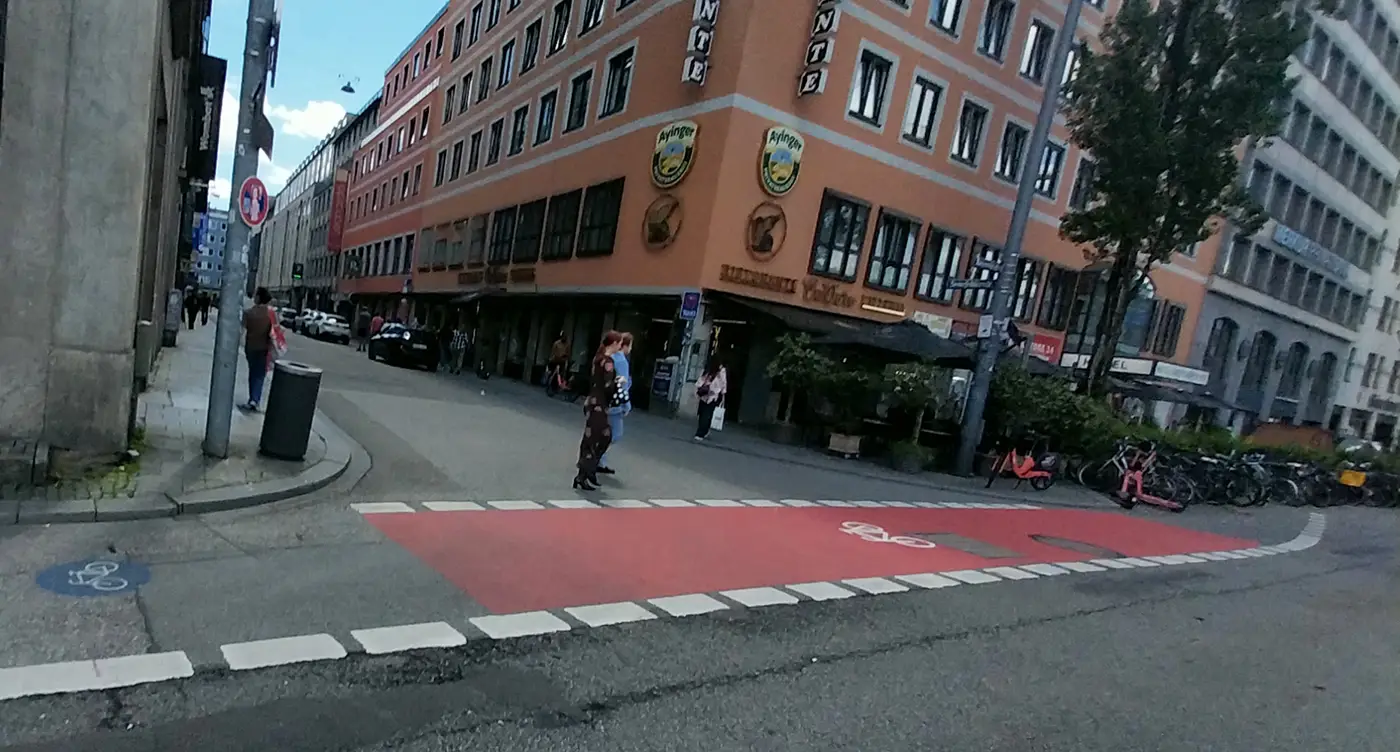
Before turning across a bike lane, check the right side again. Cyclists may be going straight.
If your trip stays inside central Munich, public transport and walking are usually easier. A car becomes more useful for family luggage, rural hotels, several stops in one day, Alpine routes, late returns, work trips, and cross-border travel.
This guide starts once you already have a car. It covers the situations that often cause questions: bike lanes, right-before-left, parking signs, the Umweltzone, fuel, Autobahn driving, winter equipment, and border rules.
Central Munich: leave the car parked when public transport is simpler.
Umweltzone: check the green environmental sticker and current diesel restrictions before entering the Mittlerer Ring area.
Winter: Germany uses a situational winter-tyre rule; winter-capable tyres must meet the Alpine-symbol requirement when winter road conditions apply.
Austria / Switzerland: check toll products, rental permission, roaming, and local access rules before the border.
If you are still deciding whether to rent a car, start with Renting a Car in Munich. This article assumes the car decision is already made.
01Who this article is for
This note is useful for visitors, new residents, and Munich-based drivers who want a practical refresher before city driving, a Bavaria road trip, or a border crossing.
If your whole plan is in central Munich, parking the car and using public transport may still be easier.
02City driving needs the most attention
Munich is manageable by car, but city driving needs more attention than an open motorway. Cyclists, trams, bus lanes, parking rules, and small priority situations often appear close together.
Start with right turns at a red light. In Germany you generally do not turn right on red unless a green arrow sign or signal allows it. If you are unsure, wait. That is safer than carrying a habit from another country.
Small intersections matter too. In residential areas and Tempo 30 zones, the right before left rule can apply. With no priority sign, traffic from your right may go first. This surprises drivers who are used to feeling that the wider road always has priority.
Many drivers underestimate cyclists. Munich has many bike lanes, and they often run directly beside the road. Before any right turn, check your mirrors and the right side carefully, because a cyclist may be going straight while you cut across the bike lane.
Trams need room as well. They are heavy, they run on rails, and they cannot swerve. Near tram stops, watch for passengers crossing to and from the doors.
Bus, taxi, and bicycle lanes may look useful when your lane is slow. Stay out of them unless a sign clearly allows it. Navigation apps help, but road signs and markings decide what is legal.
The most common city mistakes are turning right on red where it is not allowed, missing the right before left rule in quiet streets, and turning across a cyclist who is going straight. Slow down earlier, read the signs, and check the right side before every turn.
03Road signs and words worth recognizing
You do not need to memorize every German road sign before driving here. But a few words and signs change what you can do the moment you see them, so they are worth recognizing on sight.
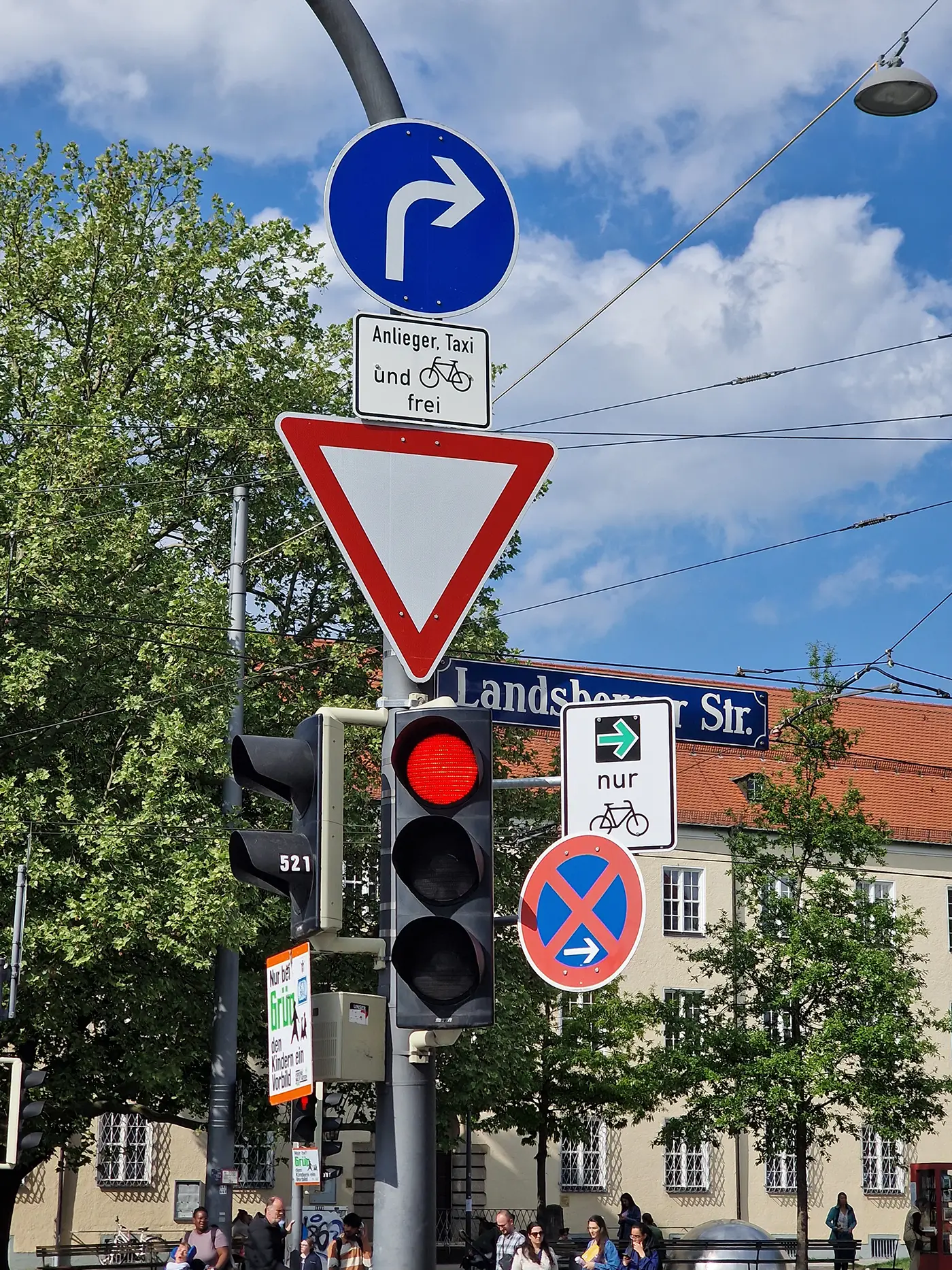
Munich traffic signs often work in combinations. Direction, priority, bicycle exceptions, and stopping rules may appear on the same pole.
Einbahnstraße: one way street, common in city and residential areas.
Verbot der Einfahrt: no entry from that direction.
Vorfahrtstraße: priority road, often shown by a yellow diamond sign.
Vorfahrt gewähren: yield before entering.
Rechts vor links: right before left, important in smaller streets without priority signs.
Tempo 30 Zone: a 30 km/h zone with more pedestrians, cyclists, parked cars, and small junctions.
Anlieger frei: access allowed for people with a real destination there, not a shortcut.
Umweltzone: low emission zone. The car needs the right environmental sticker on the windscreen.
For a broader English overview of German traffic signs, the German Road Safety guide Getting around in Germany is a useful starting point. For a more visual sign by sign reference, Getting Around Germany also has a detailed English overview, but treat it as a practical reference rather than official legal text.
These signs are part of normal daily driving. A new resident may see them every week. A visitor may see them only once, but that may be when the navigation app sends the car through a small street near the old town.
04Check the low emission zone before entering
Munich’s low emission zone covers the Mittlerer Ring itself and the area inside it. Vehicles entering the zone need the correct green environmental sticker, and that requirement also applies to electric vehicles.
For diesel cars, the green sticker is not the only question. Munich’s current rules also restrict older diesel vehicles; the city currently states that diesel vehicles meeting Euro 5/V or better may enter with the green sticker, while older vehicles may need an exemption.
This matters especially with foreign, borrowed, company, or older diesel cars. A German rental collected in Munich will usually be prepared for normal local use, but still check the windscreen and the vehicle if you are unsure.
See the City’s current Munich low-emission-zone information and environmental badge page before bringing an unfamiliar vehicle into the zone.
If the car does not have the correct sticker, do not enter the zone first and try to fix the problem later. Check it before you drive in. Electric vehicles also need the correct sticker in German low emission zones.
05Parking signs can cost time and money
Parking mistakes in Munich often come from misreading the conditions on the sign rather than from the parking price itself.
A space can look empty and still be illegal for you. The sign may allow parking only at certain times, only with a ticket, only with a parking disc, only for residents, or not at all because a temporary sign has been added for construction or moving.
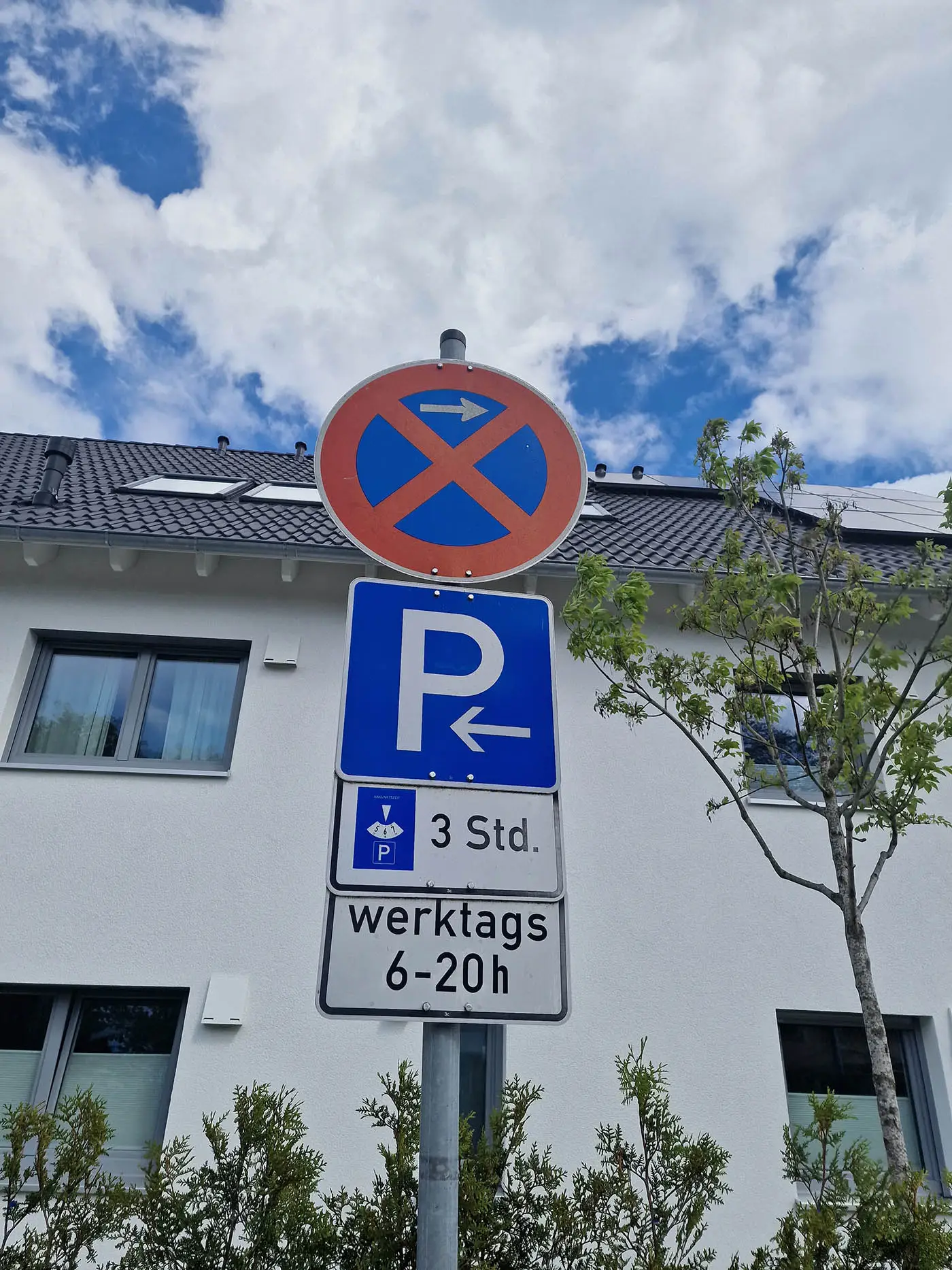
A Munich parking sign can include direction, time limits, weekday rules, and stopping restrictions.
A few words decide it.
| Word | Meaning | What to do |
|---|---|---|
| Parkschein | Parking ticket required | Use the machine or a valid digital parking app if allowed |
| Parkscheibe | Parking disc required | Set the arrival time on a parking disc and respect the maximum time |
| Bewohner | Resident parking | Do not park there unless the sign clearly allows your situation |
| Absolutes Haltverbot | No stopping | Do not stop on the carriageway unless a specific exception applies. |
| Eingeschränktes Haltverbot | No parking | Brief stopping is limited by the rule; parking is not allowed unless an exception or additional sign applies. |
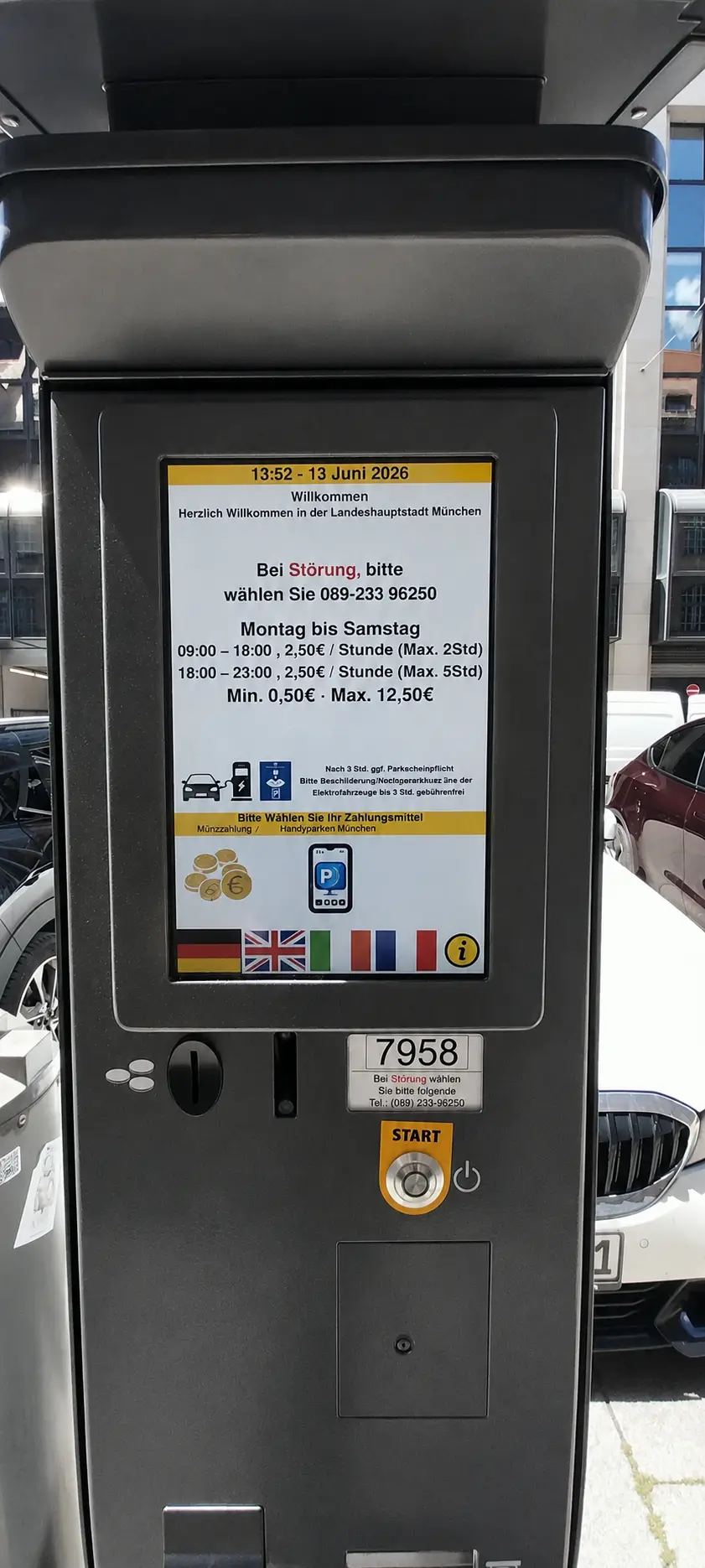
Munich parking machines often show the local time rules and HandyParken option. Payment is only one part of parking legally.
Munich has digital parking payment. With HandyParken München, you can buy a digital parking ticket for marked paid parking spaces in Munich without coins.
The app only handles payment. It does not make a forbidden space legal, remove a resident parking rule, or cancel a temporary no-stopping sign. If you enter the wrong plate number, especially with a rental or borrowed car, the digital ticket may not be valid.
Underground car parks: check the height before you enter
Old town underground car parks can be difficult with a large vehicle. Many central garages have height limits around 1.90 to 2.00 m, narrow entrance ramps, tight curves, and small parking spaces.
This matters especially if you drive a large SUV, a van, or a rental car with a roof box. Do not assume that every car park entrance will fit your vehicle just because the navigation app sends you there. Before entering, slow down and check the height sign at the ramp. If the car is close to the limit, do not gamble.
For a normal compact car, central underground parking can be convenient. For a tall SUV or a car with a roof box, a Park and Ride location or a less central garage can be the calmer choice.
If the sign, payment rule, height limit, or street situation is unclear, use a paid garage, Park and Ride, or a less central parking area instead of guessing.
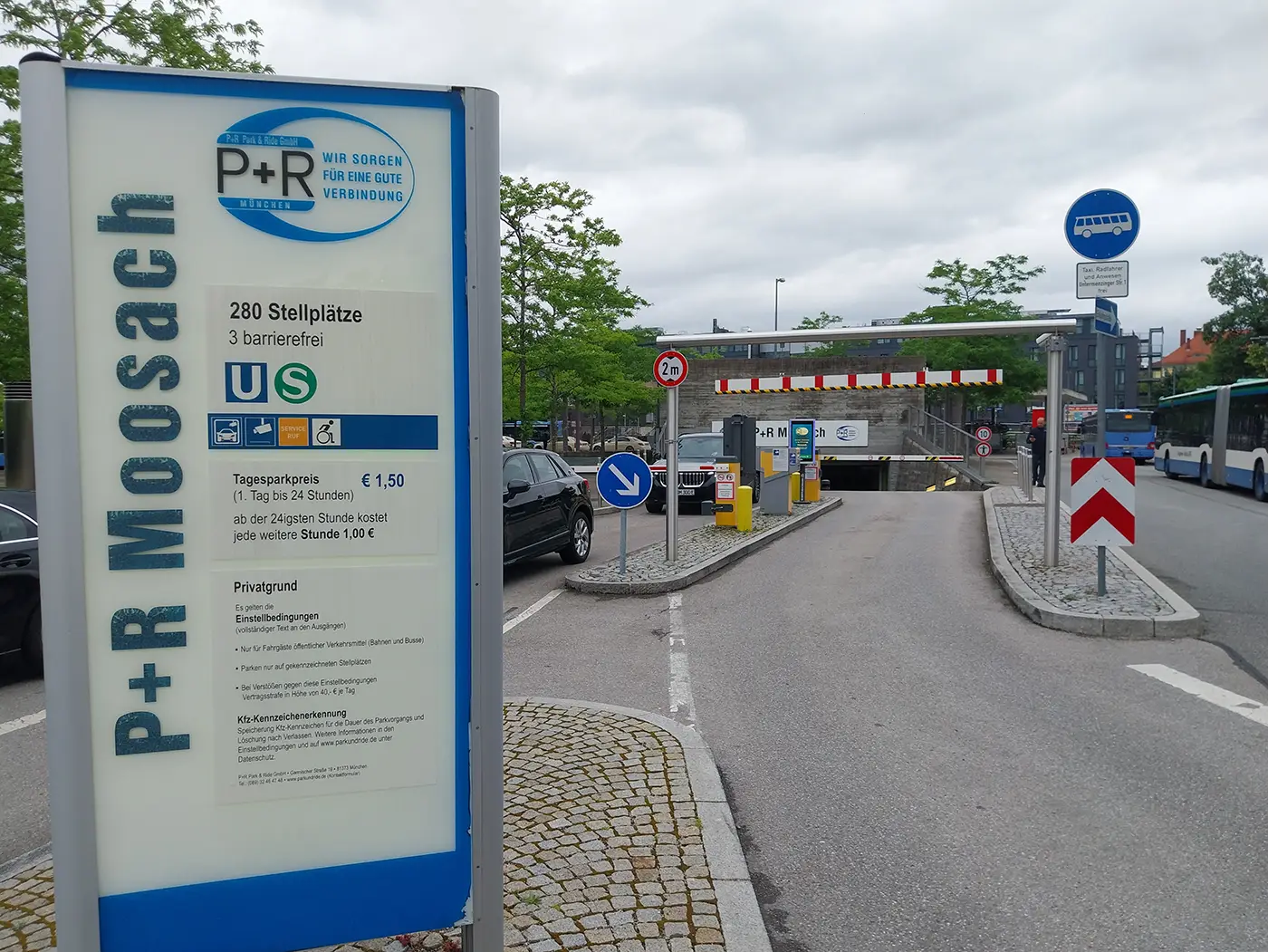
Park and Ride can be useful when the better plan is to leave the car outside the center and continue by public transport.
06Fuel, E10, diesel, and electric cars
Before filling the car, check the label inside the fuel door and the vehicle documents. Do not guess.
You may see Super, Super E10, Super Plus, and Diesel. Super and Super E10 are petrol. Diesel is not. If the car is diesel, use diesel. If it is petrol, do not use diesel.
Super E10 is common in Germany and many modern petrol cars accept it. With a rental, borrowed, company, or recently purchased car, follow the fuel label and vehicle documents instead of guessing.
Putting the wrong fuel in a car can be expensive. Confirm diesel or petrol before you start filling.
Motorway fuel stations are convenient but often more expensive. Away from the Autobahn, fuel is usually better value, though convenience may matter more before a rental return, a long family drive, or a late evening arrival.
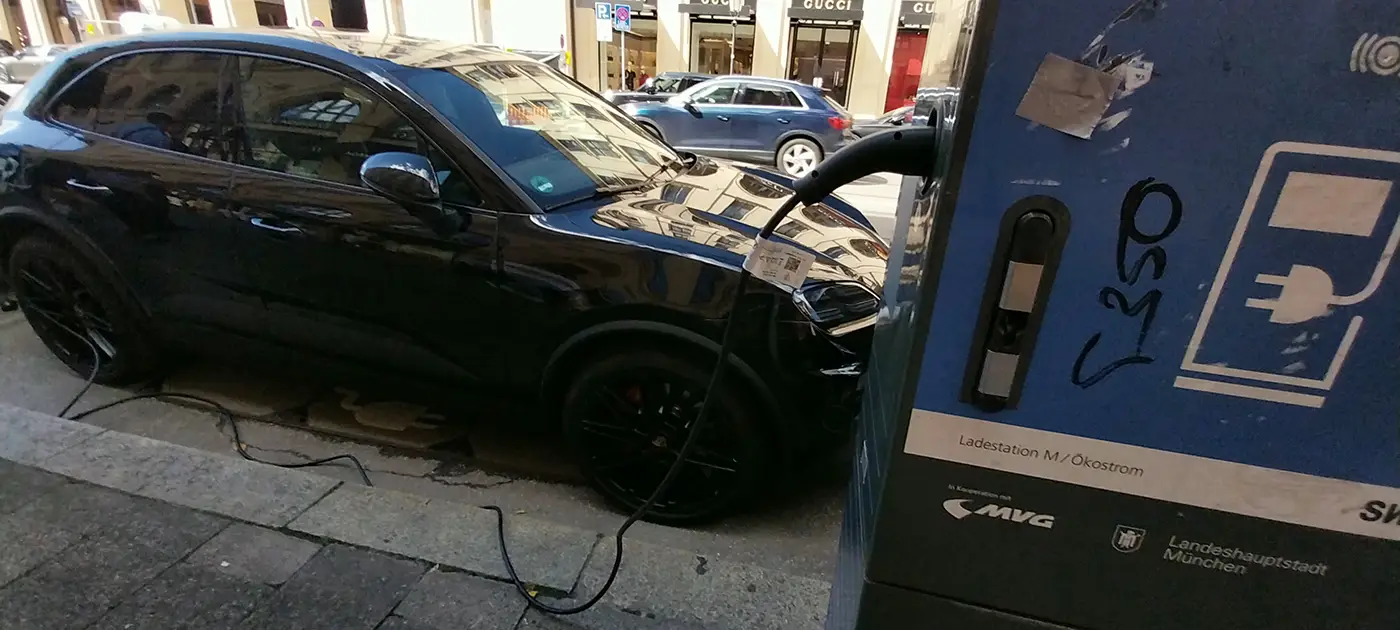
Electric charging is part of daily driving in Munich, but payment apps and access rules can vary by station.
For electric cars, do not assume that every charger accepts your usual app, card, or payment method. Residents usually build a charging routine over time. Visitors should plan charging before the battery is low, especially outside Munich, on Sundays, and on Alpine routes.
07Autobahn driving: keep right and leave space
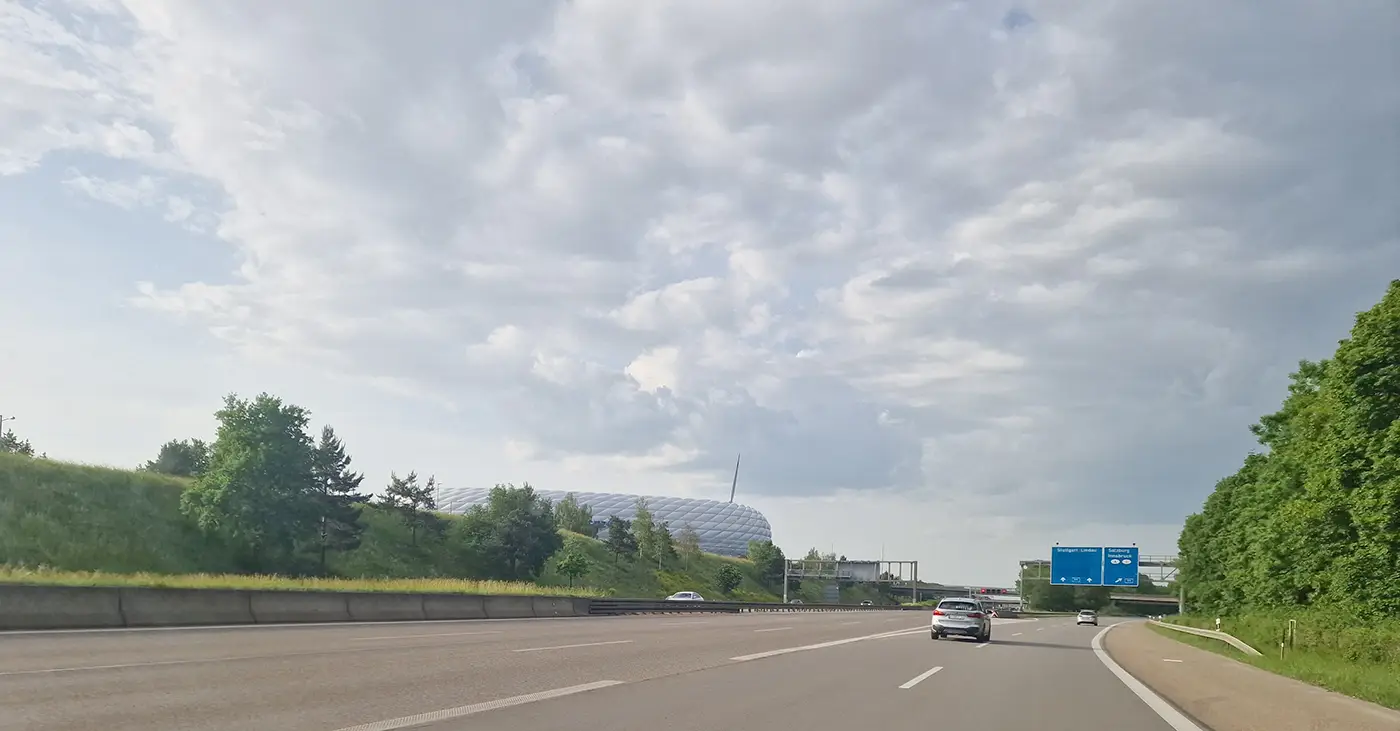
Autobahn near Munich, with routes toward Stuttgart, Lindau, Salzburg, and Innsbruck.
Some Autobahn sections have no posted speed limit, but many do. Around Munich, limits can appear because of traffic, construction, rain, tunnels, noise protection, electronic signs, and local restrictions.
A posted speed limit is the maximum speed, not a speed you need to reach.
The basic rhythm is to keep right and pass on the left. Do not sit in the left lane because it feels easier. Faster cars may appear quickly from behind. Do not pass on the right in normal traffic. Keep your distance, signal clearly, and move back to the right once you have finished passing.
Construction zones deserve extra care. Lanes narrow, limits drop suddenly, and trucks run close beside you. If that is unfamiliar, take a slower lane and leave more space.
Rain, fog, winter, darkness, and heavy traffic all change what is safe, regardless of what the sign technically allows.
Keep right unless overtaking, leave enough distance, and move back to the right after passing. For many drivers, 110 to 130 km/h feels safer and less tiring than driving much faster on unrestricted sections.
08Rest stops: Raststätte and Parkplatz offer different services
On a longer Bavaria drive, the difference between two kinds of motorway stop matters more than people expect.
| Type | What it usually has | Good for |
|---|---|---|
| Raststätte / Rastanlage | Fuel, toilets, food, coffee, a shop, sometimes showers | Families, a real toilet break, food, coffee, and longer stops |
| Parkplatz / Rastplatz | A short parking and rest area, sometimes a basic toilet, often no food or fuel | A quick stretch, a driver change, a short rest |
If someone in the car needs a proper toilet, use a larger Raststätte instead of hoping the next small Parkplatz has one. Stopping to stretch, change drivers, drink water, or take a short rest when tired is normal and often safer than pushing on.
Do not treat a motorway rest area like a campsite. Avoid setting up chairs and tables, cooking, using a grill, spreading out camping gear, or leaving rubbish behind.
At night, an isolated small parking area is not the most comfortable place to linger. A larger serviced rest area is usually the better choice for families, visitors, and tired drivers.
09Winter and Alpine driving need extra preparation
Winter driving in Bavaria should be taken seriously.
Germany does not use one fixed nationwide winter-tyre season. The rule is situational: in black ice, packed snow, slush, ice, or frost conditions, the vehicle must use qualifying winter-capable tyres. Under the current rules, those tyres need the Alpine symbol (mountain and snowflake).
Even if Munich itself looks fine, conditions can change quickly when you drive toward the Alps. Snow, ice, fog, darkness, and mountain roads can make a normal trip feel very different.
Before an Alpine winter drive, check:
- Does the car have suitable winter equipment?
- Are you comfortable driving in snow, darkness, or fog?
- Will you return after sunset?
- Is the destination higher, colder, or more exposed than Munich?
- Is the parking lot uphill, icy, or outside the town center?
A ski trip or winter lake trip can be beautiful by car. It can also become tiring if the driver is not used to the conditions.
Allow more time for a winter Alpine trip than you would in summer.
Leave early, keep the route simple, and allow time for slower traffic, bad weather, or a tired driver at the end of the day.
10Check tolls and rules before a border trip
Routes from Munich can reach Austria, Switzerland, Italy, France, Slovenia, Croatia, or the Czech Republic surprisingly quickly. Check the next country before departure because tolls, local access rules, winter requirements, and roaming can change at the border.
Germany does not have a general passenger car Autobahn toll. Austria and Switzerland are different. Italy uses toll booths on many motorways, and some Italian city centers have restricted traffic zones that can fine cars without a permit.
If your route uses Austrian motorways or expressways, check the vignette rule before crossing. Austria offers 1-day, 10-day, 2-month, and annual products; for private consumers, the digital 1-day and 10-day vignettes can currently be bought with immediate validity. Some routes, including the Brenner corridor, also use separate section tolls.
| Route question | Why it matters | Practical note |
|---|---|---|
| Austria | Motorways and expressways usually need a vignette for cars up to 3.5 tonnes. | For 2026, ASFINAG offers 1-day and 10-day short-term options as well as longer products. Buy from the official ASFINAG system or an authorized outlet and verify the plate and validity. |
| Swiss motorway | Switzerland uses an annual motorway vignette. | The 2026 Swiss motorway vignette costs CHF 40. Switzerland does not offer a daily, weekly, or monthly motorway vignette. |
| Brenner and Italy | Austria, section tolls, and Italian motorway tolls can all appear on one route. | A route that avoids Switzerland is not automatically cheaper. Compare the whole route, not one toll item. |
| Phone roaming | EU roaming habits can mislead drivers near Switzerland. | EU countries are one thing. Switzerland depends on your own mobile plan. |
| Rental car | Rental contracts may limit cross border use. | Check whether the car may enter the country before the route is fixed. |
The Lindau and Lake Constance route has a few toll details that are easy to miss. One official Austrian exemption covers the A14 from the German border at Hörbranz to the Hohenems junction. Similar short exemptions exist at Walserberg toward Salzburg and Kufstein to Kufstein-Süd. Once you continue beyond an exempt section, normal Austrian toll rules apply. If you then use Swiss motorways, the Swiss vignette is a separate requirement.
The Brenner route toward northern Italy follows different toll rules. It can make sense for some trips, but it may involve Austrian motorway rules, a Brenner section toll, and Italian motorway tolls. For a long route toward southern France, Switzerland may still be the better transit choice even when the Swiss vignette feels annoying.
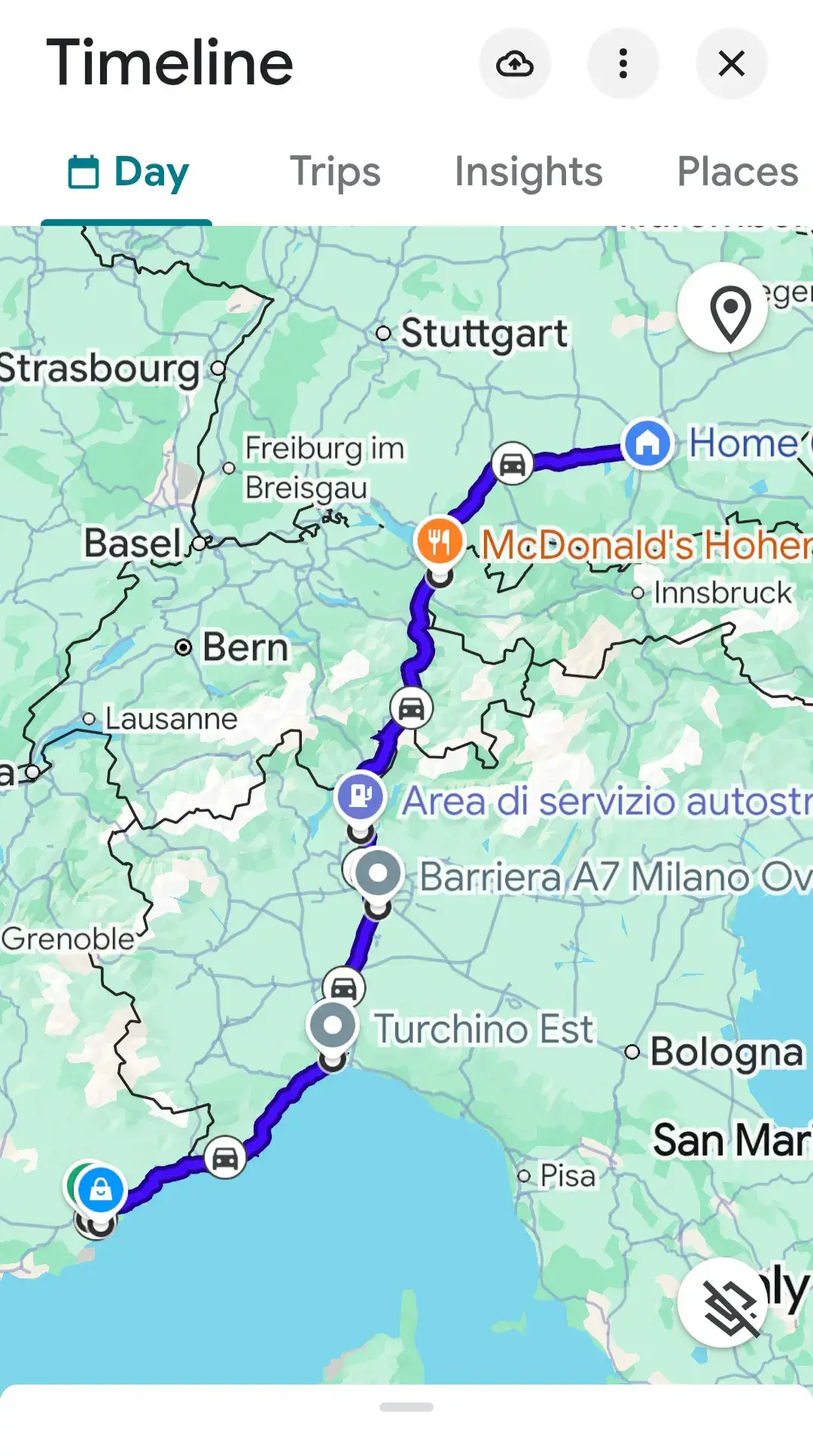
What I learned from one short stop in Switzerland
On one long drive back toward Munich from southern France, Switzerland was useful as a transit route, but I treated the Swiss stop as a short one. I used a motorway service station for fuel and a quick toilet break, then continued toward Austria for a proper food stop.
I left the Swiss service station at around 17:45, reached a simple food stop just after entering Austria at around 20:30, stayed there for about 50 minutes, and arrived back in Munich at around 23:15.
Since that trip, I check fuel, food stops, roaming, vignettes, tolls, and timing before a long border drive.
Phone costs can also change at the border. Inside the EU, many travelers can use their normal mobile plan under the “roam like at home” rule, so data use in countries such as Austria, Italy, France, and Slovenia may not create an extra roaming charge under the same conditions as at home.
Switzerland is different. It is not part of the EU roaming area, so your German or EU mobile plan may not include Swiss mobile data. Some providers include Switzerland, but many do not. Check your own mobile plan before the border, not after the first roaming text message.
I learned this the expensive way. During a short Swiss motorway stop for fuel and a toilet break, my phone still connected briefly in the background even though mobile data was switched off. The later phone bill showed that even a short stop can cost money if Switzerland is not included in your mobile plan.
Since then, I do not rely only on switching off mobile data. If my plan does not clearly include Switzerland, I use airplane mode before the border and turn Wi-Fi back on only when needed. I also download offline maps before the trip, especially if Switzerland is only a transit route.
Confirm six things before you go: whether the rental car may cross that border, whether a vignette is needed, whether separate tunnel or section tolls apply, whether the plate number is correct for any digital product, whether the destination city has local access restrictions, and whether your own mobile plan includes data in the country you are entering.
11If you are driving a rental car: road and return checks
Licence, payment card, deposit, insurance excess, and the decision about when to rent belong in the companion Renting a Car in Munich guide. Once you are driving, concentrate on the vehicle and the route.
Before leaving the station, confirm the fuel or charging type, plate number, visible damage, tyre condition, warning lights, and environmental sticker if the route enters Munich’s low emission zone. If you plan to cross a border, make sure the rental agreement allows the country and vehicle category before you go.
For a full-to-full fuel policy, refuel before return and keep the receipt. For an EV, follow the provider’s required return-battery rule rather than assuming it matches another company.
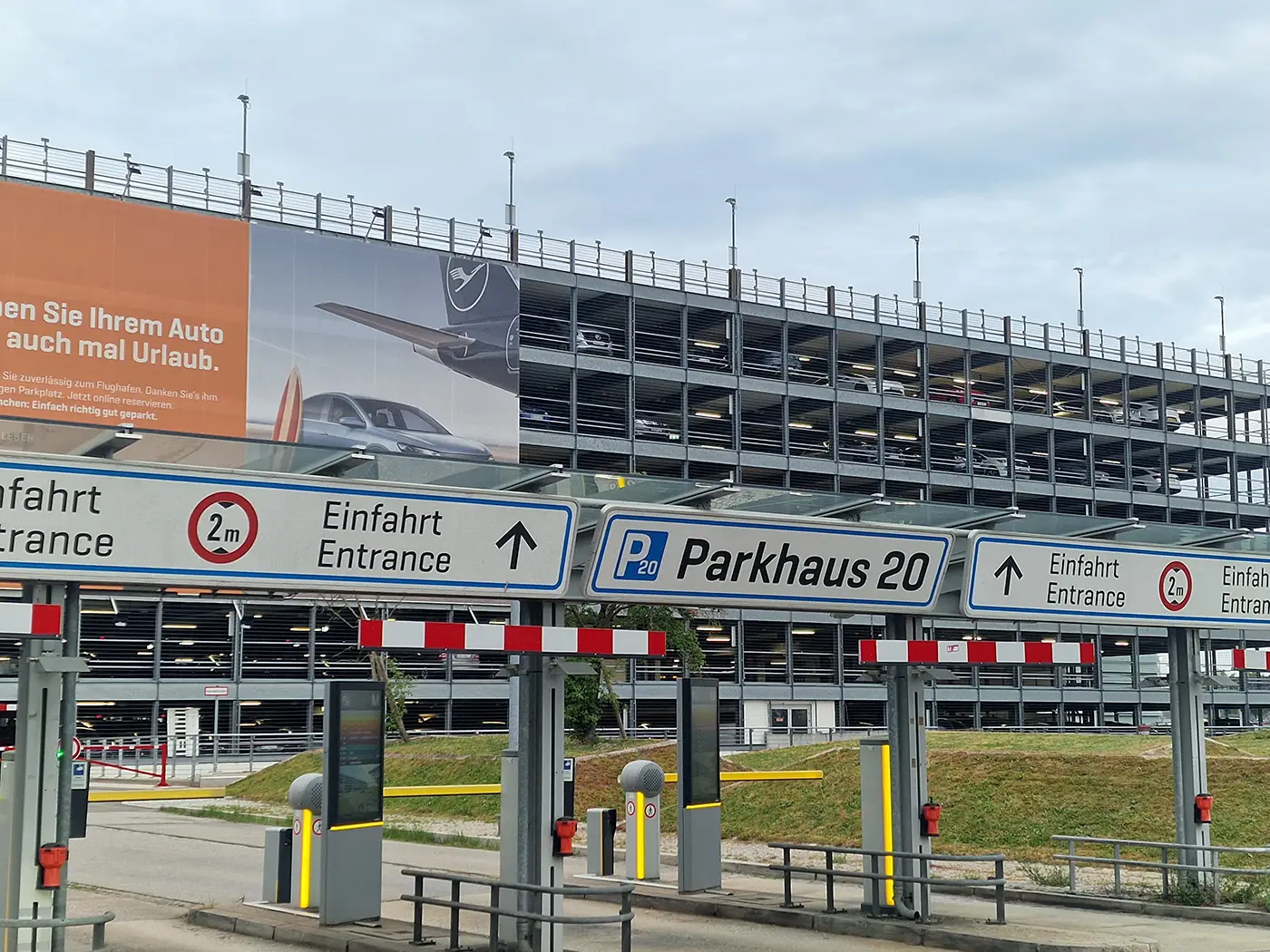
At Munich Airport, parking and rental return areas have their own lanes and signs.
At Munich Airport, follow the Rental Car Return signs rather than entering the first public car park. The airport directs rental returns to the dedicated return area.
Before you hand back the key:
- Refuel before the return area if the contract is full to full, and keep the receipt
- Clear the car: sunglasses, cables, phone mount, passports, toys, shopping bags
- Take return photos, especially outside office hours or with a key drop
- Wait for staff confirmation if someone is present
- Allow more time than you expect for return, terminal walk, luggage, and check in
Leave a time buffer for refueling or charging, finding the correct return lane, unloading, photos, the terminal walk, and check-in.
12For new residents: build a driving routine
If you have just moved to Munich or Bavaria, build confidence with simpler routes before combining central traffic, winter roads, and a border trip.
Start with easier routes before combining central Munich at rush hour, a long night drive, a border crossing, a ski trip in bad weather, and difficult old town parking.
Build the routine gradually:
- Practice local signs and right before left in quiet residential areas
- Use known garages before trying difficult street parking
- Set up HandyParken before you need it under pressure
- Learn where your nearest fuel station and tire service are
- Plan your first Alpine drive in good weather and daylight
- Check border rules before your first Austria, Switzerland, Italy, France, Slovenia, Croatia, or Czech Republic trip
Driving becomes easier once the basic routines are familiar.
Driving from Munich is easiest when the car is used for the part of the trip where it adds real flexibility. Inside the city, slow down early enough to read the bike lane, priority sign, parking condition, and environmental-zone rule before making the next move.
On longer trips, check winter conditions, toll products, rental permission, roaming, and border rules before departure. Each check is simple, but doing it on the road is harder.
Road rules, temporary signs, parking rules, winter conditions, toll systems, roaming plans, rental permissions, and local access restrictions can change. Follow current road signs and verify the official rule for the route and vehicle you are using.