
Munich Practical Notes
Shopping in Munich: Maximilianstrasse, What to Buy, and VAT Refund
A practical guide to Munich shopping areas, useful gifts, Trachten, and the VAT refund steps to prepare before you reach the airport.
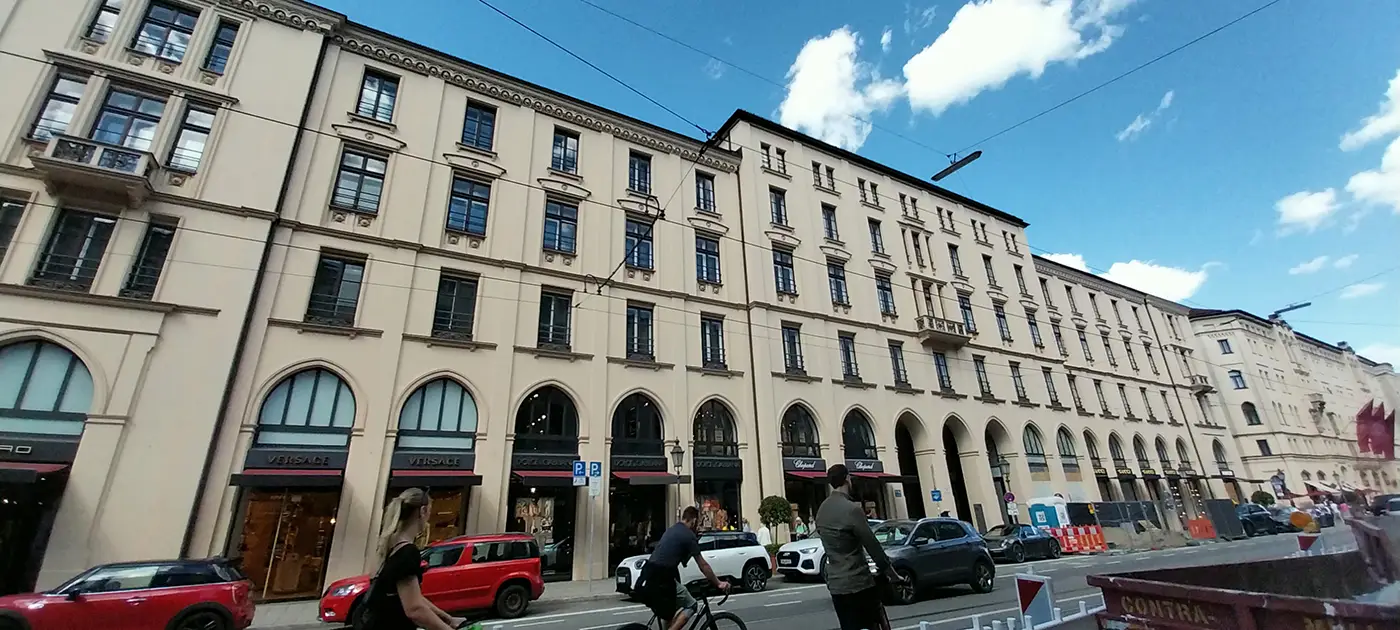
Maximilianstrasse. The street is less about quick shopping and more about browsing, architecture, and luxury storefronts.
Central Munich is easy to combine with sightseeing. The main pedestrian streets run from Karlsplatz/Stachus to Marienplatz, while Maximilianstrasse, Fünf Höfe, Dallmayr, Ludwig Beck, and several department stores are all within the same general old-town area.
You do not need to visit all of them. Use the pedestrian streets for everyday shopping, Maximilianstrasse for luxury brands, Dallmayr for food gifts that travel well, Trachten shops for fitted traditional clothing, and department stores when you want several things in one place.
If you are eligible for tax-free shopping, ask for the paperwork when you buy. At the airport, you will need the correct form, the goods, the right luggage plan, and Customs validation.
01First, understand the shopping map
Munich’s city center is easier to use when you know what each shopping area is good for.
One timing rule matters before anything else: most regular retail shops are closed on Sundays. If Sunday is your shopping day, check Sunday in Munich: What’s Open and What’s Closed before planning around department stores or the pedestrian shopping streets.
Kaufingerstrasse and Neuhauser Strasse are the busy pedestrian streets between Karlsplatz/Stachus and Marienplatz. This is where most visitors naturally end up: department stores, international chains, drugstores, shoes, bags, phone accessories, and plenty of people.
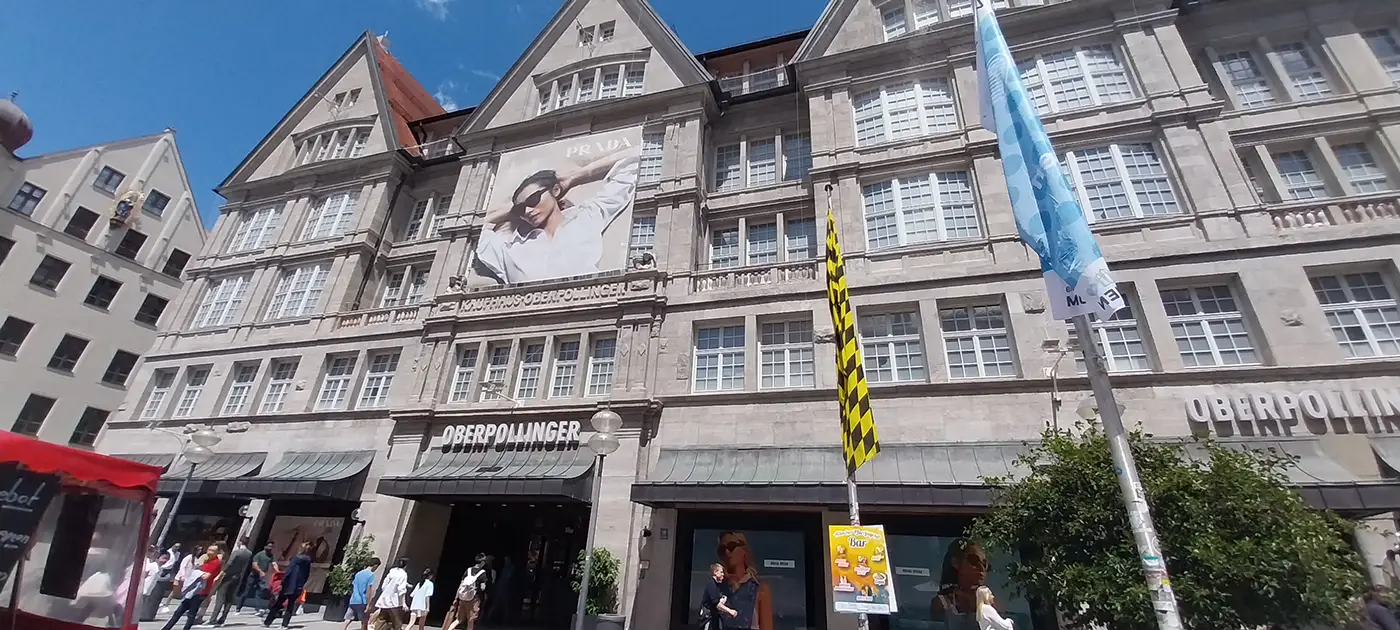
Oberpollinger beside Karlsplatz/Stachus. This is where Munich’s main pedestrian shopping axis begins.
Maximilianstrasse starts near Max-Joseph-Platz, beside the National Theatre and the Residenz, and runs east toward the Maximilianeum. The street is wider, quieter, and more formal than the pedestrian shopping streets. You will find luxury brands, watches, jewelry, fashion, and design. It is still worth walking along the street even if you do not plan to buy anything.
GALERIA at Marienplatz is the everyday department store right on the old town route, useful when you want several practical purchases in one place. More on it below.
Fünf Höfe is a calmer indoor option near Theatinerstrasse. It is easy to combine with Odeonsplatz, Marienplatz, and the Residenz. It works well in bad weather, when the group wants a slower pace, or when you want shops and cafés away from the busiest pedestrian street.
Kaufingerstrasse / Neuhauser Strasse: everyday shopping, department stores, drugstores, quick errands, and crowds.
GALERIA at Marienplatz: kitchenware, homeware, practical gifts, mixed purchases, and a convenient old town location.
Maximilianstrasse: luxury storefronts, architecture, slow browsing, and serious high-value purchases.
Fünf Höfe: indoor shopping, a calmer route, cafés, and a useful weather backup.
02Department stores: where practical shopping happens
If your group wants different things but does not want to cross the city, start with the department stores.
Oberpollinger sits close to Karlsplatz/Stachus and works well for mixed shopping: fashion, bags, cosmetics, gifts, homeware, and a rooftop terrace for a pause. It also marks the start of the main pedestrian shopping route.
GALERIA at Marienplatz is very practical. The location is hard to beat: directly beside Marienplatz, on the main old town shopping route. If you want German kitchenware, household goods, small gifts, stationery, toys, luggage items, or several simple purchases in one stop, it can save time.
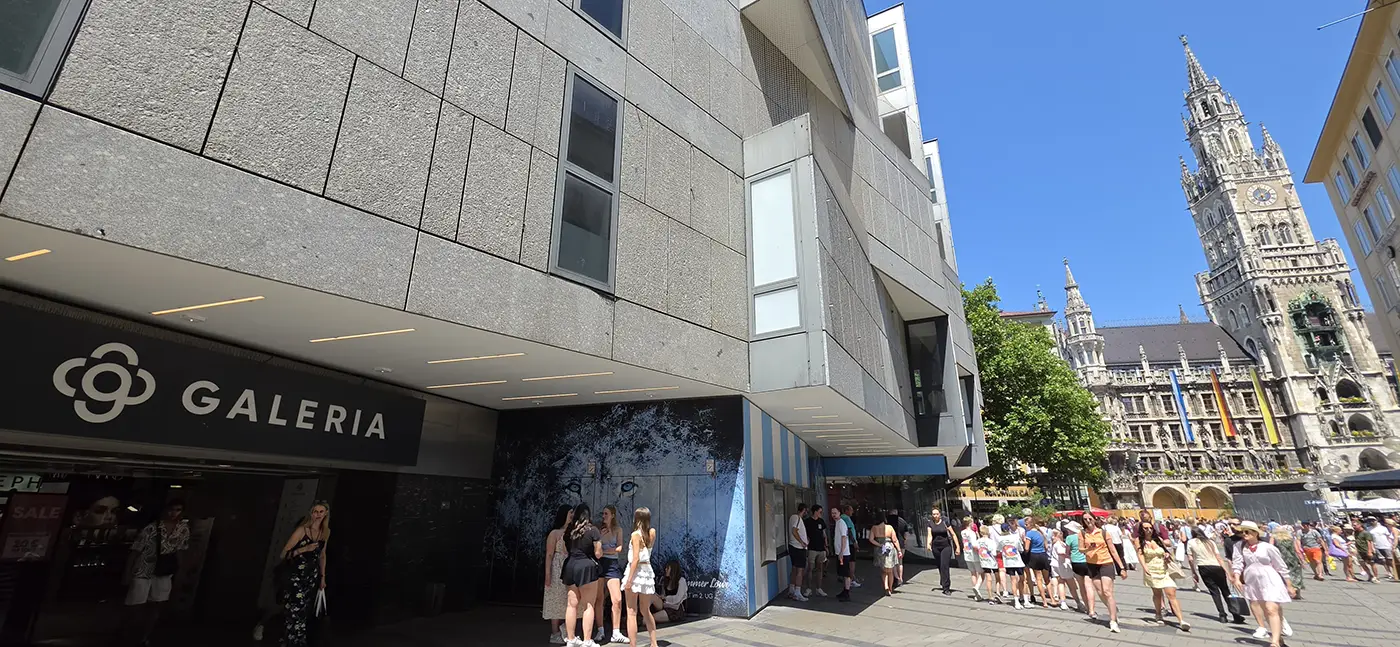
GALERIA at Marienplatz. A practical stop for gifts, homeware, and tax free shopping.
Ludwig Beck sits beside Marienplatz and is especially good for perfume, cosmetics, beauty products, and a compact city center stop. It is a more focused stop than visiting several separate chain stores.
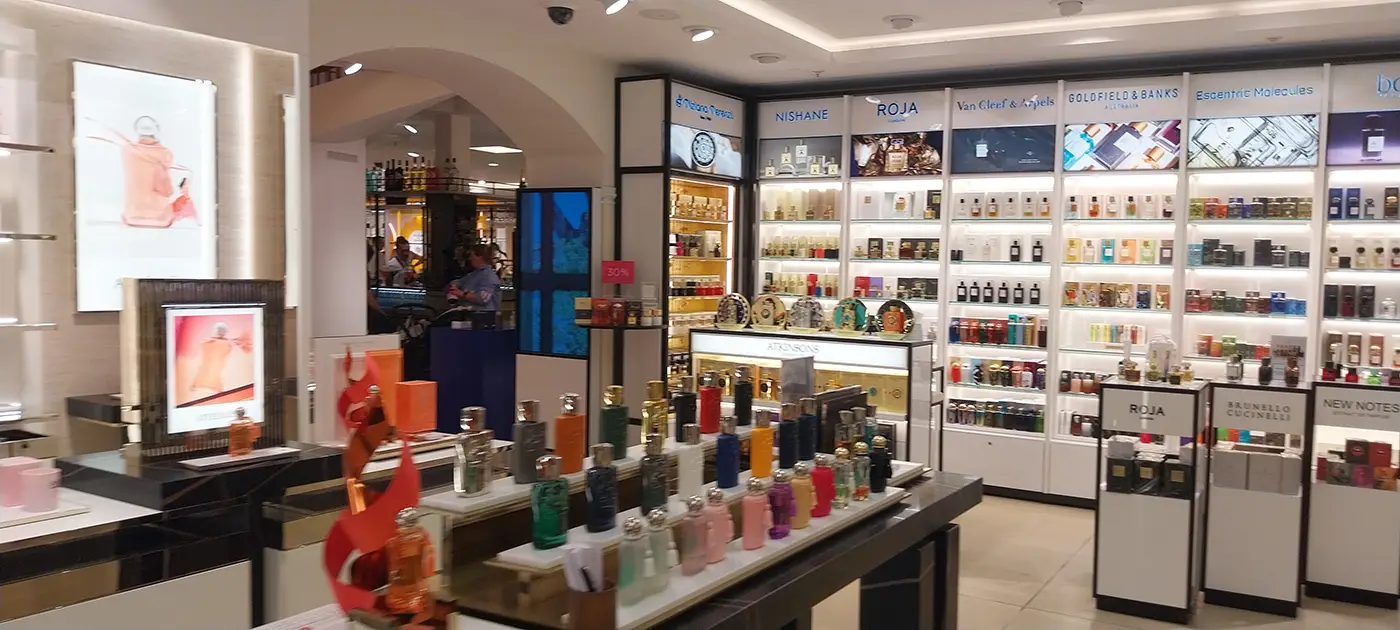
Perfume and cosmetics section inside Ludwig Beck.
For German kitchen knives, cookware, perfume, cosmetics, or a higher-value fashion item, a department store can be easier than visiting several separate boutiques. If you need tax-free paperwork, ask how the store handles the form before you pay, especially when purchases come from different counters or floors.
Zwilling and WMF are German brands, but not every product in every range is German-made. If origin matters to you, check the blade, base, box, or label before paying. A German brand name alone is not enough.
03Food gifts: Dallmayr is useful, but choose travel-friendly items
Dallmayr near Marienplatz is one of Munich’s easiest food gift stops. Coffee, tea, chocolate, packaged sweets, and small premium food items travel better than fresh market products.
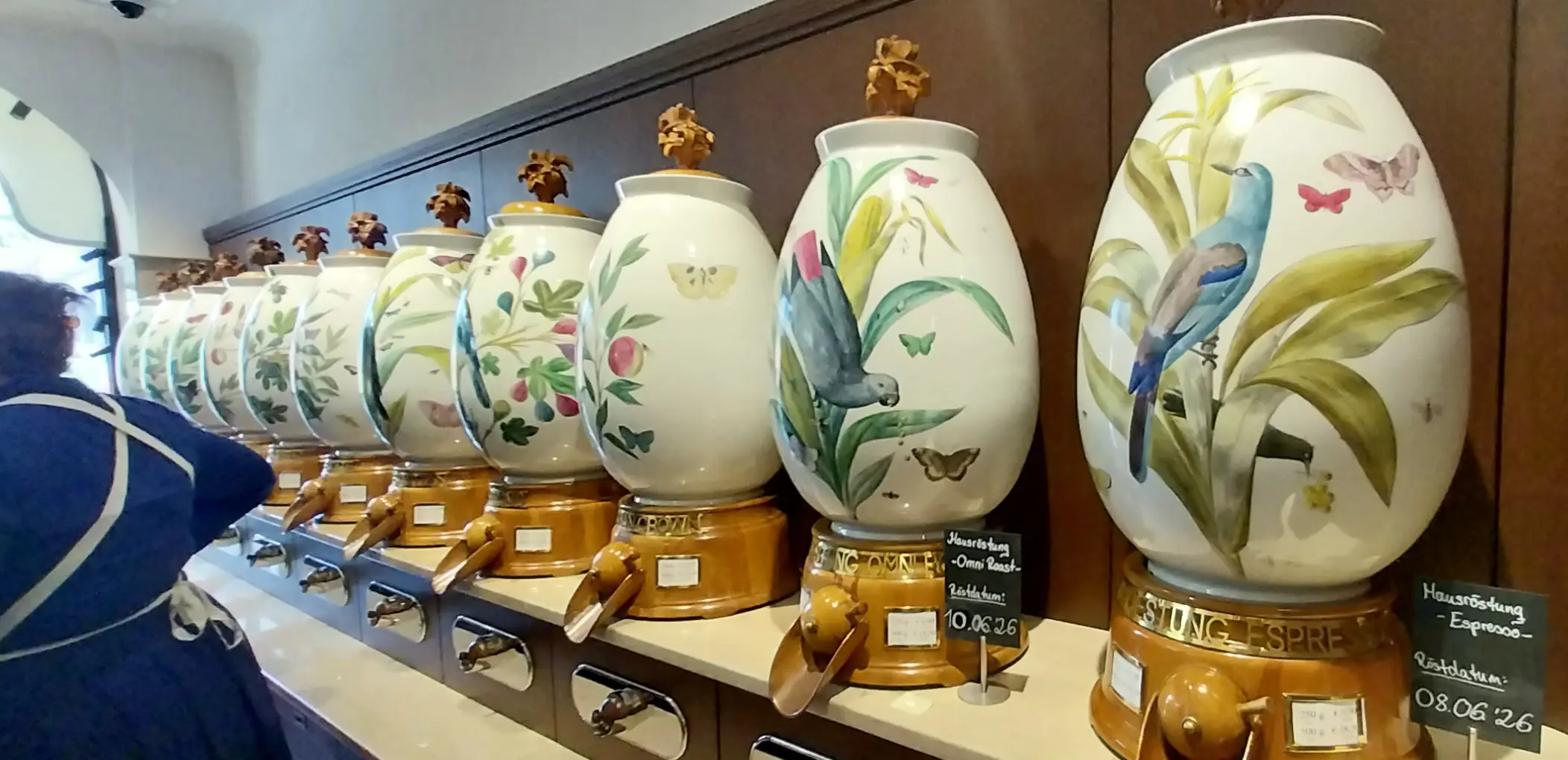
Dallmayr coffee counter. Packaged coffee is one of the easier Munich food gifts to carry home.
The deli counters are part of the pleasure of Dallmayr. Cheese, ham, sausage, pâté, smoked fish, and prepared foods make the store worth browsing even if you buy nothing for the flight.
Some of the most Bavarian-looking foods at the counter are also the hardest to carry home. Meat, sausage, dairy, and chilled deli food can run into import restrictions, storage problems, smell, leakage, and luggage temperature issues. Even vacuum-packed sausage or premium cheese is still an animal product, so check the import rules before buying it for the trip home.
If you want to enjoy those counters, eat the food in Munich. If you want a gift that is easier to carry, choose packaged coffee, tea, chocolate, biscuits, mustard, or dry sweets. If you are flying to Korea, Japan, the United States, the UK, or another non-EU destination, check the destination rules before buying meat or dairy as a souvenir.
Easier to carry: packaged coffee, tea, chocolate, biscuits, mustard, dry sweets.
Check before buying: cheese, butter, dairy, ham, sausage, cured meat, pâté, smoked fish, fresh deli items.
Simple rule: if it needs a fridge, comes from an animal, or could leak in a suitcase, it is usually easier to enjoy it in Munich instead of packing it.
04Traditional souvenirs: check the quality before buying
Munich souvenir shops are full of beer steins, cuckoo clocks, music boxes, nutcrackers, magnets, aprons, and small Bavarian decorations. Some are harmless fun. Some are heavy. Some are much better quality than others.
Max Krug near Marienplatz is a good reference point because it shows the traditional souvenir category clearly. You can see beer steins, cuckoo clocks, music boxes, and decorative pieces without pretending that all souvenirs are the same thing.
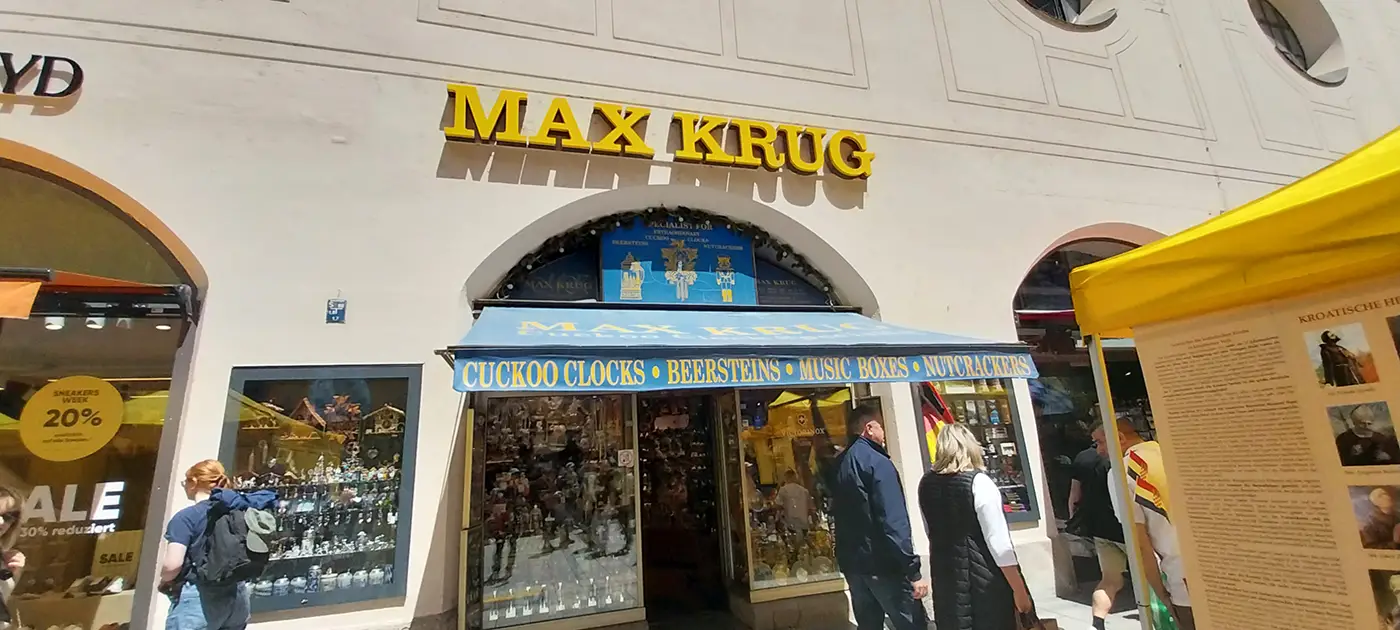
Max Krug near Marienplatz. Cuckoo clocks, beer steins, music boxes, and traditional souvenirs.
A beer stein is a classic Munich souvenir, but it can be heavy and difficult to pack. A cuckoo clock can be a good keepsake, but quality varies widely. You do not need to avoid souvenirs. Just check the quality before you buy.
If you want a simple Munich gift, Dallmayr coffee or chocolate is safer than a heavy beer stein. If you want a traditional object, Max Krug is a better place to understand quality than a random postcard shop. If you want practical gifts or kitchenware near Marienplatz, GALERIA is also worth checking before you walk farther.
05Trachten: Dirndl and Lederhosen are clothing, not quick souvenirs
Dirndl and Lederhosen can be worth buying in Munich, especially if you plan to return for Oktoberfest or attend Bavarian events. But they are not the same as buying a T-shirt.
Fit matters. Material matters. Comfort matters. A cheap set can look fine on a hanger and feel wrong after ten minutes. A better piece may cost more, but it is easier to wear and keep.
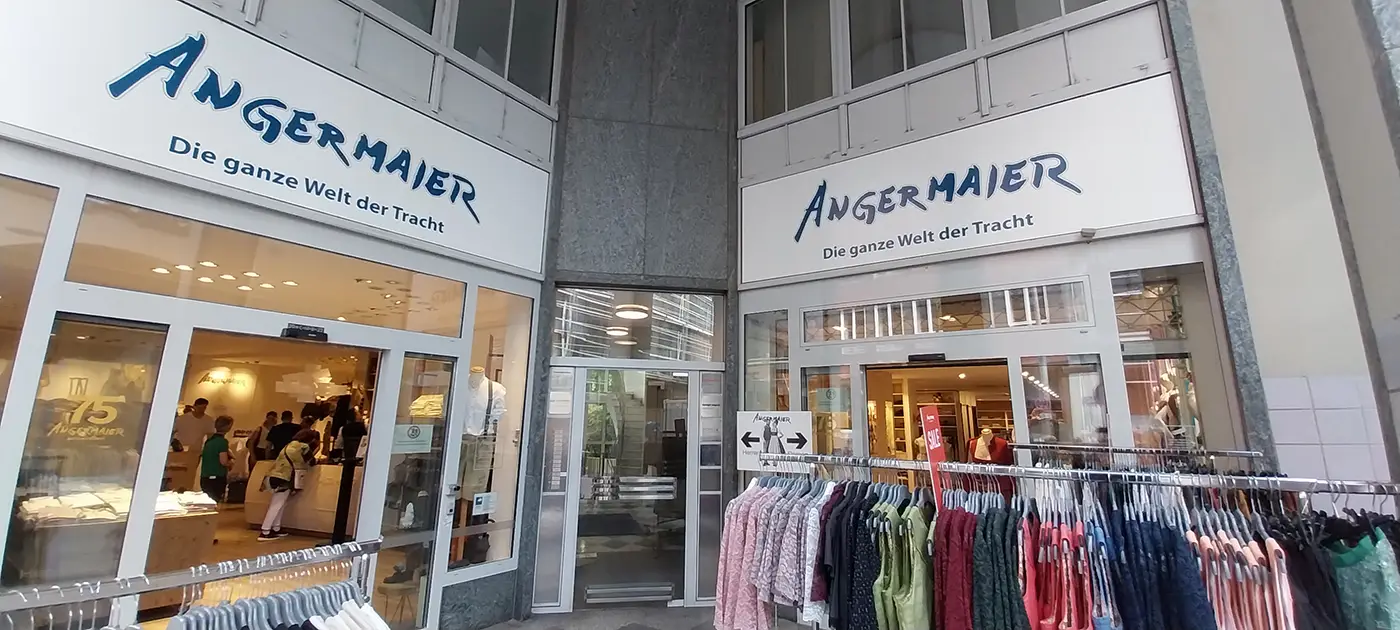
Angermaier on Rosental. Dirndl and Lederhosen are better treated as fitted clothing, not quick souvenirs.
Angermaier on Rosental is easy to reach from Marienplatz and gives visitors a practical look at Trachten without leaving the city center. Lodenfrey at Maffeistrasse 7 is more premium and also worth knowing if you want to understand the higher end of Bavarian traditional wear.
Shopping for Trachten is easier before the busy Oktoberfest period. Closer to the festival, shops can be more crowded and fittings may feel rushed.
06Fünf Höfe: the indoor route when the weather turns
Fünf Höfe is a quiet indoor shopping passage with distinctive architecture. It is easy to include in an old town route.
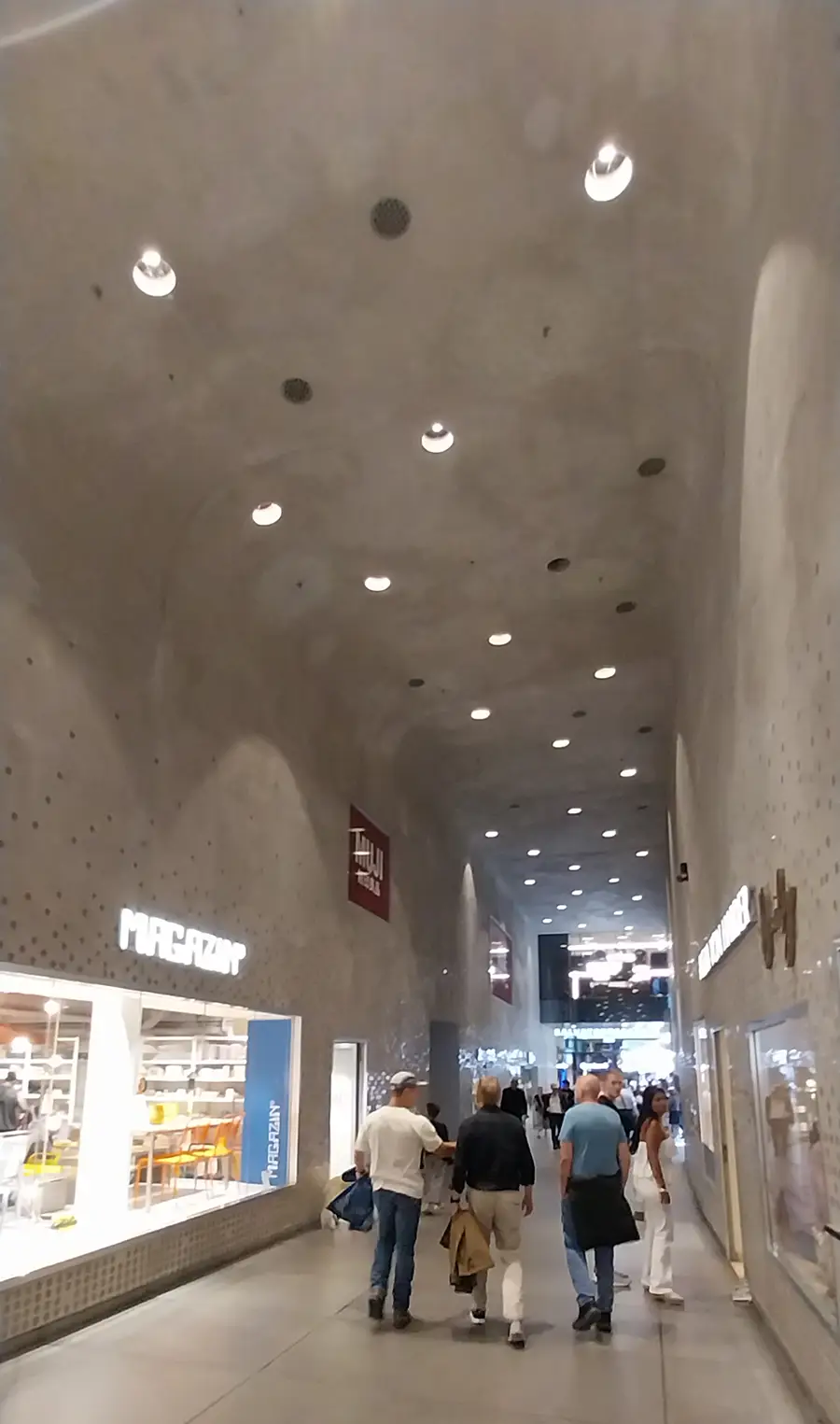
Inside Fünf Höfe. The passage works well as a calmer shopping route between Theatinerstrasse and the old town.
Use it when the weather turns bad, when someone is tired of the pedestrian street, or when you want a short indoor break between Odeonsplatz, Theatinerstrasse, and Marienplatz.
It is not the place for bargain hunting. It is better for a slower browse, a coffee, a small design or fashion stop, or a break from the noise outside.
07Plan one place to sit down
Munich’s center is compact, but department stores, pedestrian streets, and side streets still add up to a lot of walking. Plan one place to sit down before the group is already tired.
The rooftop terrace at Oberpollinger is useful because you can take a break without leaving the shopping area. Stop before the group is already tired.
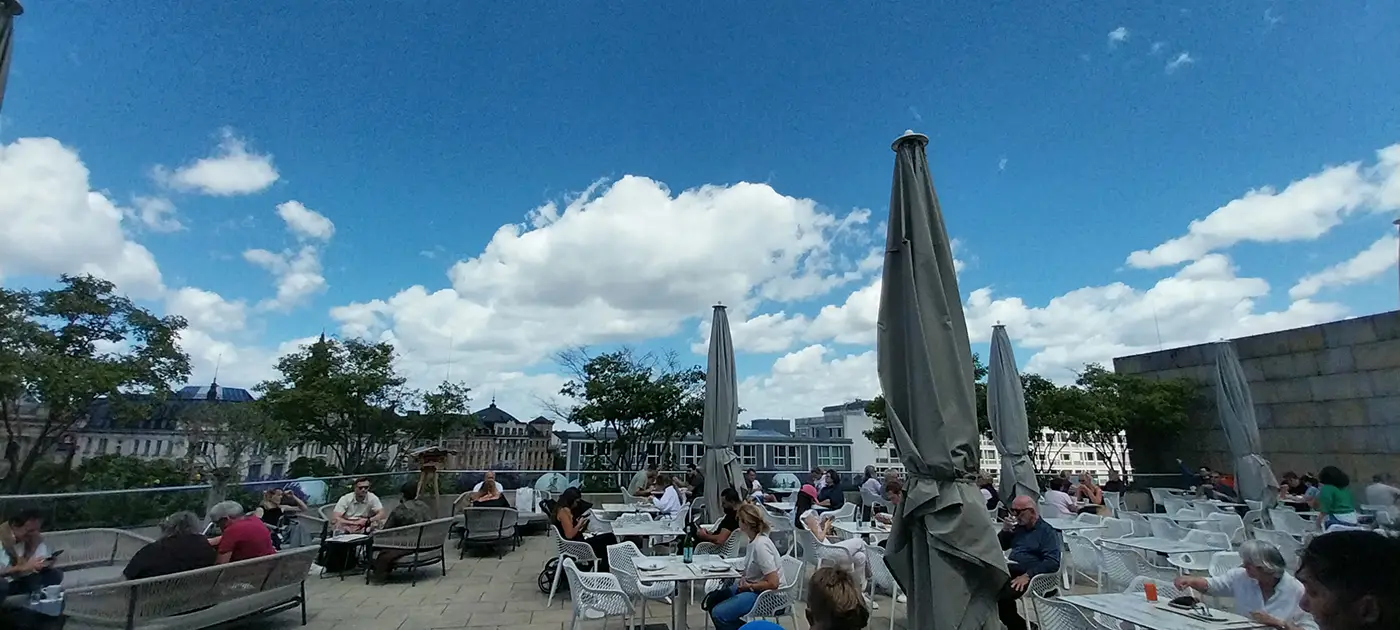
Rooftop terrace at Oberpollinger. A useful place to stop during a long city center shopping walk.
Start at Karlsplatz/Stachus, walk toward Oberpollinger, continue through the pedestrian street toward Marienplatz, use GALERIA, Ludwig Beck, or Dallmayr if they match your shopping goal, then continue to Fünf Höfe or Maximilianstrasse if the group still has energy.
08VAT refund: start at the store, finish at the airport
A VAT refund can save money on larger purchases, but it is not an automatic discount when you pay. The retailer has to support tax-free shopping, the purchase has to qualify, Customs has to confirm the export, and the refund operator or retailer then completes the refund.
Many retail purchases in Germany include 19% VAT. German Customs says travelers resident outside the EU can use tax-free shopping for eligible goods exported in their personal baggage when the value of the delivery including VAT is more than 50 €. In practical terms, that means at least 50.01 € on one qualifying invoice. The goods must also leave the EU within the permitted export period.
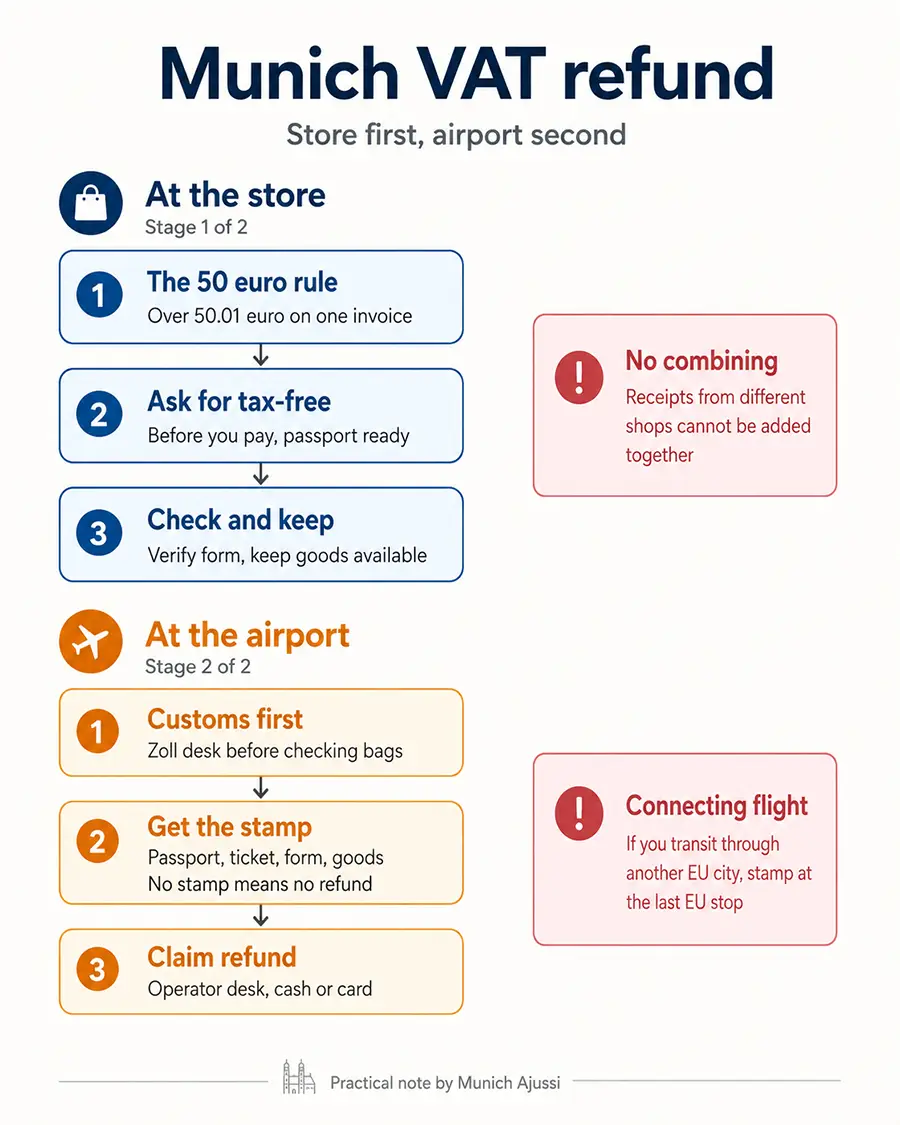
VAT refund works in two stages: first at the store, then at the airport.
The threshold is not your total shopping for the day. Several items can count together only when they are on the same qualifying invoice. That usually has to be arranged at the store when you pay.
For small purchases, the refund may not be worth the extra time. For a planned luxury bag, watch, jewelry, coat, or one larger department store purchase, it can matter. It makes more sense to use the refund on something you already planned to buy.
09At the store: make the refund possible
Ask before you pay. “Tax free, please” is enough in most shops that offer the service. Have your passport ready, because the form needs your traveler details.
This is where a large department store can be convenient. GALERIA at Marienplatz currently participates in Global Blue tax-free shopping, but do not assume purchases from different counters or floors will automatically be combined onto one qualifying invoice. Ask the cashier or customer service how the store is handling tax-free purchases before you split the payment. Its Marienplatz location also keeps the stop on the normal old-town route.
On my visit to GALERIA at Marienplatz, I also saw Global Blue tax-free machines inside the store. That is useful because part of the process can be started before you reach the airport. The exact digital or in-store steps can change, so follow the instructions attached to the Tax Free Form issued for your purchase.
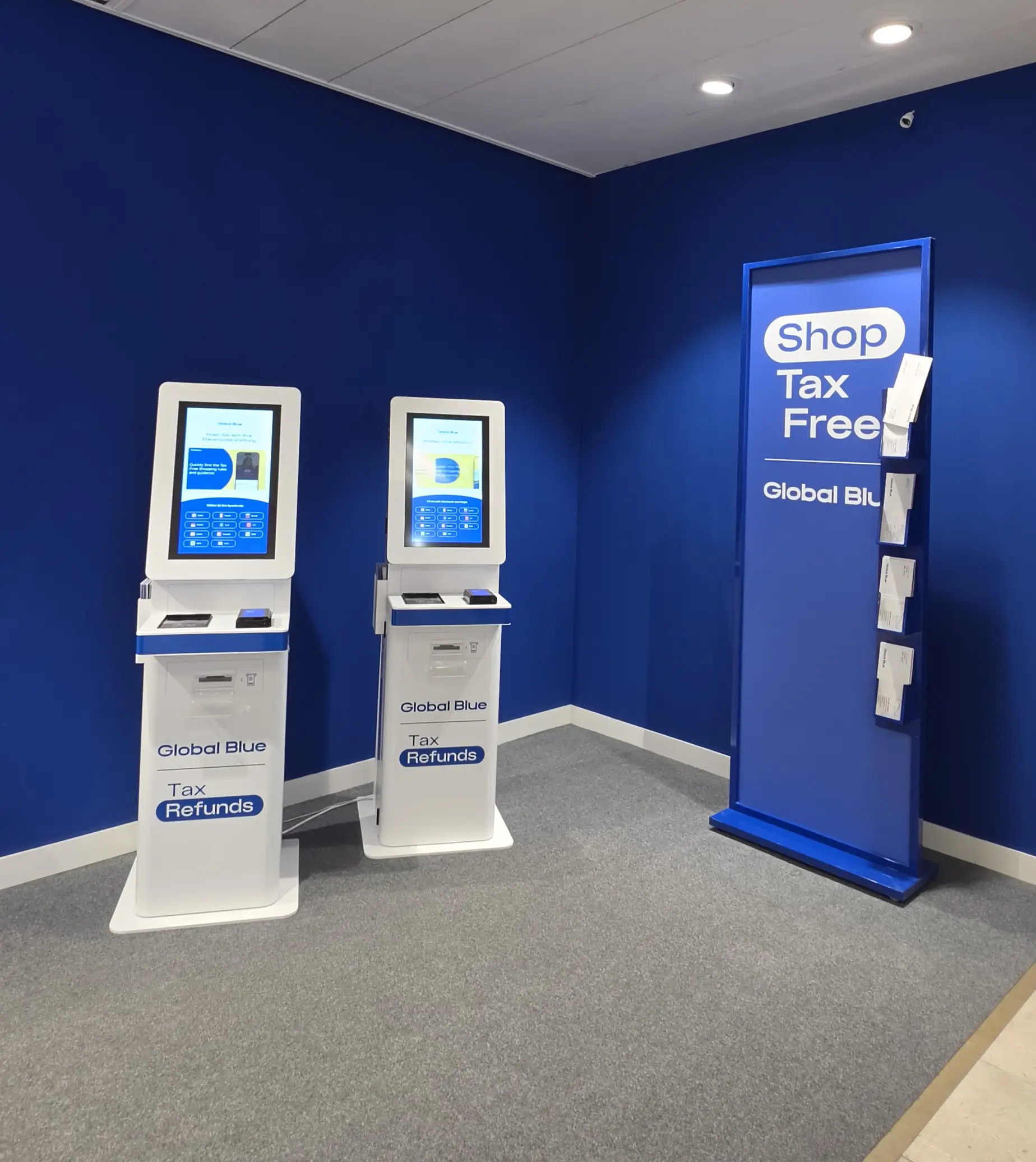
Global Blue tax free machines inside GALERIA. The store step matters before you reach the airport.
Some refund services can pay before you leave the EU. This does not replace Customs validation. Global Blue states that a Fast Refund still requires a Customs-approved Tax Free Form to be returned within the required period; without that validation, the refund can be reversed and the nominated card charged according to the service terms.
The store only prepares the tax-free paperwork. Ask before paying, make sure the invoice qualifies, and keep the goods unused and easy to reach. Customs validation at departure confirms that the goods are leaving the EU.
- Several items in one shop: put them on one invoice if you want them to count together.
- Two separate receipts, 30 € and 25 €: do not assume you can add them later.
- Different shops: do not add their receipts together. Each retailer and invoice has to qualify on its own unless the retailer has a specific tax free handling system.
- Department stores: ask the cashier or customer service how tax free paperwork is handled before you split purchases across counters or floors.
Before leaving the shop, check the form. Your name, passport details, store information, purchase amount, receipt, and refund method should be correct. A shop mistake is much harder to fix at the airport.
Keep the goods and original receipts easy to reach for Customs inspection. Tax-free operators also commonly require the goods to remain unused before export. Do not bury a high-value purchase somewhere you cannot produce when Customs asks to see it.
10At the airport: checked luggage and hand luggage follow different routes
Customs does not create your Tax Free Form. It confirms that the qualifying goods are being exported from the EU. Munich Airport says you should be ready to present the export documents, purchases, receipts, passport, and a ticket for the current date before taking the Customs confirmation to the refund provider.
German Customs says goods travelling in hold baggage should be presented at the first airport of departure before the bag is checked in. At Munich Airport, have the baggage tagged at the airline desk if required, then take the bag and goods to Customs before the suitcase disappears into the baggage system.
If you have an EU connection, German Customs says hand-luggage goods are normally validated at the last EU airport of departure. For example, on Munich → Frankfurt → Seoul, hand-luggage goods are normally presented in Frankfurt; on Munich → Amsterdam → New York, they are normally presented in Amsterdam.
Checked luggage and hand luggage do not always follow the same Customs route. Your exact process also depends on the airline, whether the bag is checked through, where you can still access the goods, and the refund operator’s instructions. Allow extra time and ask Customs or your airline if the itinerary is unusual.
11After customs: collect the refund
After customs validation, take the confirmed form to the refund provider used by the store, such as Global Blue or another tax free service. Some refunds go to a card, some may be paid at a counter, and service fees can reduce the amount. You should not expect the full 19% VAT back in your hand.
Service and currency-conversion fees can reduce the final refund, so do not expect to receive the full VAT amount.
For most visitors, a simple Munich shopping day works well: stay near the old town, choose one main shopping area, make one or two planned purchases, and take a break before the group gets tired.
If you use tax-free shopping, finish the store paperwork when you buy and plan the Customs step around the way the goods are packed. This is more important than trying to save a small extra amount at the airport.
More from Munich Ajussi
Store locations, opening hours, brand ranges, tax-free services, Customs procedures, and refund-company rules can change. Food-import rules also depend on your destination country. Check the relevant official information before making a special trip or relying on a VAT refund.