
Munich Things to Do
Munich Old Town Walk for First-Time Visitors
A practical first day route from Karlsplatz/Stachus to Marienplatz, Viktualienmarkt, Residenz, Hofgarten, and the edge of the English Garden.
If this is your first time in Munich, the old town is a good place to begin. The route below gives you a simple west-to-east walk through the center without turning the day into a long checklist.
Start at Karlsplatz/Stachus, walk through the pedestrian center to Frauenkirche and Marienplatz, stop at Viktualienmarkt, then continue toward the Residenz, Odeonsplatz, Hofgarten, and the southern edge of the English Garden if you still have energy.
The old town is compact, but normal travel time disappears quickly into cobblestones, crowds, church interiors, food stops, photos, toilets, weather, and tired legs. Treat the route as flexible rather than something you have to finish.
01Use the route at your own pace
The route works as either a short first walk or most of a day. Keep to exteriors and short stops for the shorter version; add one or two interiors, a tower, or a longer meal if you have more time.
Use the same route and decide where you want to spend more time.
02Adjust the first day to your trip
Your first-day plan depends on whether Munich is your arrival city, a short stop, a day-trip base, or the main destination.
Arriving after a long flight? Keep the first day light: hotel, food, a short old town walk, sleep. Passing through by train? Luggage storage comes before sightseeing. Using Munich as a base for day trips? Keep at least one city day separate from the long train days. Visiting for a major event or concert? Do not use the same day for a heavy museum, tower climb, long beer session, and late night return.
If you have a major event in the evening, shorten the walk rather than trying to finish every stop before the event.
03The route axis: west to east, then slightly north
This walk starts near Karlsplatz/Stachus, enters the old town from the west, crosses the central pedestrian streets, reaches Marienplatz, drops into Viktualienmarkt, then bends toward Residenz, Odeonsplatz, Hofgarten, and the edge of the English Garden.
That flow is easier than zigzagging between separate landmarks. Use the map for orientation, but take short detours for coffee, shade, toilets, or a quieter street when you need them.
Extended route: Viktualienmarkt → Residenz → Hofgarten → Eisbachwelle
04Start at Karlsplatz/Stachus
Karlsplatz/Stachus is a practical starting point for entering Munich’s old town. If you arrive by S-Bahn or U-Bahn, the station is well connected. If you start from Hauptbahnhof, you can walk here and then enter the pedestrian street toward the old town.
The square itself is not where you need to spend much time. It is a gateway. Take a quick look, orient yourself, and move into Neuhauser Straße and Kaufingerstraße, the broad pedestrian streets that lead toward the heart of the old town.
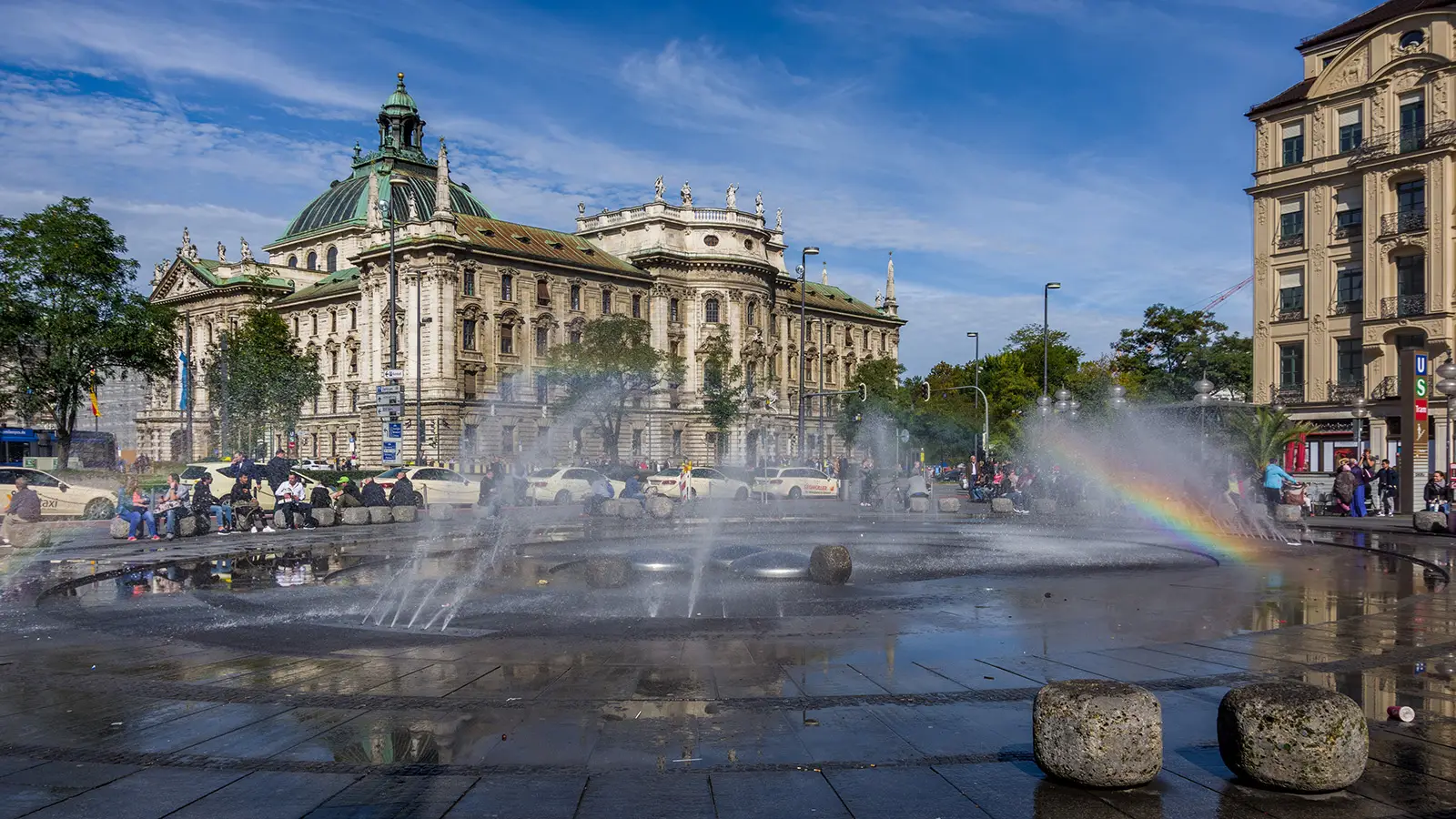
Karlsplatz/Stachus: a practical starting point for entering Munich’s old town. Walter Pohl / Pixabay.
05Frauenkirche: the visual compass
Frauenkirche is one of the easiest landmarks to use in Munich’s old town. Its twin towers appear above the rooftops and work as a useful visual reference while you walk toward the center.
If you are interested in churches, step inside briefly. If your schedule is tight, the exterior and the towers are enough for a first walk. Use the towers to orient yourself in the old town.
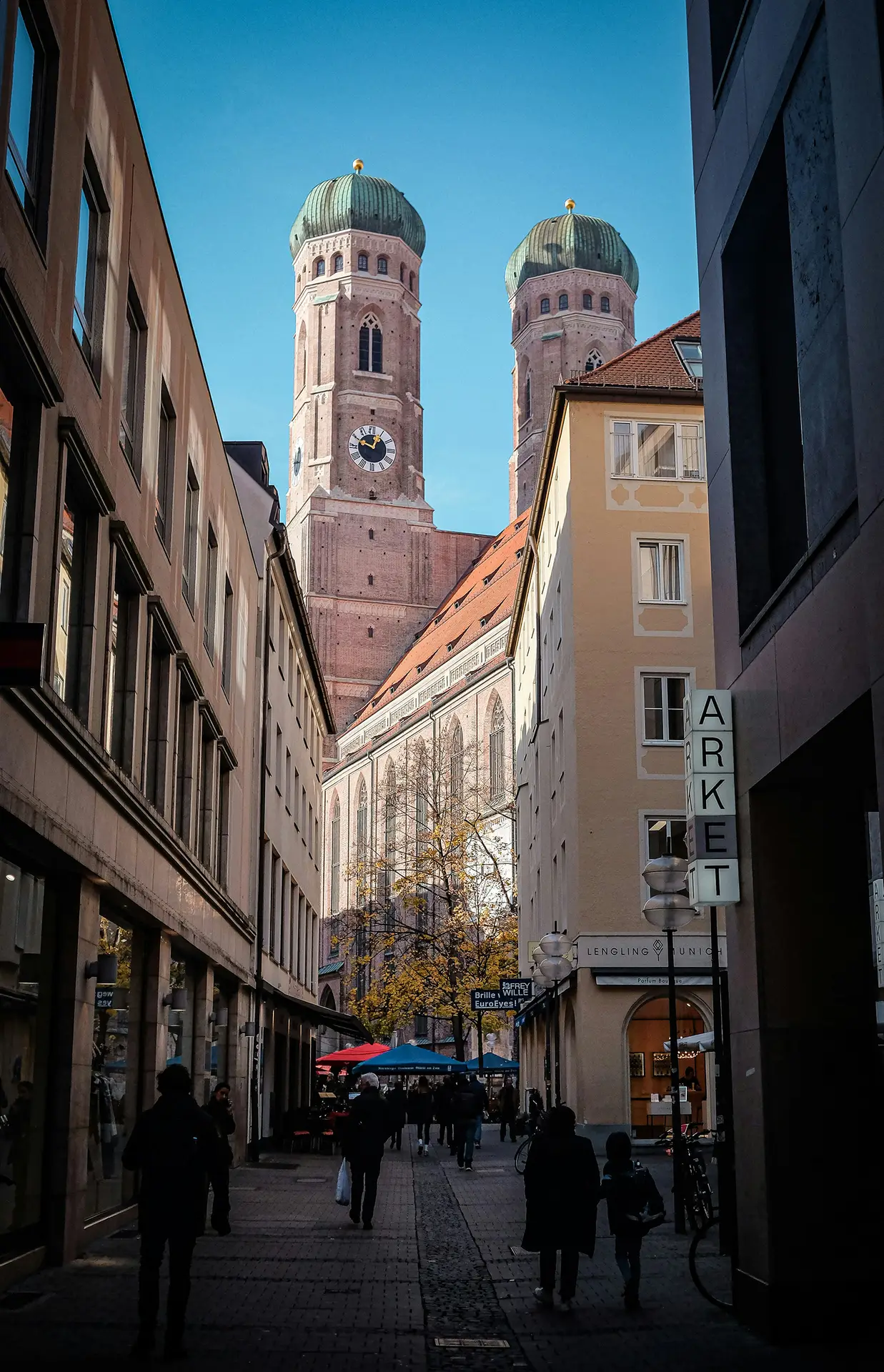
The twin towers of Frauenkirche work like a visual compass in Munich’s old town. Thomas Chizzali / Unsplash.
06Marienplatz: orient yourself, then continue
Marienplatz is the central reference point of Munich’s old town and one of the busiest places in the city. See the New Town Hall and the square, then continue when you are ready. You do not need to spend a long time there unless you are waiting for the Glockenspiel, visiting a tower, or taking a longer break.
Use Marienplatz to orient yourself. From here you can go toward St. Peter, Viktualienmarkt, Residenz, or the U-Bahn / S-Bahn if you need to leave.
If you want a view, St. Peter / Alter Peter gives a classic view over the old town but requires a long stair climb. The New Town Hall tower currently offers elevator access and is the easier physical option. Check current opening hours and ticket availability before planning the day around either tower.
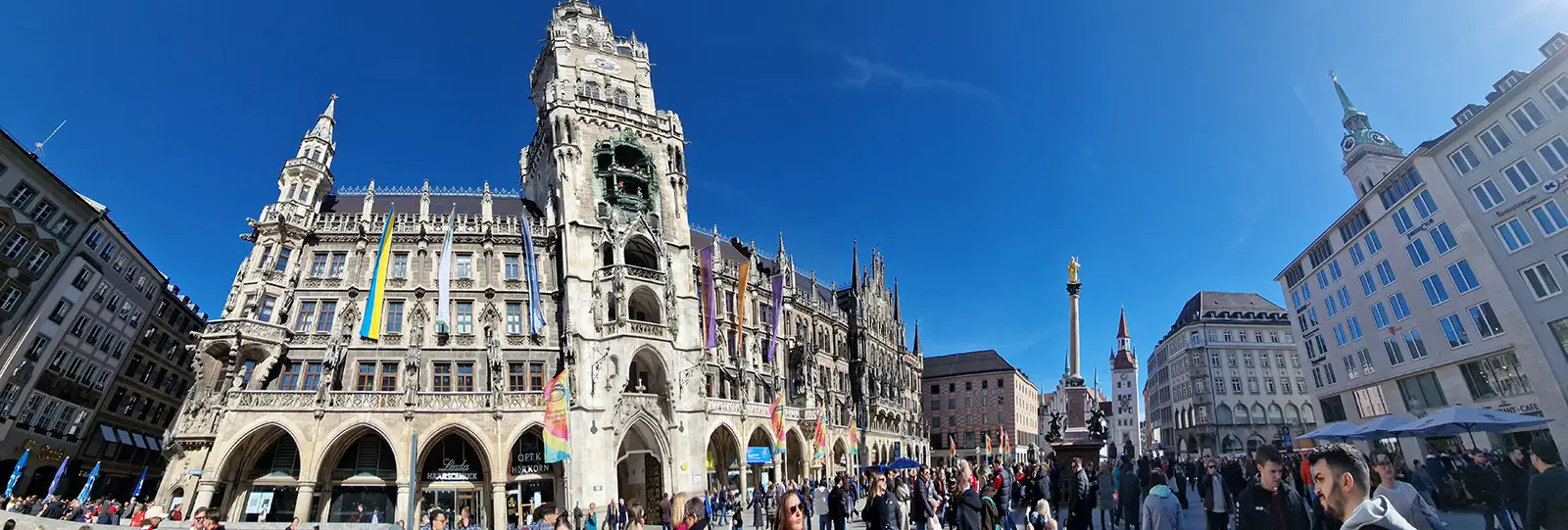
Marienplatz and the New Town Hall are the central reference point of the old town.
07Viktualienmarkt: food and a break
Viktualienmarkt is only a short walk from Marienplatz, but it changes the rhythm of the day. It is a useful place for food, a drink, and a break during the old town walk.
If you are doing a short walk, this may be where you eat something and decide whether to continue. On a longer day, it is a natural break before the second half of the route. A Leberkäse semmel, fish sandwich, fruit, pretzel, coffee, or another quick market snack can be enough.
I occasionally end up doing exactly that here myself: a beer or a sausage, just watching the mix of tourists and locals pass by. It is also a good place to decide whether to keep walking or slow the rest of the day down.
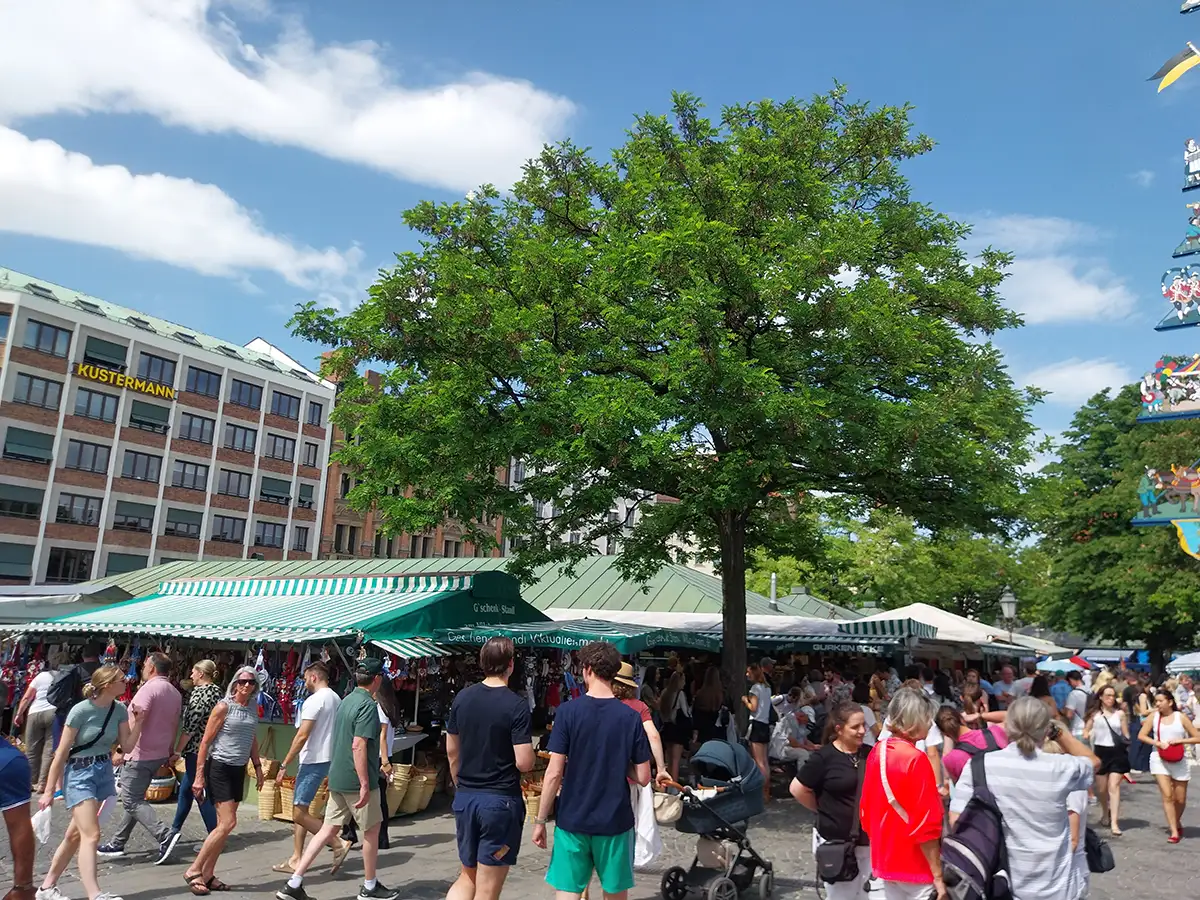
Viktualienmarkt on a sunny afternoon. This is where the old town walk naturally turns into a food break.
08After the market: Hofbräuhaus, Maximilianstraße, Nationaltheater, Residenz
From Viktualienmarkt, continue toward Hofbräuhaus and Platzl, then past Maximilianstraße and Nationaltheater toward the Residenz. This part of the route shifts from the market area into Munich’s royal quarter.
Hofbräuhaus is famous and touristy. Both can be true. You do not have to drink a liter of beer to make it worthwhile. If you are short on time, even a quick look inside gives you a sense of the noise, long tables, music, and beer hall atmosphere. If this is also your first meal in a traditional Munich restaurant or beer hall, Munich Restaurant Etiquette explains seating, water, tipping, cash, card payment, and how to ask for the bill.
Residenz is large. If you enter properly, it becomes a major indoor visit. For a first old town walk, the exterior, courtyards, and surrounding squares may be enough unless you specifically want a palace museum.
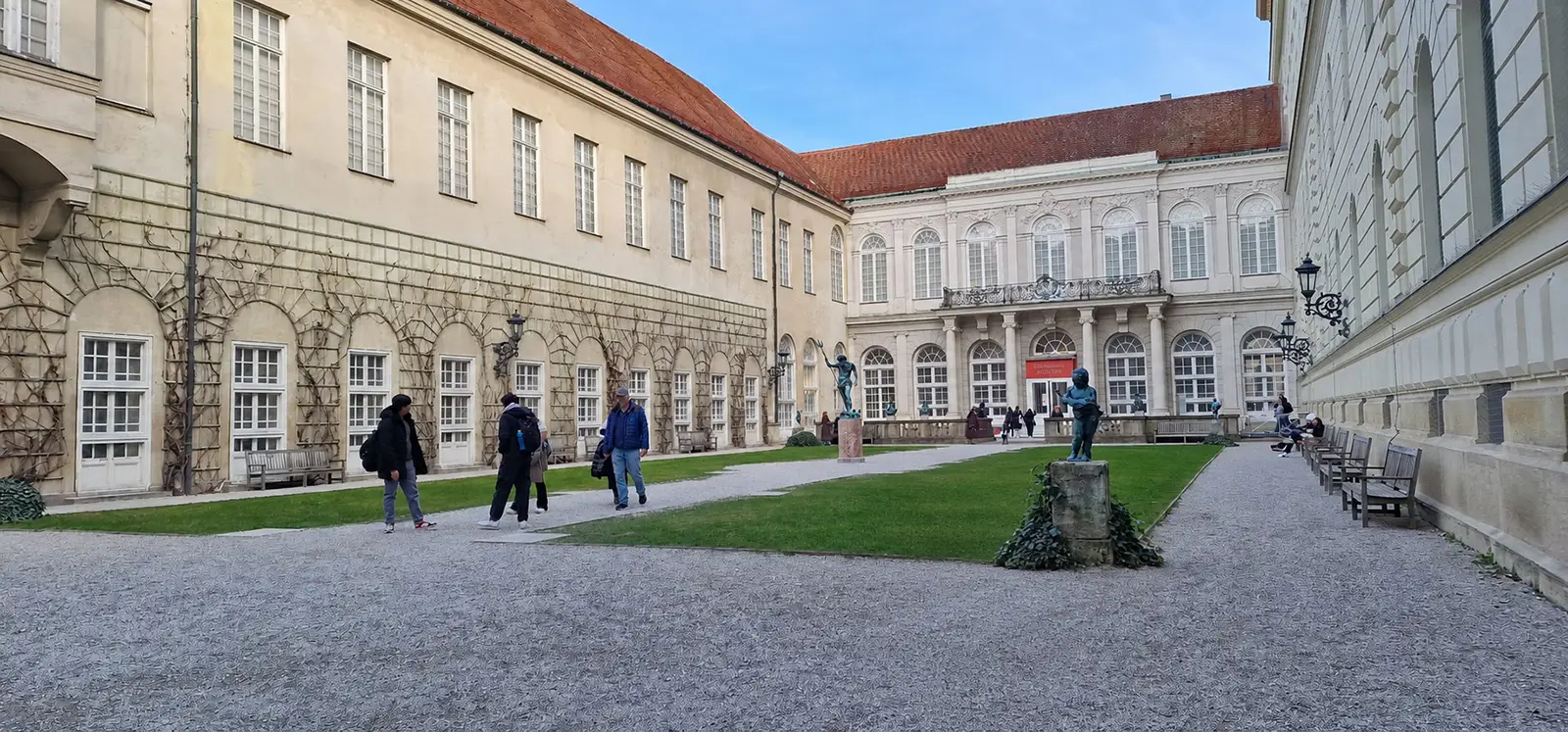
Residenz courtyard garden, where the old town begins to shift toward the royal quarter.
09Odeonsplatz, Theatinerkirche, and Hofgarten
From the Residenz area, the route naturally reaches Odeonsplatz and Theatinerkirche, the yellow baroque church beside the square. Even if you do not go inside, it works as a visual marker: you are leaving the tighter old town streets and entering a more open area of squares and gardens.
Hofgarten is one of the easiest places to rest near the old town. After the market, beer hall streets, palace area, and crowds, this garden gives the day a calmer rhythm. Sit for a few minutes if you need to. A short break here can make the second half of the walk much easier.
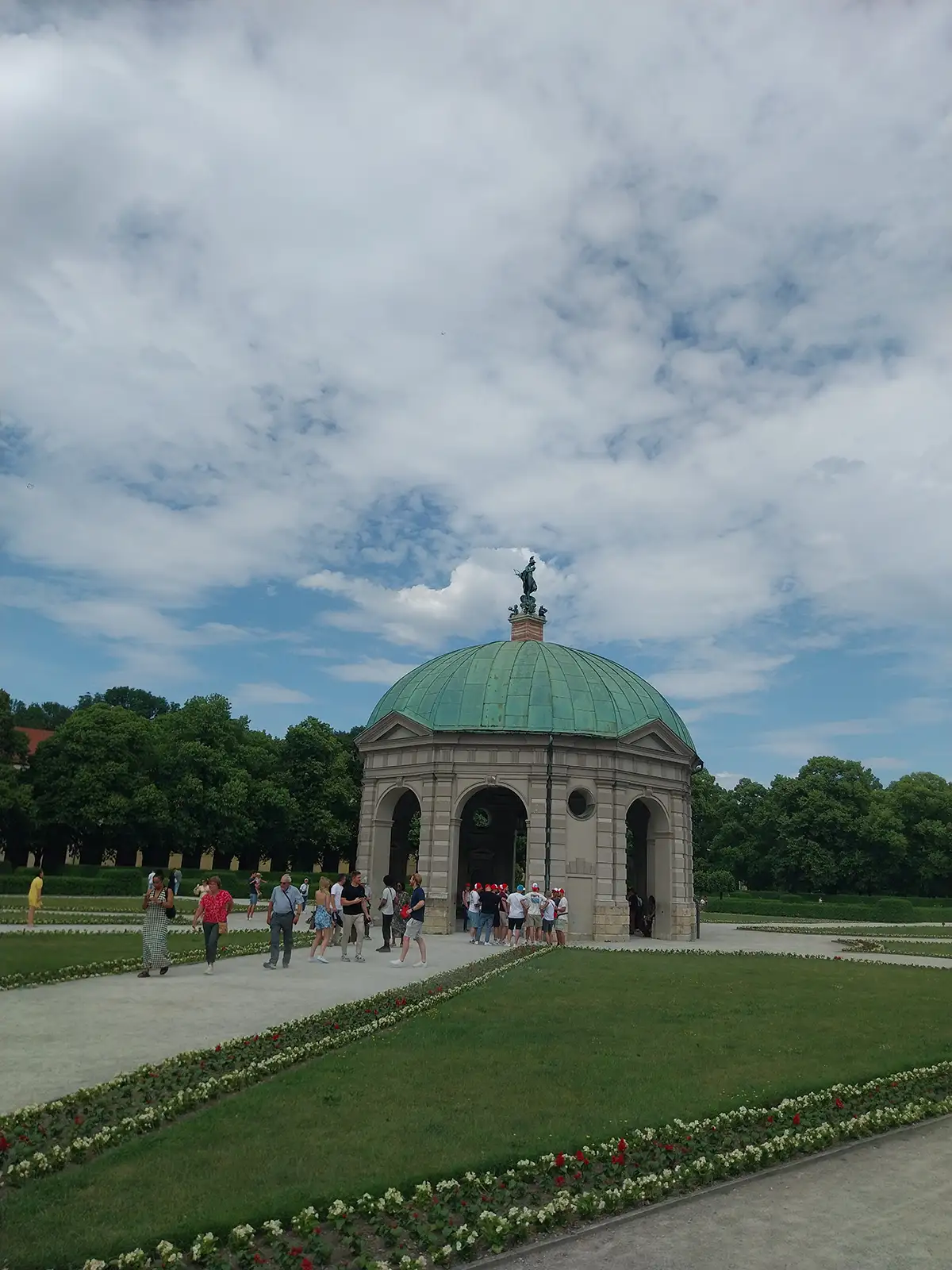
Hofgarten and the Dianatempel. A quiet pause before the route continues toward the English Garden.
10The English Garden: Eisbach, surfers, and summer park life
The English Garden is huge. For this first-day route, continue from Hofgarten toward the Eisbachwelle and the southern edge of the park rather than trying to cover the whole garden.
The Eisbachwelle is again an active surf spot. After a temporary closure, the City of Munich officially reopened the wave for surfing on May 8, 2026. On a normal day you can once again see experienced surfers taking turns on the standing wave while people watch from the bridge and riverbank.

Surfers at the Eisbachwelle. Surfing was officially reopened by the City of Munich on May 8, 2026.
On warm days, you may also see people farther downstream getting into the Eisbach and letting the current carry them through part of the park. I saw plenty of people doing exactly that during my visits in June and again in August.
Just before BTS’s Munich concerts in July 2026, videos of BTS members playing in the Eisbach spread widely among fans. For a short time, a very local Munich summer habit suddenly became part of the wider BTS conversation around the city.
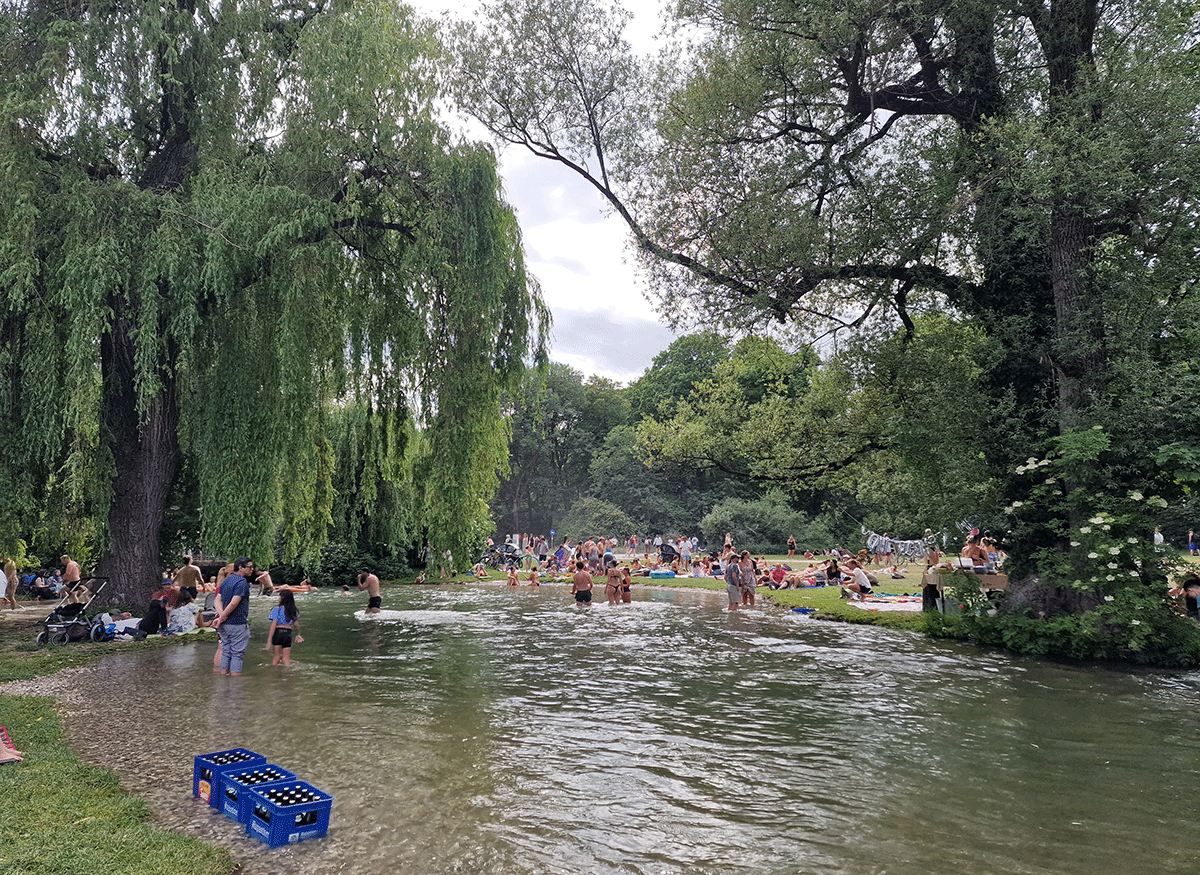
A warm day in the English Garden. The southern part is often busy with surfers, cyclists, students, and groups relaxing on the grass.
That mix is part of what surprises first-time visitors. Around the southern English Garden you may see surfers, cyclists, students, people playing games, groups of friends on the grass, and occasional nude sunbathing in designated areas.
11How to shorten or stretch the same walk
The same route can be short or long. If you only have a few hours, keep it focused on exteriors: Karlsplatz/Stachus, Frauenkirche, Marienplatz, St. Peter exterior, and Viktualienmarkt. Eat or drink something small, then stop.
If you have most of a day, add one deeper choice: St. Peter tower, Residenz interior, a longer market meal, Hofgarten, or the edge of the English Garden.
If you travel with children or older parents, decide rest points first. Viktualienmarkt and Hofgarten break the route naturally. If you want a beer hall or bar in the evening, keep the daytime walk lighter.
12Things outside the old town are separate choices
BMW Welt, BMW Museum, Allianz Arena, Alte Pinakothek, Deutsches Museum, opera, shopping, and a longer beer-hall visit all need extra time. Treat them as separate half-day or evening choices rather than adding them to this walk.
BMW and Olympiapark work well together. Museums need their own time. Allianz Arena is a destination, not a casual old town extra stop. Opera is an evening plan. Beer halls work better as the end of the day, not as another stop in the middle of the walk.
13If you stay more than one night, use Munich as a base
Separate arrival day from real sightseeing day. Arrival day: get to your accommodation, eat, take a short walk, sleep. City day: use the old town route properly. Day trip day: choose one direction only.
Füssen and Neuschwanstein, Salzburg, Garmisch-Partenkirchen and Zugspitze, Chiemsee, and Starnberger See can all be good day trips. But each one takes time, weather awareness, ticket planning, and energy. Do not treat a day trip as a morning extra stop before an afternoon old town checklist.
14Small moments that can trip you up
If you are in Munich only for half a day, solve luggage storage before starting the walk. Hauptbahnhof, Ostbahnhof, and Munich Airport have different storage options, and availability can change. See Luggage Storage in Munich for current locker locations, reservable options, airport storage, and the places that are easy to misunderstand.
On Sundays, most regular shops and supermarkets are closed. Station shops and a few legal exceptions may still help, but do not plan normal shopping for Sunday evening. See Sunday in Munich: What’s Open and What’s Closed if this walk falls on a Sunday.
Public toilets are not always free or easy to find. Use the toilet before leaving a museum, café, restaurant, or department store.
Small cash is still useful for toilets, small bakeries, market stands, and traditional beer garden situations.
Bike lanes matter. Munich has many cyclists. Do not stand in marked bike lanes while taking photos.
Late dinner can be tricky. A restaurant may still be open while the kitchen is already closing. If you arrive late, ask whether food is still available before sitting down.
15Choose how far to continue
Use your available time and energy to choose how far to continue.
| Situation | Suggested choice |
|---|---|
| Half day | Karlsplatz/Stachus → Frauenkirche → Marienplatz → Viktualienmarkt |
| Full day | Add Residenz area, Hofgarten, or English Garden edge |
| With parents or children | Plan rest points first: Viktualienmarkt and Hofgarten |
| Hot day | Avoid too many interiors and tower climbs; carry water |
| Rainy day | Shorten the walk and add one indoor place |
| Beer evening planned | Keep the daytime route lighter |
| Transit / layover | Solve luggage storage before sightseeing |
| More than one night | One city day, one day-trip direction, one flexible buffer |
For a first visit, the basic route is enough: Karlsplatz/Stachus → Frauenkirche → Marienplatz → Viktualienmarkt. Continue toward Residenz, Odeonsplatz, Hofgarten, and the English Garden only if the day still feels comfortable.
You can always come back for the tower, palace interior, museum, beer hall, or a longer English Garden walk. Leave some energy for the evening, especially on your first day.
Continue from the Old Town
Opening hours, tickets, market operations, transport routes, and access conditions can change. Check current official information when a detail matters.