
Munich Things to Do
Munich Beer Garden Rules and Culture: Food, Shared Tables, and What to Order
How traditional beer gardens work, where outside food is allowed, why tables are shared, what Pfand means, and how Munich beer culture fits together.
Shared tables and food brought from home are still normal in the traditional self-service section of a Munich beer garden.
Families unpack Brotzeit, strangers share long tables, and drinks come from the beer garden. The custom grew out of rules that shaped Munich beer-cellar life more than two centuries ago.
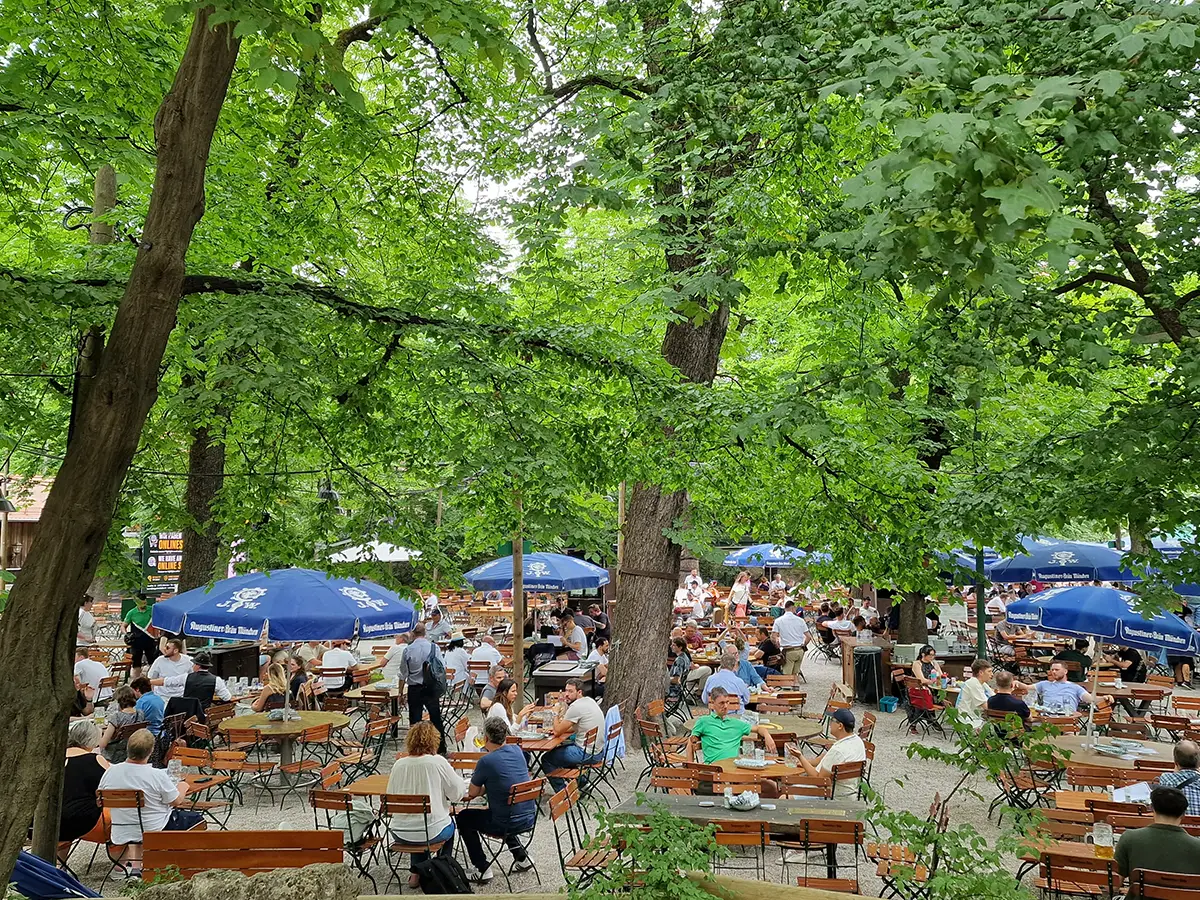
At Augustiner-Keller, communal tables and food from home are part of an ordinary Munich afternoon.
These customs do not begin with Oktoberfest. The festival gathers the same shared tables, local breweries, heavy food and music, but the rules are different: tent service is organized around the table, and bringing your own food is not part of the experience. The rule behind Munich’s bring your own food tradition was formalized in 1812, when brewers were allowed to sell beer above their storage cellars but only limited food, so guests brought the rest themselves.
01How Munich’s beer gardens began
By the mid-16th century, brewing during the warm months was restricted in Bavaria. A 1553 state ordinance formalized the summer brewing ban, building on earlier rules in Munich. Brewers therefore had to make enough beer during the cooler months and store it in deep cellars for summer. Chestnut trees were planted above many cellars for shade, and people began coming to drink beer at these storage sites.
The conflict came when brewers also started selling food, which competed with licensed innkeepers. In 1812, King Maximilian I allowed brewers to continue selling their own Märzen beer at the cellars, but they could offer only bread, not prepared food.
With prepared food unavailable from the brewers, bringing food from home became the practical solution. Over time, food stalls and full kitchens appeared, so today most large self service beer gardens sell roast chicken, sausages, grilled fish and other meals. But the older custom never disappeared. In the traditional self service section, guests may still bring their own food, while all drinks must be bought from the beer garden.
Many people still mix both options today: food brought from home beside something bought from the beer-garden grill or food counter.
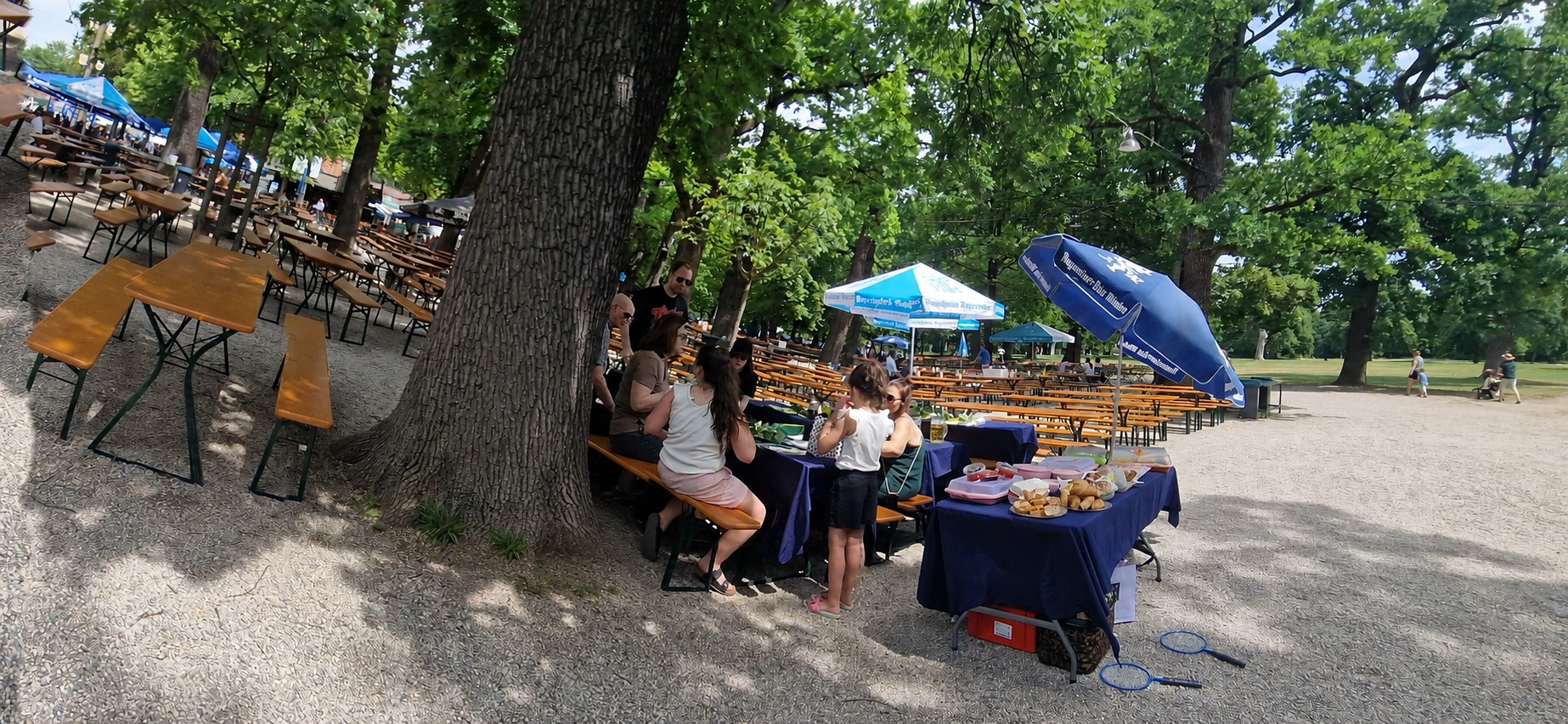
At Hirschgarten, a tablecloth and food from home sit beside beer bought from the garden.
02How the tradition works today
Many large beer gardens divide the same venue into a traditional self service area and a served terrace. At the counter, you carry your own tray and return the empty glass for the Pfand deposit. In the served section, a waiter takes the order and outside food is not allowed.
The border is usually easy to spot. Trays moving between tables mean self service; tablecloths and waitstaff mark the served section.
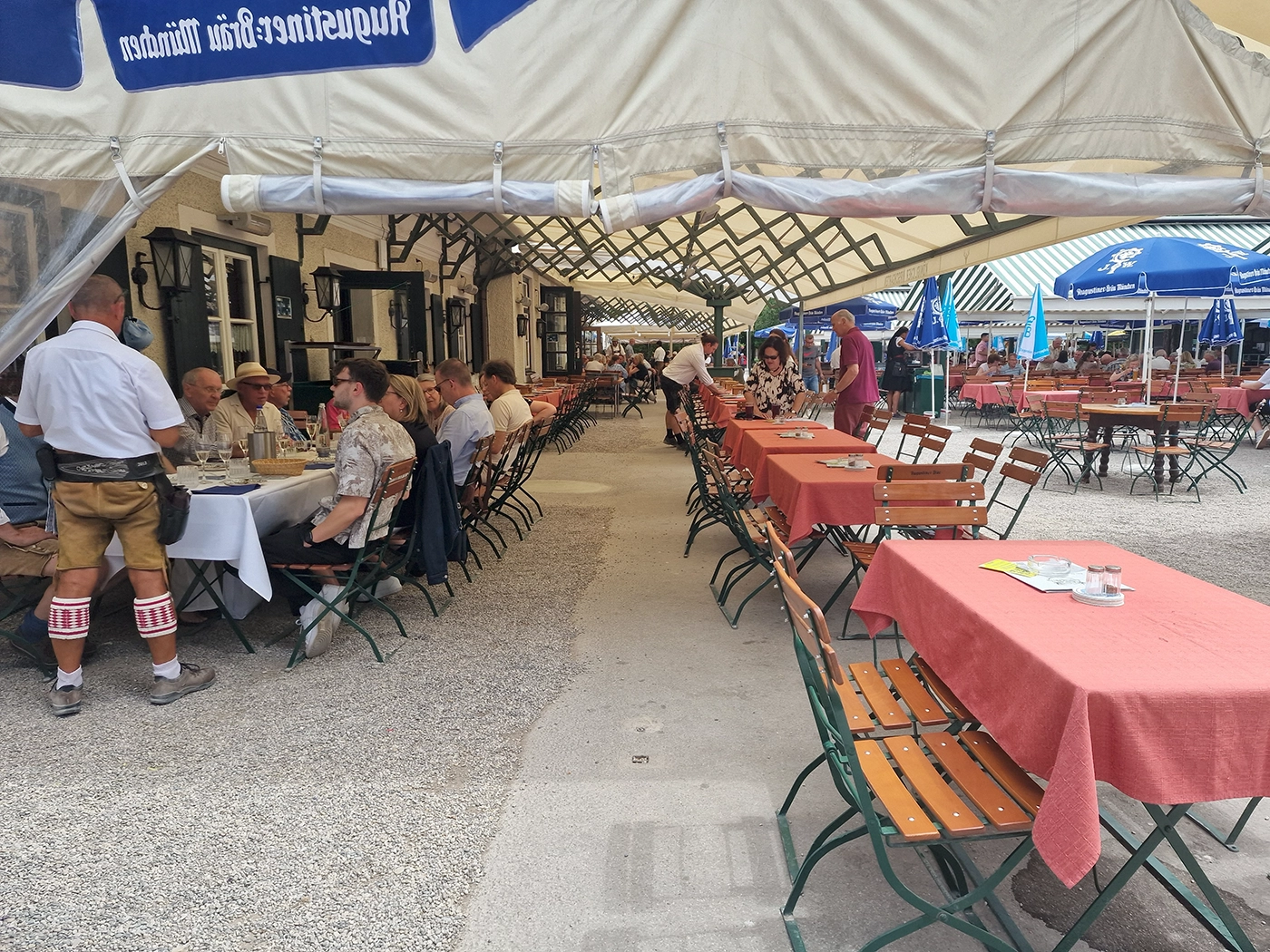
Hirschgarten’s served terrace sits beside the long self service benches, but follows normal restaurant rules.
Finding a seat: Empty places at communal tables are usually shared. Ask, “Ist hier noch frei?” and wait for an answer before sitting down.
At the table: Use the space you need. Do not block an empty bench with bags when the garden is busy.
Bringing food: Only in the traditional self service area. A restaurant terrace labeled Biergarten may still follow normal table service rules. Drinks must be bought from the beer garden.
Pfand: A deposit may be added to the glass or mug. Return it at the designated counter and keep any token or receipt you receive.
Payment: Card acceptance can differ between the drinks counter, food counter and served section. Some cash remains useful.
In a served section: Ask for the bill with “Zahlen, bitte.” When tipping, state the final total rather than leaving money silently on the table.
Beer hall / served section: order from the server and normally pay at the table. “Zahlen, bitte” asks for the bill. “Stimmt so” means the change can be kept as the tip.
Self-service beer garden: order and pay at the counter. Return the glass or Maßkrug to the designated Pfand point if a deposit was charged.
Cash: card acceptance has improved, but a small cash backup is still useful because drinks, food and served areas can use different payment systems.
For the wider German habits around tipping, water and card payment, see Munich Restaurant Etiquette.
A small Hirschgarten ritual
At Hirschgarten, the ritual starts before you even get your beer. Grab an empty Maßkrug from the rack, rinse it yourself under cold water, and carry the dripping mug to the counter.
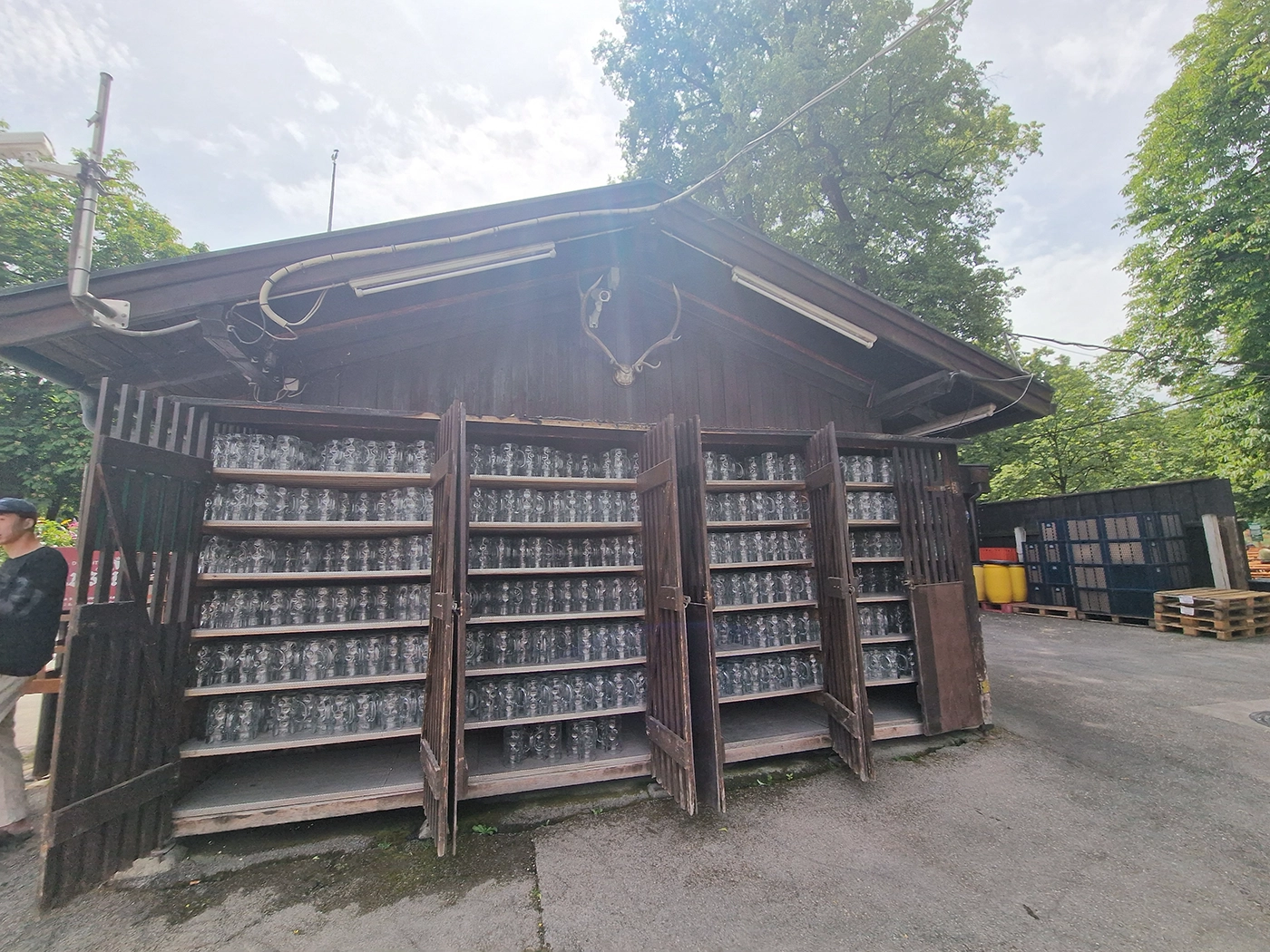
At Hirschgarten, the self-service routine starts by taking an empty Maßkrug, rinsing it, and bringing it to the beer counter.
03One culture, three rooms
Beer halls, beer gardens and Oktoberfest tents share communal tables and familiar brewery names, but they do not operate by the same rules.
Beer hall
A historic hall or Wirtshaus with table service. Communal seating is common, but reservation rules depend on the room.
Beer garden
Seasonal and weather dependent. One address may contain both a traditional self service section and a served terrace.
Oktoberfest tent
A temporary festival structure with table service. Reserved and unreserved areas exist, but a walk-in entry does not guarantee a seat.
Hofbräuhaus shows this well. The ground floor and courtyard use unreserved communal tables, although drinks and food are served at the table. Some rooms upstairs need a reservation.
A traditional beer garden usually works as a spontaneous stop, while an Oktoberfest tent may require more planning, especially on busy evenings.
04The six Munich breweries you keep seeing
The same brewery names appear across beer gardens, beer halls, restaurants, and Oktoberfest tents.
Visitors quickly notice the same names: Augustiner, Paulaner, Hofbräu, Hacker-Pschorr, Löwenbräu, and Spaten. The official Oktoberfest also uses these six Munich breweries.
The six official Oktoberfest breweries are Augustiner, Hacker-Pschorr, Hofbräu, Löwenbräu, Paulaner and Spaten. They are the established traditional Munich breweries permitted to serve at the Wiesn, and the beer must comply with the applicable Munich and German purity rules.
Why the same brewery name appears at different venues
Many Munich beer halls, Wirtshaus restaurants and beer gardens have long-term supply relationships with a particular brewery. That is why the same names appear repeatedly across the city: Augustiner here, Paulaner there, Hofbräu somewhere else.
The brewery name usually tells you who supplies the beer, not who operates the whole venue. The same beer brand can therefore appear in places with very different kitchens, service styles, crowds and atmospheres. A flagship brewery venue and an independent Wirtshaus pouring the same beer are not automatically the same experience.
Viktualienmarkt is the useful exception to the one-brewery pattern: its traditional beer garden rotates through Munich’s six Oktoberfest breweries instead of belonging permanently to one of them.
Independent Munich identity
Wooden-barrel service and local attachment make Augustiner the brewery many visitors hear about from Munich residents first. Useful city reference: Augustiner-Keller.
Royal and state-owned history
The best-known international name, with Hofbräuhaus connecting royal history, tavern music and modern visitor culture. Useful city reference: Hofbräuhaus am Platzl.
Old Munich brewing family
A historic Munich name that now appears across Wirtshaus and beer-garden settings rather than one single flagship experience. Useful city reference: Der Pschorr beside Viktualienmarkt.
Traditional Munich brewery
A major historic Munich name with a strong Oktoberfest identity and a visible brewery presence around Stiglmaierplatz. Useful city reference: Löwenbräukeller.
Salvator and Starkbierzeit
Paulaner’s strongest cultural reference is the spring strong-beer tradition at Nockherberg. Useful city reference: Paulaner am Nockherberg.
Helles history
Spaten is closely tied to the development of Munich’s pale Helles style in the 1890s. Useful city reference: Spatenhaus an der Oper.
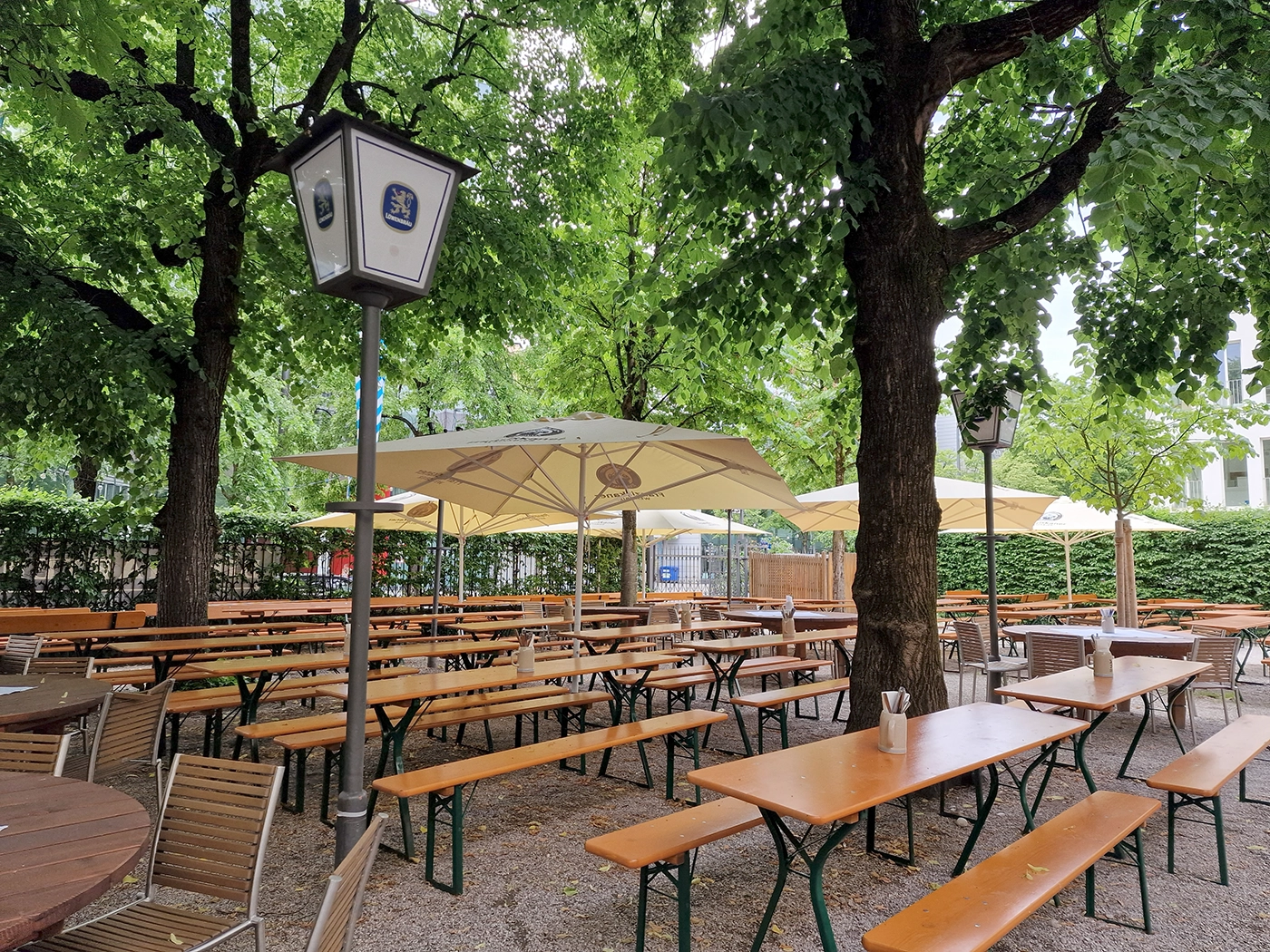
Löwenbräukeller is one example of how a brewery name connects to a specific hall and beer garden in Munich.
Augustiner and local attachment
Augustiner stands out for more than taste. In 1996, a private foundation became its majority owner, which helped keep the brewery independent while several bigger rivals got folded into larger groups.
That ownership structure helps explain the strong local attachment to Augustiner, along with its familiar bottles and wooden-barrel service at traditional venues.
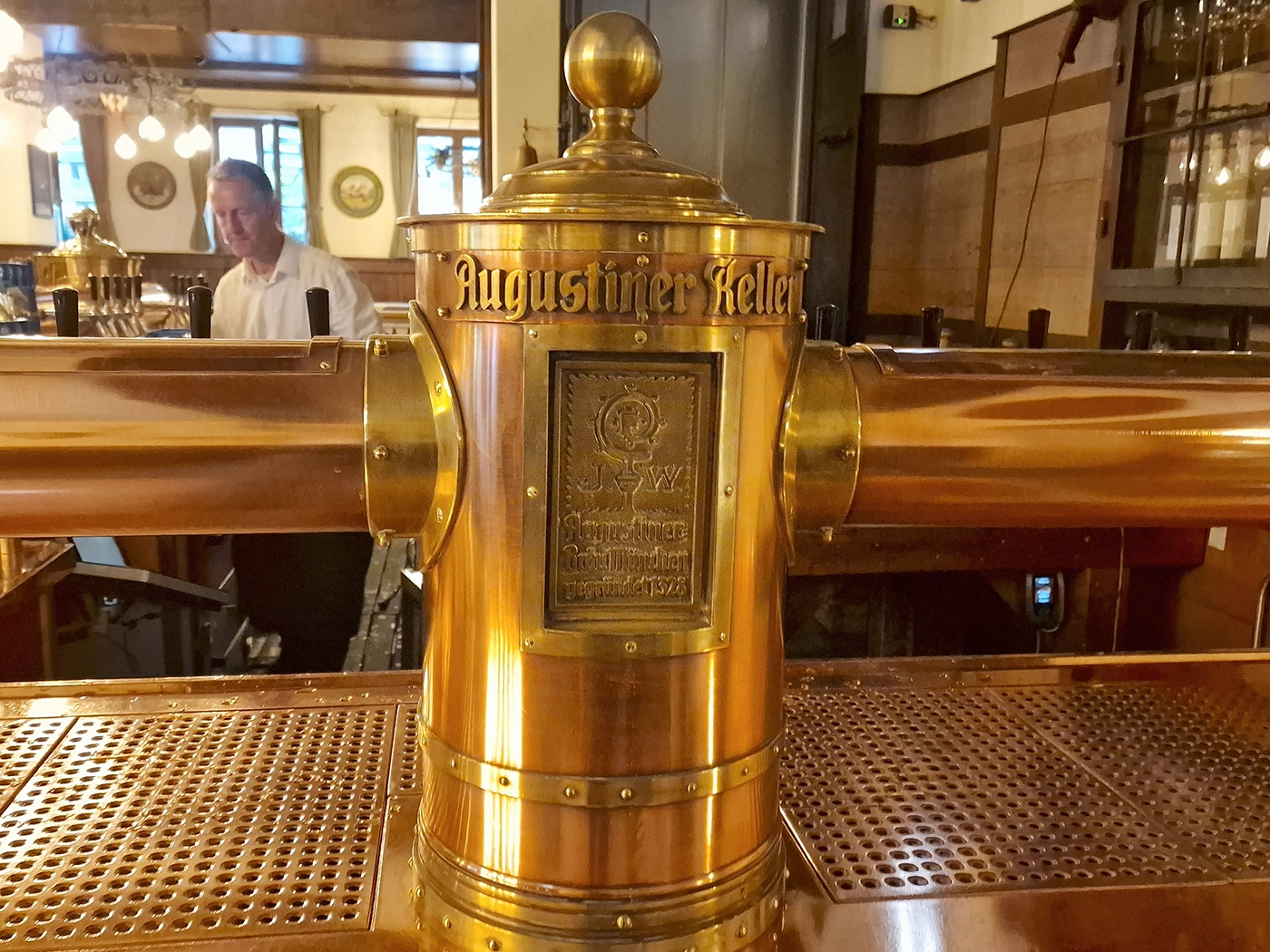
At Augustiner-Keller, even the tap has history. A bell rings every time a fresh wooden barrel gets tapped in the self service garden.
Spaten and Munich’s first Helles
In 1894, Spaten brewed Munich’s first Helles. Until then, the city’s everyday beer was mainly dark, malt driven Dunkel. Spaten developed a pale lager for the northern German market, where lighter beers were already popular, while keeping it softer and less bitter than a Pilsner.
The beer reached Munich the following year. It did not replace Dunkel overnight, but it gradually became the city’s everyday standard. Helles now feels inseparable from Munich, even though the style itself is only a little over a century old.
The group’s wheat beer appears under a different name. Spaten and Franziskaner-Leist-Bräu joined in 1922, and Franziskaner remains the group’s Weissbier label.
05Important breweries outside the Oktoberfest six
Schneider, Giesinger, and Erdinger help explain why “Munich brewery” and “Oktoberfest brewery” are not the same thing.
The protected name Münchener Bier concerns where and how a beer is brewed. It answers whether a beer is Münchener Bier, not whether its brewery belongs at the Wiesn.
Schneider Weisse: Munich roots, brewed in Kelheim
Schneider Weisse was founded in Munich in 1872, when Georg Schneider helped preserve a wheat beer tradition that had nearly disappeared. Its historic Wirtshaus still stands in Tal, close to where the brewery began.
In 1945, brewing moved from Munich to Kelheim. That move matters for Oktoberfest: beer served in the tents must come from established traditional Munich breweries. Schneider still has deep Munich roots, but because its beer is now brewed in Kelheim, it is not counted among today’s six Oktoberfest breweries.
Giesinger Bräu: how a new brewery qualified as Münchener Bier
Munich’s established breweries already draw brewing water from deep wells within the city. Giesinger, founded only in 2006, did not initially have that infrastructure.
By drilling its own deep well, Giesinger gained access to Munich groundwater and met a key condition for using the protected name Münchener Bier. That made it a genuine Munich brewery in geographic and production terms. It did not add Giesinger to the Wiesn lineup, which is not an open qualification based only on location or water.
Tegernseer: not a Munich brewery, but very visible in the city
Tegernseer comes from the Herzogliches Brauhaus Tegernsee on the lake south of Munich. It is not a Munich brewery and therefore does not belong to the Oktoberfest six, but Tegernseer Hell is easy to find in Munich and has become part of the wider beer landscape many residents know.
Chiemgau: a region of smaller breweries rather than one brand
Chiemgau is not one brewery. It is a region southeast of Munich with a dense network of smaller private breweries. It matters here because Munich beer culture does not stop at the city boundary; weekend trips toward Chiemsee and the foothills quickly open into a much broader Bavarian brewing landscape.
Andechs: monastery beer and a destination of its own
Kloster Andechs belongs in another category again. The Benedictine monastery above the Ammersee has a long brewing tradition and works less like a Munich city beer stop than a half-day outing with a walk, monastery, meal and strong beer at the end.
Its Doppelbock Dunkel belongs naturally in the same strong-beer conversation as Paulaner Salvator, Augustiner Maximator and Löwenbräu Triumphator. The Where to Go guide keeps the practical route from Munich because the journey is part of the experience.
Erdinger: a huge name, from a different town
Erdinger is a major international Weissbier brand brewed in Erding, about 30 kilometers northeast of Munich. Because production is outside the city, it is not part of the current Oktoberfest brewery lineup.
The six Oktoberfest breweries are a historical Munich group, not a ranking of the city’s best beer.
06What to order
You do not need to learn the history before ordering. A few basic styles are enough for a first visit.
Lager: bottom fermenting yeast works at cooler temperatures and the beer is conditioned cold. Helles, Dunkel, Pils and Märzen are all lagers.
Ale: top fermenting yeast works at warmer temperatures and often creates fruity or spicy fermentation character. Bavarian Weißbier belongs to this family, although people in Munich almost never call it an ale.
The difference is the yeast and fermentation method, not a quality ranking.
Start with Helles
Helles is the easiest place to start: pale, clean, softly malty and noticeably less bitter than a Pils.
A Halbe is half a liter and a Maß is a full liter. If you order a Maß, remember that it contains twice as much beer as a Halbe and plan your next train, walk or meal accordingly.
Do not plan to drive after a Maß. Use public transport, walk, take a taxi, or make the beer stop the end of the day.
Weißbier is a different branch
Weißbier is wheat beer, poured into a tall curved glass, usually fruitier and fuller than Helles. Banana and clove notes are common.
A plain Weißbier order will usually mean the standard pale Hefeweizen. Ask separately for dunkel or alcohol free.
Dunkel, Radler and alcohol free choices
Dunkel is darker and maltier, not automatically stronger. Radler is beer cut with lemon soda, useful on a hot day or after a long bike ride.
The story goes that an innkeeper named Franz Xaver Kugler invented it in the 1920s for a crowd of thirsty cyclists his beer supply could not handle alone. The story is difficult to prove, but it has survived almost as well as the drink itself. In a Munich beer garden, a Radler is not treated as a lesser order.
Alcohol-free Helles, Weißbier, Apfelschorle, Spezi and ordinary soft drinks are all normal beer-garden orders. You do not have to drink alcohol to join the table.
Food should match the place
Brezn with Obatzda, the soft Bavarian cheese spread, is the obvious starting point. A cold Brotzeit works well when you plan to stay for a while.
- Hendl: roast chicken.
- Wurstsalat: a cold sausage salad.
- Steckerlfisch: usually mackerel grilled on a stick over charcoal.
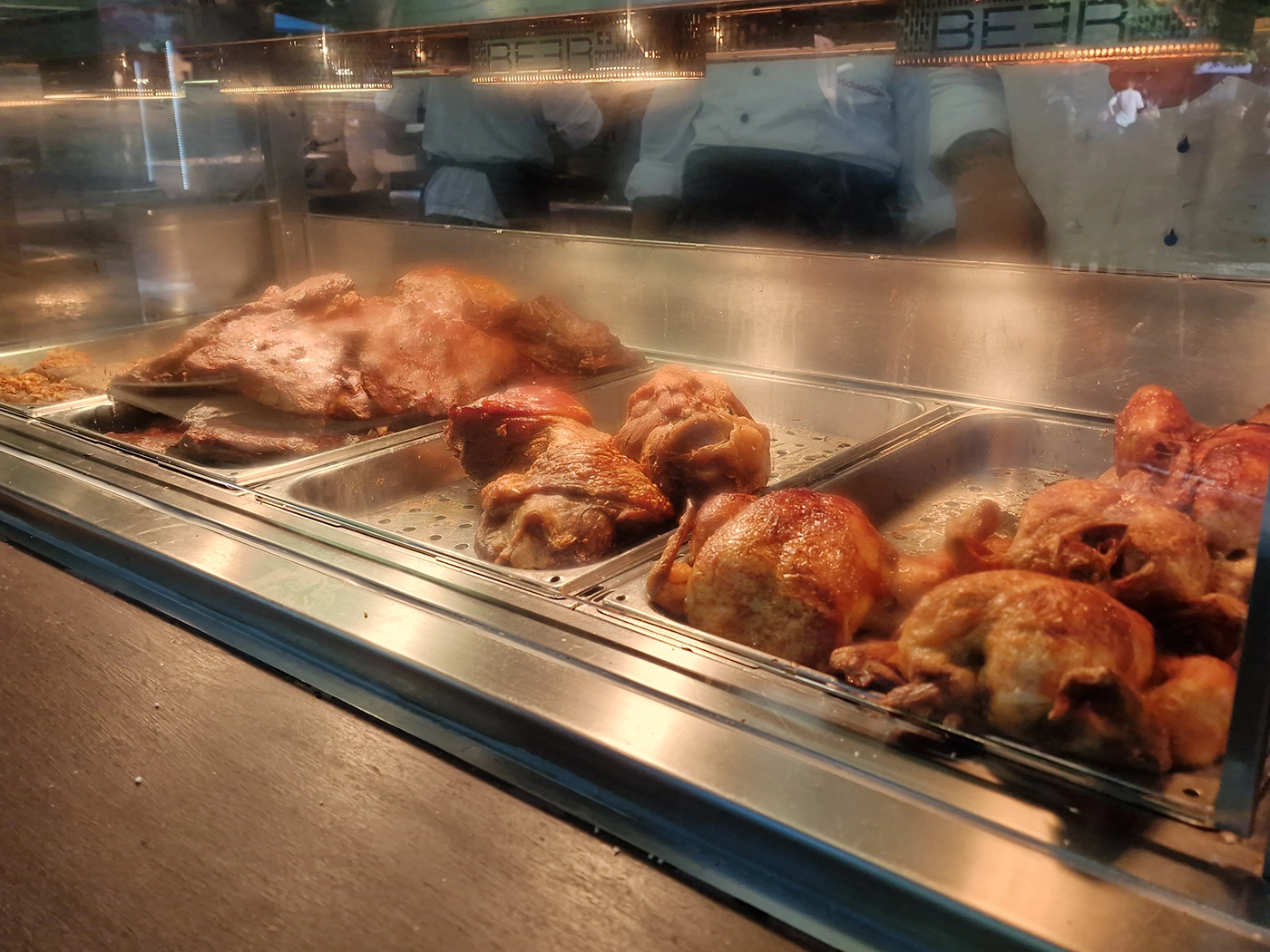
Hendl is familiar, easy to share and available at almost every large beer garden.
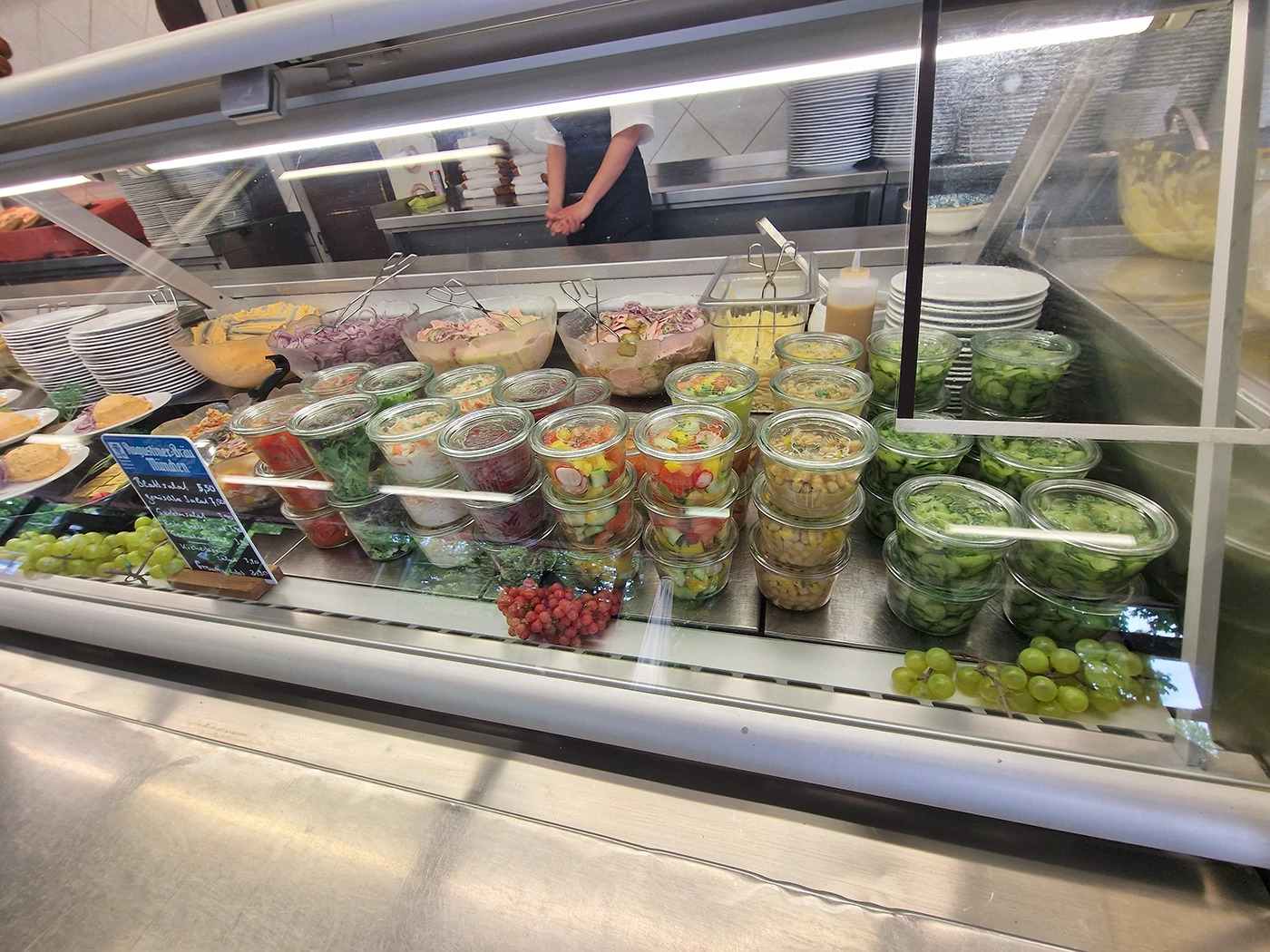
Self service does not mean only sausages and roast meat. Larger venues also offer salads and lighter dishes.
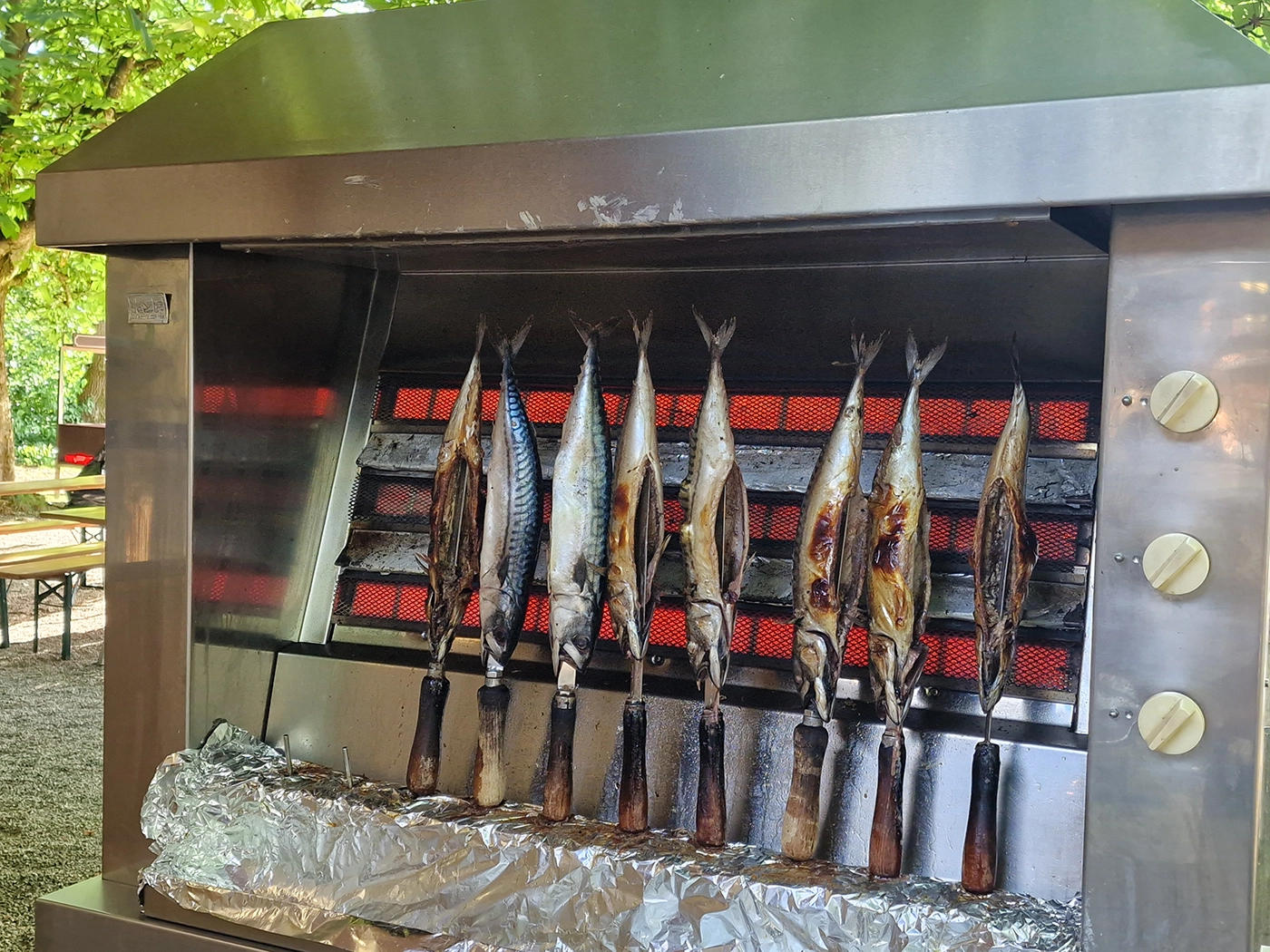
At the grill: mackerel roasting over charcoal before it reaches the table.
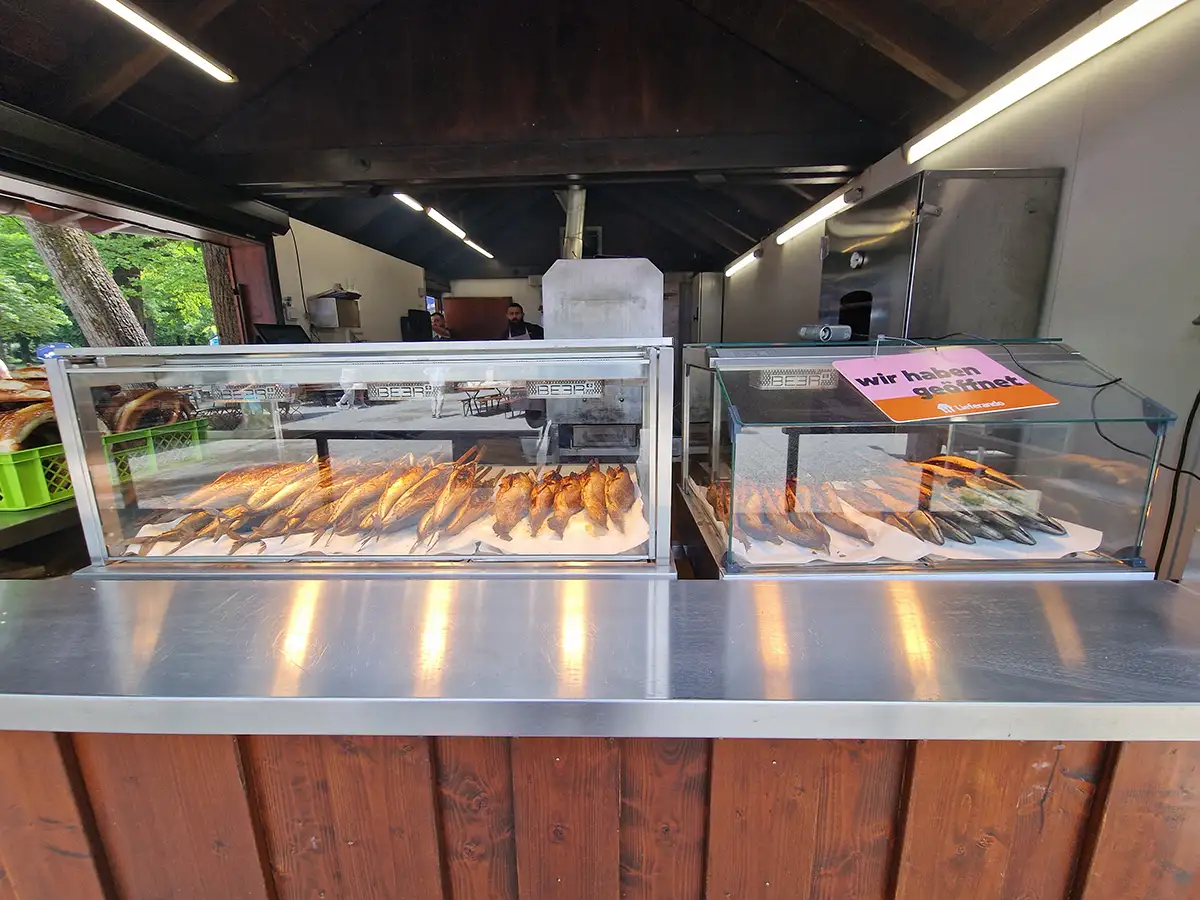
At Hirschgarten: the finished Steckerlfisch, smoky, salty and much easier to understand outdoors than in a formal dining room.
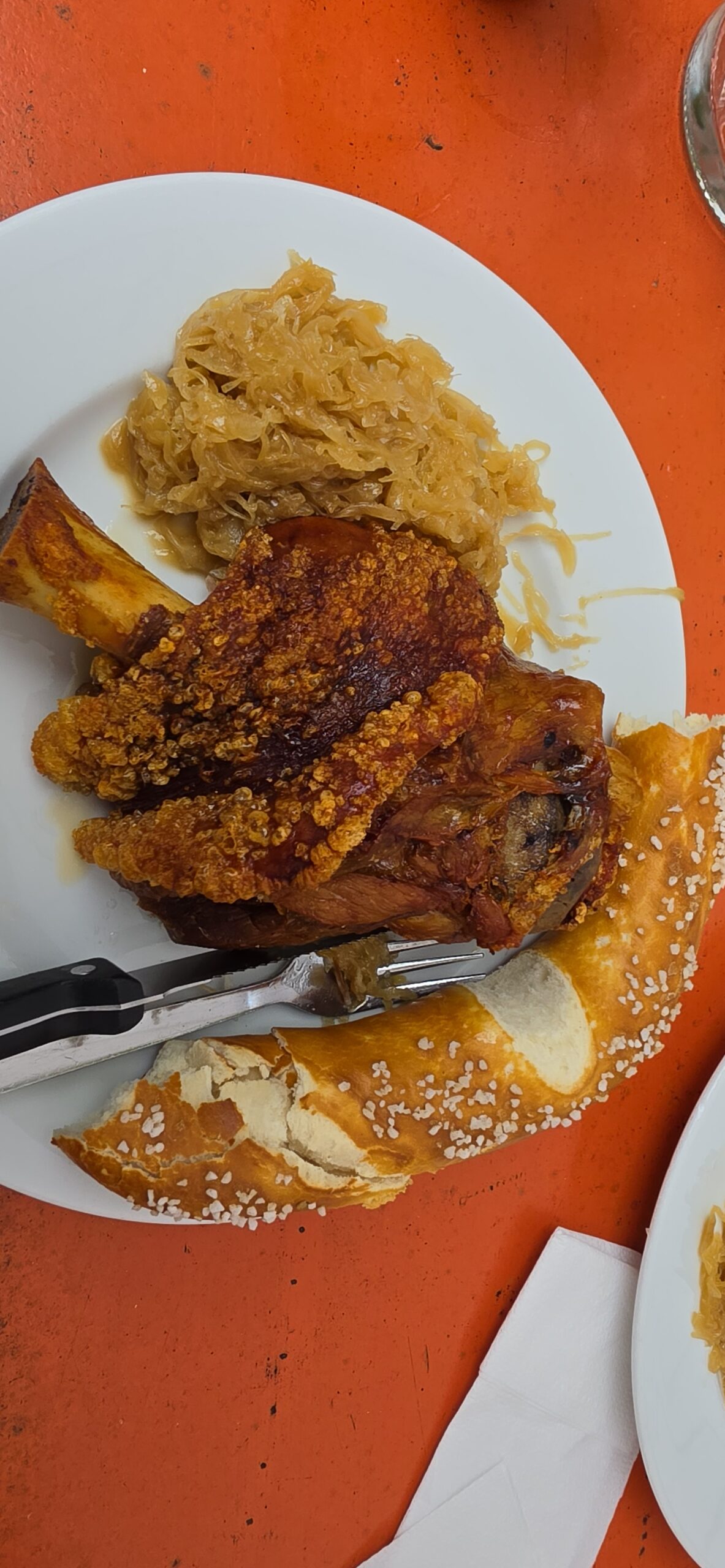
Schweinshaxe is filling, salty and built for a long table rather than a quick snack. Sharing is usually the wiser plan.
Pommes mit Mayo
The first time I saw fries served with mayonnaise instead of ketchup, it looked unusual to me. After a few beer-garden afternoons, I stopped noticing it.
Currywurst is more famous, but fries with mayonnaise are also a completely normal beer garden order.
The pretzel correction
I once picked up a Brezn because the coarse white crystals looked like sugar. One bite made it clear that they were salt.
When every beer ends in “-ator”
Munich’s Starkbier season falls during Lent for a reason. Paulaner monks at Neudeck ob der Au brewed a strong, malt rich beer at a time when fasting rules limited solid food. The old principle that liquids did not break the fast helped make beer acceptable, and the stronger brew provided more nourishment than ordinary beer.
The familiar story that the monks lived on nothing but beer for forty days is much harder to prove. It is safer to say that strong beer supplemented a sparse Lenten diet rather than replaced every meal.
Paulaner’s beer became Salvator. After the name was legally protected in 1896, other breweries could no longer use it, so they kept the ending and created names such as Maximator, Triumphator and Animator. That is why Munich’s spring beer list still sounds like one large, slightly dangerous family.
Aventinus Eisbock: a different strong-beer branch
Schneider Bräuhaus im Tal adds another strong-beer reference that does not belong to the Oktoberfest-six story: Aventinus Eisbock. It is much stronger than a normal Helles and makes more sense as a deliberate evening beer than as something to add casually to a beer-garden afternoon.
If the style names become interesting after your visit, Bierdex is a useful informal reference for browsing terms such as Helles, Dunkel, Bock, Kellerbier or Rauchbier later. You do not need a beer encyclopedia at the table.
07Munich’s beer year
Oktoberfest is only one point in Munich’s beer calendar.
Spring begins with Starkbierzeit, especially at Paulaner am Nockherberg, where strong beer, packed halls and political satire arrive months before the Oktoberfest tents.
Warm weather brings the beer gardens back, although never on one official date. A good week fills the tables; a cold weekend sends everyone indoors again.
Summer adds events such as the Kocherlball at Chinesischer Turm, which starts at sunrise on the third Sunday in July. For a few hours, an ordinary beer garden becomes a dance floor before returning to its usual tables by late morning.
Then the tents rise on the Theresienwiese. When they come down, the beer halls carry the same social habit through winter.
Past event note · Münchner Brauertag 2026
Münchner Brauertag took place on Saturday, June 20, 2026 around Marienplatz. The biennial event marked the completion of Munich brewing apprentices’ training and, in 2026, also included the Schäffler dancers outside their normal seven-year cycle.
The city programme listed 32 new brewers completing their training that year, roughly half of them women. The morning began with the apprentice brewers gathering on Marienplatz and processing to St. Peter’s Church, followed by a return through the old town with brewery horse-drawn carriages, mountain riflemen, traditional costume groups and the young brewers.
The main public ceremony and Freibier drew the largest crowd around midday. The route along Tal from the Isartor side toward Marienplatz was one of the practical places to watch the procession.
Brauertag showed a side of Munich beer culture that is easy to miss if Oktoberfest becomes the only reference point: apprentice training, guild tradition, brewery horses, brass and procession music, city ceremony and beer all sharing the same morning.
Once you understand the rules, the whole system is easy: share the table, buy the drinks there, and bring food only in the traditional self service area.
Continue reading
Beer garden procedures, payment methods, outdoor service, and seasonal events can vary by venue and date. Check the venue or official event page when a specific detail matters.